





On August 3, 2026, the European Food Safety Authority (EFSA) issued an urgent notice that tightens MRL requirements for herbicide residues in natural food colorants and adds a new documentary expectation for batches exported to the EU from October 1, 2026. The change matters not only for exporters of beet red, carmine, and spirulina blue, but also for importers, procurement teams, testing providers, and supply chain managers because compliance now depends more directly on residue verification capacity, documentation readiness, and delivery coordination.
What the EFSA notice confirms
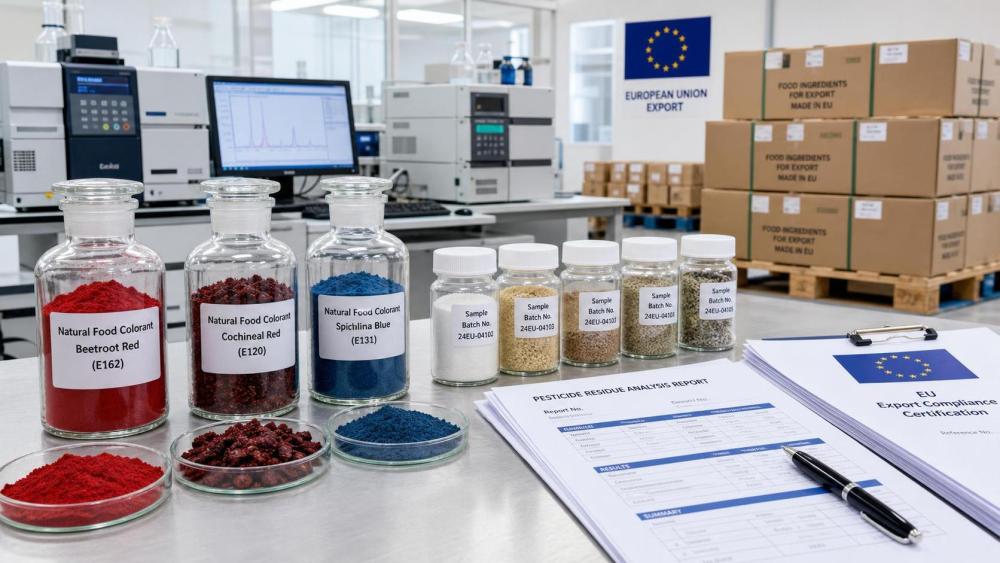
The confirmed information is limited but commercially significant. EFSA released the urgent update on August 3, 2026. The notice introduces tiered tightening of MRLs for herbicide residues in natural food colorants, including residues such as glyphosate and acetamiprid, and applies to mainstream natural colorant raw materials including beet red, carmine, and spirulina blue. It also states that, from October 1, 2026, batches exported to the EU must be accompanied by a third-party full-spectrum pesticide residue test report. The adjustment directly affects compliance export pathways for major supplying countries including China, India, and Peru, and importers are required to reassess supplier testing capability and supply chain stability.
Where the pressure is likely to appear first
Export shipments now depend more heavily on test documentation
From an industry perspective, exporters of natural colorant raw materials are likely to feel the impact first because shipment eligibility for the EU market is now tied more closely to third-party full-spectrum residue reporting. The practical effect is not only a product compliance issue but also a document and release issue, since batches without the required report may face disruption in export preparation, customs-facing paperwork, or customer acceptance.
Importer review shifts from price and availability to verification capability
Importers serving the EU market may need to reassess suppliers on more than origin, volume, or commercial terms. Analysis shows that supplier selection may increasingly depend on whether testing can be completed on time, whether reports are aligned with the new requirement, and whether supply continuity can be maintained once stricter MRLs are applied across relevant natural color categories.
Procurement and production planning may face timing risk
For procurement teams and downstream processors using natural colors, the main concern is likely to be lead-time reliability. What deserves closer attention is the possibility that testing readiness and documentation turnaround could become part of routine purchasing and delivery planning. Where supply contracts or customer specifications reference EU-compliant materials, buyers may need to review how batch release, replenishment timing, and substitute sourcing are managed.
Testing and compliance support functions move closer to the transaction
Testing service providers and compliance support teams may become more central to execution because the rule change explicitly connects market access with third-party analytical evidence. Observably, this can shift the compliance burden from a background quality function to a front-end trade requirement, especially for suppliers serving EU-bound business.
What companies should monitor before October 1
Check whether current documentation meets the new batch-level expectation
Analysis shows that companies involved in EU exports should review whether their existing test documentation is sufficient for the stated requirement of a third-party full-spectrum pesticide residue report. The key point is not to assume that older report formats, narrower screens, or non-batch-specific files will necessarily satisfy customer or border-side expectations.
Reassess supplier qualification against actual testing capacity
What deserves closer attention is whether approved suppliers can consistently produce compliant reports within commercial timelines. This is particularly relevant for sourcing teams working with natural colorant materials covered by the notice, because the issue is no longer limited to product specification alignment; it also touches release readiness and supply continuity.
Review delivery commitments tied to EU-bound orders
Observably, companies may need to revisit delivery schedules and internal order confirmation practices where EU shipments are involved. If testing turnaround or document verification becomes a gating step, lead times, booking windows, and customer communication may need adjustment. The available information does not confirm how market participants will implement this in practice, so this remains a point for active monitoring rather than a settled outcome.
Track how buyers and counterparties translate the notice into contract terms
From an industry perspective, it is worth watching whether importers, distributors, or downstream buyers begin to revise specification sheets, purchase conditions, tender documents, or supplier approval requirements in response to the EFSA update. The current notice signals a compliance threshold, but the exact commercial translation may emerge through transaction documents and customer-side enforcement practices.
Why this looks like an execution signal, not just a policy headline
Analysis shows that this development is more appropriately understood as an execution-oriented compliance signal because it combines two elements at once: tighter residue thresholds and a dated documentary requirement for EU-bound batches. At the same time, it should not yet be overstated as a fully mapped enforcement landscape, since the provided information does not include detailed implementation guidance, buyer interpretation, or operational handling across all trade channels. For now, the market is likely to treat it as a near-term rule change with immediate preparation value and continuing need for clarification.
How to read the change at this stage
The most balanced reading is that the EFSA notice marks a concrete tightening of compliance conditions for natural food colorant exports to the EU, especially for suppliers and buyers dealing in beet red, carmine, and spirulina blue. It is more appropriate to understand this as a rule change with direct operational implications, while also recognizing that the full impact on procurement behavior, delivery timing, and supplier restructuring still depends on how counterparties and execution channels respond in the coming period.
Basis of this article and points still requiring verification
This article is generated from the user-provided news title, event date, and event summary. For developments of this kind, commonly relevant source categories may include official notices, releases from regulatory authorities, customs or trade administration information, industry association updates, standard-setting documents, and reporting by authoritative media. A specific official source link was not provided in the input, so the original notice and any later clarifications still need to be verified on an ongoing basis. Further observation should focus on detailed implementation language, compliance interpretation, buyer-side documentation requirements, tender or specification changes, industry feedback, and how companies actually execute the requirement in trade practice.
Related News
- How to assess color stability from a natural food colors manufacturerOct 06, 2026Food Rheology Expert
- How natural food pigments for bakery hold color during bakingSep 20, 2026Food Rheology Expert
- EFSA Tightens MRLs for Natural Food ColorsAug 10, 2026Food Rheology Expert
- EFSA Updates Residue Limits for Natural Colorants, Drawing Attention to China’s Export Compliance PathwaysAug 08, 2026Food Rheology Expert
Related News
- 00
0000-00
Can biomimetic peptides in cosmetics reduce the look of wrinkles? - 00
0000-00
How to assess a bio-based thickener manufacturer's batch consistency - 00
0000-00
Verifying halal status of hydrocolloid ingredients in the Middle East - 00
0000-00
How to interpret active matter on a surfactant specification sheet - 00
0000-00
How Do You Test Hydrocolloid Viscosity After Changing a Thickener?
Food Rheology Expert
Weekly Insights
Stay ahead with our curated technology reports delivered every Monday.