





On August 9, 2026, the European Food Safety Authority (EFSA) issued an urgent notice cutting maximum residue limits (MRLs) for herbicide-related residues in natural food colors including beet red, cochineal red, and spirulina blue, with the new requirements taking effect on August 15. For exporters shipping these ingredients to the EU, as well as importers, distributors, formulators, and compliance teams, the short implementation window and added pre-shipment documentation requirement make this a development that deserves immediate operational attention.
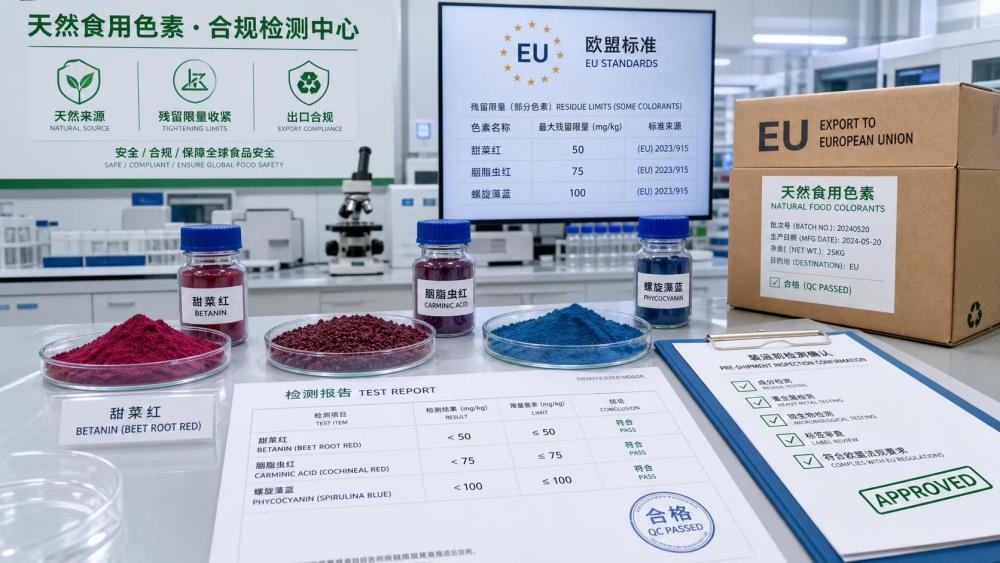
What the EFSA notice confirms
According to the information provided, EFSA announced on August 9, 2026 that it would lower MRLs for residues linked to herbicides and related compounds, including glyphosate and fipronil, in natural food color products such as beet red, cochineal red, and spirulina blue. The reduction range was stated at 40% to 60%, and the revised rule is scheduled to enter into force on August 15, 2026.
The notice also directly affects compliance checks for natural food color exports from China to the EU. Exporters are required to submit a full-spectrum residue report issued by a third-party GLP laboratory within 72 hours before shipment. Batches that do not meet the revised requirements may be rejected or returned, affecting importers, distributors, and formulators handling these products.
Where pressure is likely to appear first
Export transactions face a narrower compliance window
From an industry perspective, direct trading companies are likely to feel the first impact because the rule takes effect only days after the notice was issued. The main pressure point is shipment readiness: test timing, document completeness, and alignment between the cargo and the laboratory report now become more sensitive parts of export execution.
Import and distribution decisions become more risk-sensitive
For EU-side importers and distributors, the reported risk is straightforward: non-compliant batches may be refused or sent back. That raises the importance of document review, batch confirmation, and delivery scheduling. What deserves closer attention is not only whether a product can be shipped, but whether it can still be received and circulated without interruption under the new MRL threshold.
Formulators may need closer control over incoming materials
Companies using natural food colors in formulations may also be affected because upstream compliance issues can quickly turn into supply disruptions. The key business impact is less about formulation change in the immediate term and more about whether incoming color ingredients can clear residue checks and arrive on schedule.
Testing and supply chain coordination become part of the commercial timeline
Supply chain service providers and compliance support teams are also pulled into the adjustment. With a third-party GLP full-spectrum residue report required within 72 hours before shipment, testing capacity, document turnaround, and coordination across seller, laboratory, and buyer now sit directly inside the delivery timeline.
What companies should watch now
The distinction between shipment eligibility and market acceptance
Analysis shows that passing internal shipment review is no longer enough on its own. Companies need to focus on whether each batch can also satisfy the receiving side under the revised EU requirement, since the stated consequence for non-compliant lots is rejection or return.
Batch-level documents and laboratory timing
The practical issue is timing. Businesses involved in exports to the EU should pay close attention to whether third-party GLP testing can be completed within the 72-hour pre-shipment window and whether the resulting full-spectrum residue report is consistent with the actual batch being shipped.
Supplier qualification and communication discipline
For buyers, formulators, and traders, supplier qualification now becomes more document-driven in the short term. Current attention should center on whether suppliers can provide compliant residue testing records on time, and whether communication with customers clearly reflects the updated delivery and acceptance risk.
Contingency planning around refusal or return risk
Observably, the rule change compresses the margin for error across procurement and delivery. Businesses should pay attention to operational contingencies tied to delayed testing, shipment rescheduling, and the possibility that a batch may not be accepted after arrival.
How this development is best understood
Analysis shows that this is not only a technical adjustment to residue limits. It also acts as a short-notice compliance signal to the trade in natural food colors entering the EU. At the same time, it would be premature to treat it as a complete long-term market conclusion based on the current information alone. It is more appropriate to understand this as an immediate regulatory change with operational consequences now, and as a signal that residue compliance expectations in this product area warrant continued monitoring.
A short-term rule change with wider compliance implications
At this stage, the most balanced reading is that the EFSA move creates an immediate execution issue for companies trading natural food colors into the EU, especially where testing, documentation, and shipment timing are tightly linked. The longer-term significance still needs continued observation, but the near-term effect is already clear: compliance timing and batch-level evidence have become central to whether business can proceed smoothly.
Basis of this article
This article is based on the user-provided news title, event date, and event summary concerning EFSA's urgent revision of MRLs for natural food colors. For this type of development, relevant source categories typically include official notices, company statements, industry association updates, coverage from authoritative media, and standard-setting or regulatory documents. A specific official source link was not provided in the input, so the exact source document still requires ongoing verification. Follow-up attention should remain on any further official wording, implementation detail, or related compliance clarification tied to the August 15 effective date.
Related News
- How to assess color stability from a natural food colors manufacturerOct 06, 2026Food Rheology Expert
- How natural food pigments for bakery hold color during bakingSep 20, 2026Food Rheology Expert
- EFSA Tightens MRLs for Natural Food ColorsAug 10, 2026Food Rheology Expert
- EFSA Updates Residue Limits for Natural Colorants, Drawing Attention to China’s Export Compliance PathwaysAug 08, 2026Food Rheology Expert
Related News
- 00
0000-00
What drives fragrance ingredients price changes in bulk orders? - 00
0000-00
How to assess a food antioxidants distributor’s traceability practices - 00
0000-00
How minimum order quantities shape private label ingredient sourcing costs - 00
0000-00
What drives personal care ingredient price volatility in sourcing - 00
0000-00
What drives micelles price differences in cosmetic formulations?
Food Rheology Expert
Weekly Insights
Stay ahead with our curated technology reports delivered every Monday.