





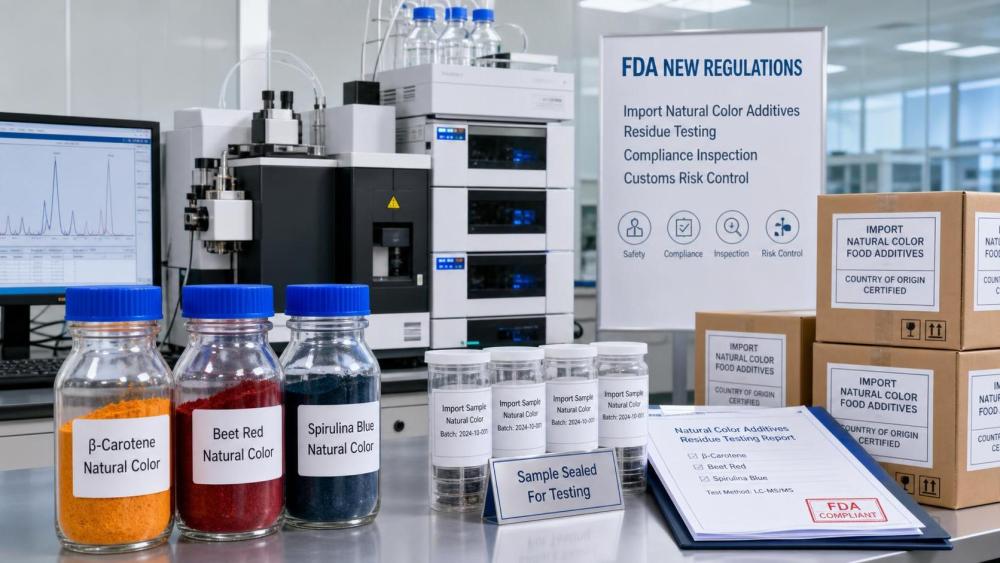
Starting at 12:00 a.m. on July 22, 2026, the US FDA is mandating a stricter testing approach for glyphosate and its metabolites in imported natural food colors. The update matters most to exporters, import compliance teams, third-party laboratories, and buyers handling products such as beta-carotene, beet red, and spirulina blue, because it changes both the required testing method and the sensitivity threshold tied to customs clearance.
What the new FDA requirement changes
According to the information provided, the FDA began mandatory implementation of the Technical Guidance for Detection of Glyphosate and Metabolite Residues in Natural Food Colors (Rev. 3.1) at 12:00 a.m. on July 22, 2026. The requirement applies to imported natural food colors, including examples such as beta-carotene, beet red, and spirulina blue.
The guidance requires the use of an LC-MS/MS dual-verification method. It also lowers the limit of detection to 0.005 mg/kg. The information provided further states that products failing to meet the requirement may face customs clearance delays or automatic return.
Where the immediate pressure is likely to appear
Export compliance and shipment documentation
From an industry perspective, exporters in major supplying countries such as China, India, and Peru are likely to feel the impact first because the rule directly affects compliance filing paths for shipments entering the US market. The practical pressure point is not only testing itself, but whether supporting documents match the updated method requirement in time for clearance.
Third-party testing and release schedules
Third-party laboratories and the companies relying on them may see pressure in cost and timing. Analysis shows that when a rule specifies dual verification and a lower detection limit, the testing step becomes more central to release planning, especially for import-bound lots that need to move without delay.
Buyers and downstream users of natural colors
Procurement teams and downstream users of natural food colors may also need to reassess supplier readiness. The issue is not only raw material availability, but whether incoming lots can support uninterrupted delivery once the new method is enforced. What deserves closer attention is whether contracts, specifications, and shipment lead times still reflect the old compliance assumptions.
What companies should review now
Whether current certificates align with the revised method
Companies handling US-bound natural food colors should check whether existing test reports and compliance files reflect the LC-MS/MS dual-verification requirement rather than earlier practices. This is a documentation and admissibility issue as much as a laboratory issue.
Which product lines carry the most immediate exposure
Products specifically referenced in the provided information, such as beta-carotene, beet red, and spirulina blue, deserve early review. Businesses should map which export batches, customer programs, or import declarations are tied to these categories and whether any shipments could be exposed to delay or return if documentation is incomplete.
How testing cost and timing affect delivery commitments
Observably, the rule change may alter third-party testing cost and turnaround expectations. Companies should therefore review how much buffer remains in production, booking, and delivery schedules when a stricter detection threshold is now part of the release pathway.
How to communicate with suppliers and customers
Supplier qualification and customer communication are likely to become immediate operational topics. Businesses may need to confirm testing capability, certificate format, and shipment readiness with suppliers, while also preparing customers for possible timing changes related to customs review.
How this should be read at this stage
Analysis shows that this is more than a routine procedural update because the FDA is making a specific testing method and a lower detection limit mandatory from a fixed effective date. At the same time, it is more appropriate to understand this as a compliance tightening signal rather than as proof of a broader market outcome. The direct facts concern testing, filing, cost, and customs risk; any wider shift in sourcing or trade patterns still requires observation.
A near-term compliance shift with longer-term significance
The immediate industry meaning of this development lies in execution: import natural food colors now face a stricter residue testing standard tied to market entry into the United States. In practical terms, this is best understood as a near-term compliance change with potential longer-term implications for supplier screening, lab reliance, and shipment planning, but those broader effects still need to be monitored rather than assumed.
Basis of this report and what still needs verification
This article is based on the user-provided news title, event date, and event summary. For developments of this type, commonly relevant source categories include official regulatory notices, company statements, industry association updates, authoritative media coverage, and standards-related technical documents. No specific official source link was provided in the input, so the exact official publication path still needs ongoing verification. Areas that merit continued follow-up include any further FDA wording updates, implementation clarifications, and how market participants adjust compliance documentation and testing arrangements after July 22, 2026.
Related News
- How to assess color stability from a natural food colors manufacturerOct 06, 2026Food Rheology Expert
- How natural food pigments for bakery hold color during bakingSep 20, 2026Food Rheology Expert
- EFSA Tightens MRLs for Natural Food ColorsAug 10, 2026Food Rheology Expert
- EFSA Updates Residue Limits for Natural Colorants, Drawing Attention to China’s Export Compliance PathwaysAug 08, 2026Food Rheology Expert
Related News
- 00
0000-00
Can biomimetic peptides in cosmetics reduce the look of wrinkles? - 00
0000-00
How to assess a bio-based thickener manufacturer's batch consistency - 00
0000-00
Verifying halal status of hydrocolloid ingredients in the Middle East - 00
0000-00
How to interpret active matter on a surfactant specification sheet - 00
0000-00
How Do You Test Hydrocolloid Viscosity After Changing a Thickener?
Food Rheology Expert
Weekly Insights
Stay ahead with our curated technology reports delivered every Monday.