





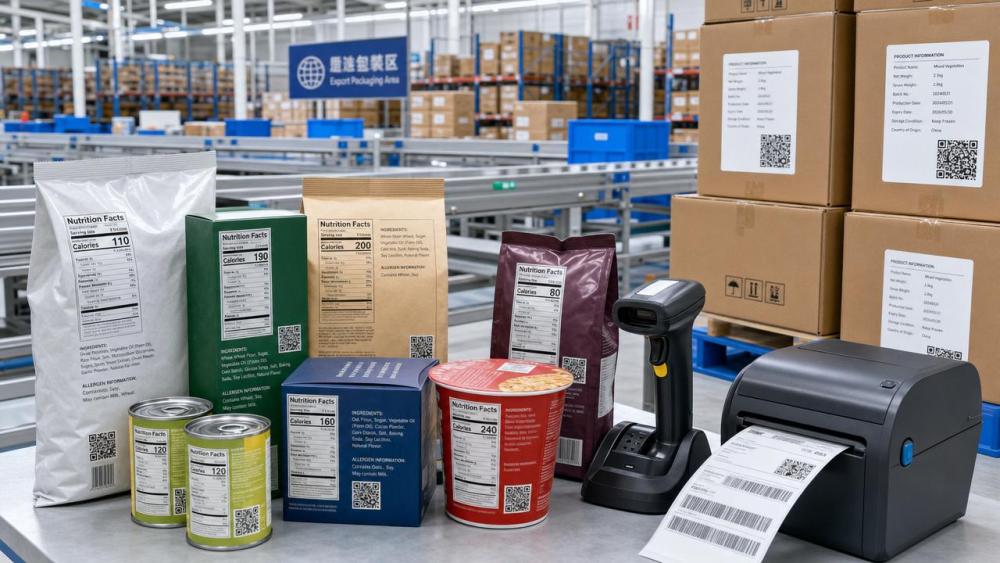
As of June 1, 2026, GB 7718-2025 has entered mandatory implementation for prepackaged foods exported to China, turning digital labeling from a packaging option into a compliance requirement. The rule centers on a traceable QR code that must carry structured information such as ingredients, allergens, shelf life, and additive INS numbers, making it especially relevant for exporters, label management teams, supply chain operators, and buyers that depend on smooth customs-facing documentation and delivery readiness.
What the mandatory change now requires
The confirmed change is tied to the National Food Safety Standard General Rules for the Labeling of Prepackaged Foods, GB 7718-2025, issued on March 27, 2025 and fully enforced from June 1, 2026. Under this requirement, all prepackaged foods exported to China must carry a traceable digital label QR code. The required structured data includes the ingredient list, allergen information, shelf life, and additive INS numbers. The input information also makes clear that this requirement directly affects overseas suppliers through higher label adaptation needs and stronger system integration demands for exports to China.
Where the pressure is likely to appear first
Export packaging and label control
For exporters shipping prepackaged foods to China, the immediate exposure lies in whether existing labels and packaging workflows can support a compliant QR-based digital label. The impact is not limited to artwork revision; it also touches version control, multilingual data consistency, and the ability to keep structured label content aligned with what is placed on pack and submitted in trade documentation.
Procurement and supplier coordination
Buyers and sourcing teams may feel the change through supplier qualification and onboarding. From an industry perspective, what deserves closer attention is whether suppliers can provide the necessary structured data for ingredients, allergens, shelf life, and additive INS numbers in a usable format. This can affect purchase planning, supplier review cycles, and the timing of orders where label readiness becomes a practical delivery condition.
Supply chain and system handoff
Supply chain service providers and trade support teams may be affected where product data, packaging instructions, and shipment preparation need to move across multiple systems. Analysis shows that the rule is likely to raise the importance of data handoff accuracy, because the QR code is tied to traceable structured information rather than only printed text. In practice, that means businesses may need to pay closer attention to document alignment, internal data maintenance, and readiness for downstream verification.
What companies should review now
Check whether label data is structured and usable
Companies involved in exports to China should focus on whether the required information already exists in a structured format that can support QR-based labeling. If not, the issue may be less about wording and more about data preparation, internal ownership, and consistency across packaging, specification files, and product records.
Revisit compliance review around label content
Observably, compliance review is no longer only about what appears visually on the package. Businesses should pay closer attention to how ingredient lists, allergen declarations, shelf-life information, and additive INS numbers are checked before shipment, especially where multiple teams or outside partners manage labeling, documentation, or product localization.
Watch for execution language and document expectations
The input does not provide detailed enforcement mechanics, so it would be premature to describe settled operational outcomes. It is more appropriate to monitor how this requirement is reflected in trade paperwork, technical files, supplier documents, and customer-facing specifications, particularly where buyers or channel partners may begin incorporating the QR label requirement into their own acceptance standards.
Build more time into delivery planning
Because the summary explicitly points to label adaptation cost and system integration capability, companies may need to review lead times for packaging updates, data verification, and supplier coordination. This is not yet evidence of a uniform market outcome, but it is a practical area for risk review where exports depend on accurate label conversion and release timing.
How this development is best understood
Analysis shows that this is better understood as a rule already moving from publication into execution, rather than a distant policy signal. At the same time, it remains a development that warrants continued observation because the provided information does not include detailed implementation interpretations, review procedures, or market feedback. From an industry perspective, the key point is that digital label readiness now sits closer to core export compliance for prepackaged foods entering China.
A compliance signal with operational consequences
This development matters because it links food labeling compliance with traceable digital data requirements in a more direct way. The practical significance is not only that a standard has taken effect, but that exporters and their partners may need to align packaging, product data, and shipment preparation more tightly than before. At present, it is more appropriate to understand this as an implemented compliance change with operational implications, while still keeping watch on how execution details and market responses continue to develop.
Basis for this article
This article is generated from the user-provided news title, event date, and event summary. For developments of this type, commonly relevant source categories may include official notices, regulator publications, customs or trade authority information, industry association updates, standard-setting documents, and reporting by established media. No specific official source link was provided in the input, so any formal source trail still needs to be verified on an ongoing basis. What also requires continued follow-up includes implementation detail, compliance interpretation, document requirements, buyer-side adoption, and feedback from companies handling actual export execution.
Related News
- How to assess color stability from a natural food colors manufacturerOct 06, 2026Food Rheology Expert
- How natural food pigments for bakery hold color during bakingSep 20, 2026Food Rheology Expert
- EFSA Tightens MRLs for Natural Food ColorsAug 10, 2026Food Rheology Expert
- EFSA Updates Residue Limits for Natural Colorants, Drawing Attention to China’s Export Compliance PathwaysAug 08, 2026Food Rheology Expert
Related News
- 00
0000-00
Verifying halal status of hydrocolloid ingredients in the Middle East - 00
0000-00
How to interpret active matter on a surfactant specification sheet - 00
0000-00
What Quality Checks Should You Run on Fragrance Ingredient Suppliers? - 00
0000-00
How to assess a flavor chemistry manufacturer's batch consistency - 00
0000-00
What drives fragrance ingredients price changes in bulk orders?
Food Rheology Expert
Weekly Insights
Stay ahead with our curated technology reports delivered every Monday.