





As of June 1, 2026, GB 7718-2025 has come fully into force for prepackaged food labeling, introducing a more specific disclosure requirement for natural food colorants used in ingredient lists. For food manufacturers, ingredient suppliers, traders, and supply chain teams connected to natural colorants exported from China, the update is worth close attention because it shifts the discussion from using a broad “natural color” description toward naming the actual plant source behind the coloring ingredient.
What the new labeling rule now requires
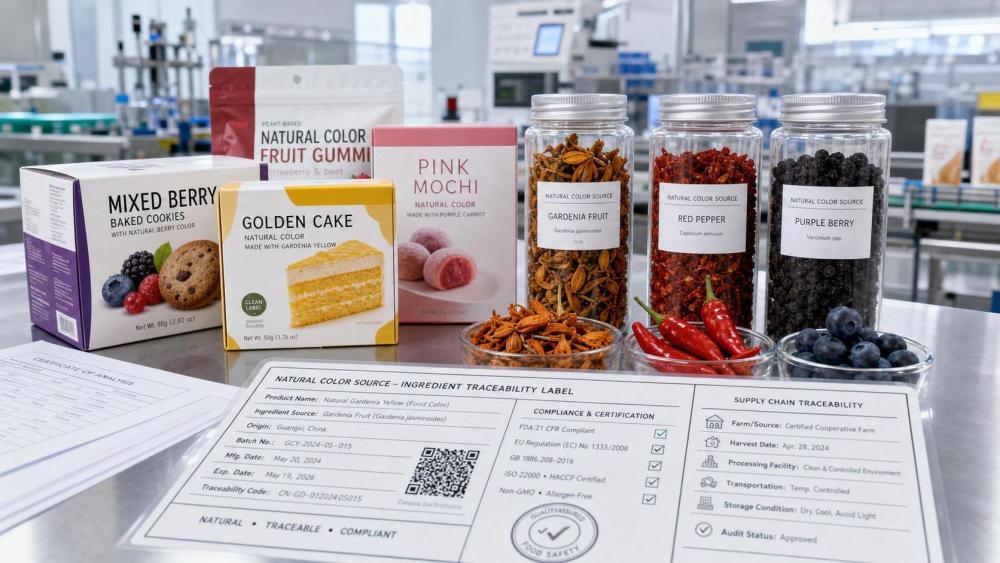
The fully effective standard is the General Standard for the Labeling of Prepackaged Foods, GB 7718-2025, released under Announcement No. 2 of 2025 by the State Administration for Market Regulation. According to the information provided, from June 1, 2026, when natural food colorants such as gardenia yellow, paprika red, or anthocyanins are used, the ingredient list must identify the specific plant source rather than using only a general expression such as “natural color.”
The example provided shows the required direction of labeling: instead of a generic category label, a declaration should specify the plant origin, such as an extract from gardenia fruit. The information provided also states that this change is expected to raise requirements around quality traceability and verifiability for China-origin natural food colorants in global trade, beyond export volume alone.
Where the immediate pressure is likely to appear
Ingredient trading and sourcing workflows
From an industry perspective, trading companies and raw material sourcing teams may be affected first because product descriptions, procurement documents, and supplier communications often sit at the front end of compliance. If a product has been handled internally under a broad natural-color description, teams may need to confirm whether the underlying plant source is clearly documented and consistently reflected across commercial and technical materials.
Food manufacturing and label execution
For processors and food manufacturers, the most visible impact is likely to fall on ingredient list preparation and packaging execution. Analysis shows that the issue is not only whether a natural colorant is used, but whether the final label wording aligns with the required source-specific expression. That makes formula records, artwork review, and packaging change coordination key business points to monitor.
Supply chain and delivery coordination
Supply chain service providers and fulfillment teams may also need to pay attention, especially where goods move across multiple parties before reaching the end user. Observably, a requirement centered on source identification can increase the importance of supporting documents, version control, and consistency between what is purchased, what is declared, and what is delivered.
Downstream buyers and application users
Buyers and end-use food brands may face a practical review task as well. What deserves closer attention is whether existing supplier submissions provide enough detail to support source-specific labeling, particularly for product lines using natural colorants as part of a clean-label or ingredient-transparency positioning.
What companies should be checking now
Whether ingredient naming is specific enough
Companies using natural food colorants should review whether current ingredient declarations rely on broad category wording and whether those descriptions can be supported by a source-specific plant declaration under the now-effective rule.
Whether supplier documents can support the label claim
Analysis shows that the practical issue is not limited to packaging text. Supplier qualifications, technical specifications, and transaction documents may all matter if companies need to demonstrate that the named plant source on the label matches the ingredient actually supplied.
Whether internal teams are aligned on implementation
Procurement, regulatory, quality, and packaging teams may need tighter coordination so that the source stated in internal records, customer-facing documents, and printed labels remains consistent. This is especially relevant where one ingredient may previously have been handled under a generalized colorant description.
Whether client communication needs to change
For exporters and service providers linked to natural colorants from China, customer communication may need to become more precise. The information provided indicates growing emphasis on traceability and verifiability, so counterparties may increasingly focus on how source information is described and evidenced, not only on shipment volume.
Why this looks like more than a wording adjustment
Observably, this development can be read as more than a narrow labeling edit. The confirmed fact is the new requirement for specific plant-source disclosure in ingredient lists. The industry implication, however, is that naming standards and traceability expectations are becoming more closely connected. It is more appropriate to understand this as a concrete compliance change that also sends a longer-term signal about documentation quality and verification readiness in the natural colorant segment.
At the same time, this should not be overstated. Analysis shows that the information provided supports a clear rule change and a likely rise in traceability expectations, but it does not by itself establish how every market participant will adjust, or how quickly counterparties outside China will standardize their own review practices.
How the market may best read this stage
The most balanced reading is that GB 7718-2025 has already created an immediate compliance reality for prepackaged food labels, while also pointing to a broader industry direction for natural food colorants tied to China. Current attention is best placed on label wording, source documentation, and consistency across procurement and delivery records, rather than on making oversized conclusions about market outcomes. In that sense, this is both a short-term operational change and a longer-term signal that remains worth watching.
Basis of this article and follow-up points
This article is generated from the user-provided news title, event date, and event summary. The content is based on the stated implementation of GB 7718-2025 on June 1, 2026 and the stated requirement that natural food colorants in prepackaged foods must disclose the specific plant source in the ingredient list rather than only a generic natural-color description.
For this type of industry update, commonly relevant source categories may include official announcements, standard documents, company disclosures, industry association information, and reporting from authoritative media. A specific official source link was not provided in the input, so the exact source document path still requires ongoing verification. Follow-up attention should remain on any further official wording, implementation clarification, and how traceability and verifiability expectations are reflected in actual business documentation and customer requirements.
Related News
- How to assess color stability from a natural food colors manufacturerOct 06, 2026Food Rheology Expert
- How natural food pigments for bakery hold color during bakingSep 20, 2026Food Rheology Expert
- EFSA Tightens MRLs for Natural Food ColorsAug 10, 2026Food Rheology Expert
- EFSA Updates Residue Limits for Natural Colorants, Drawing Attention to China’s Export Compliance PathwaysAug 08, 2026Food Rheology Expert
Related News
- 00
0000-00
Verifying halal status of hydrocolloid ingredients in the Middle East - 00
0000-00
How to interpret active matter on a surfactant specification sheet - 00
0000-00
What Quality Checks Should You Run on Fragrance Ingredient Suppliers? - 00
0000-00
How to assess a flavor chemistry manufacturer's batch consistency - 00
0000-00
What drives fragrance ingredients price changes in bulk orders?
Food Rheology Expert
Weekly Insights
Stay ahead with our curated technology reports delivered every Monday.