





A color sample that looks correct at receipt is only a starting point. A natural color must retain an acceptable hue, strength, and uniformity after it encounters the actual formula, process, package, distribution environment, and stated shelf life. The most reliable way to assess a natural food colors manufacturer is to turn “stable color” into a defined performance requirement for a specific product, then require evidence generated under conditions that resemble that product.
Begin with the finished application rather than a color chart. A red pigment in an acid beverage, a yellow shade in a baked cracker, and a purple tone in a refrigerated dairy dessert face different failure mechanisms. The same pigment source can appear stable in water yet fade after hot filling, shift hue after pH adjustment, or form visible specks when dispersed in a protein-rich system. A supplier evaluation therefore needs a formulation brief that records the target shade, dosage range, pH, water activity, processing temperatures and hold times, exposure to oxygen, package format, storage conditions, and intended shelf-life claim.
Define what color failure means in the product
Color loss is not the only failure mode. A pigment can retain most of its apparent intensity while moving from a clean red toward brown, from yellow toward orange, or from blue toward gray. In a lightly colored beverage, a small hue shift may be obvious long before a large reduction in color strength is measured. In an opaque sauce or bakery filling, poor distribution and surface discoloration may be more important than the average color value of the bulk product.
Set acceptance criteria around the finished product appearance. Instrumental color measurements are useful because they reveal gradual change that the eye may miss from one observation to the next. Record the initial values and compare retained samples using the same container geometry, lighting conditions, sample thickness, and instrument settings. When using L*, a*, b* or a comparable color space, assess lightness and hue direction alongside total color difference. A single overall difference value can conceal a shift that is commercially unacceptable for a particular shade.
Visual assessment still matters. Panels should compare coded samples against a retained control under controlled illumination, ideally in the intended pack as well as in an open sample. Packaging film, headspace, gloss, product opacity, and surface texture all change perceived color. A pigment that appears satisfactory in a clear laboratory vial may look dull in the final bottle or uneven across a coated snack.
Match pigment chemistry to the stress profile
Natural colors are not a single class of materials. Their chemical families respond differently to acidity, heat, light, metal ions, oxidation, enzymes, and interactions with proteins or hydrocolloids. Ask for the pigment identity, carrier system, physical form, solubility or dispersibility profile, and the conditions within which its performance data were obtained. “Natural” describes origin or labeling position; it does not predict stability.
Anthocyanin-based shades illustrate why the full operating window matters. Their color expression is strongly associated with acidity, and a formulation adjustment made for flavor or preservation can alter the final shade. Carotenoid systems often require careful dispersion in aqueous products and may be vulnerable to oxidation. Chlorophyll-derived greens, betalain colors, curcumin-based yellows, and phycocyanin-based blues each bring different sensitivities. The useful question is not whether a source material is “heat stable” or “light stable” in general, but whether the supplied grade remains suitable after the specific processing and storage sequence.
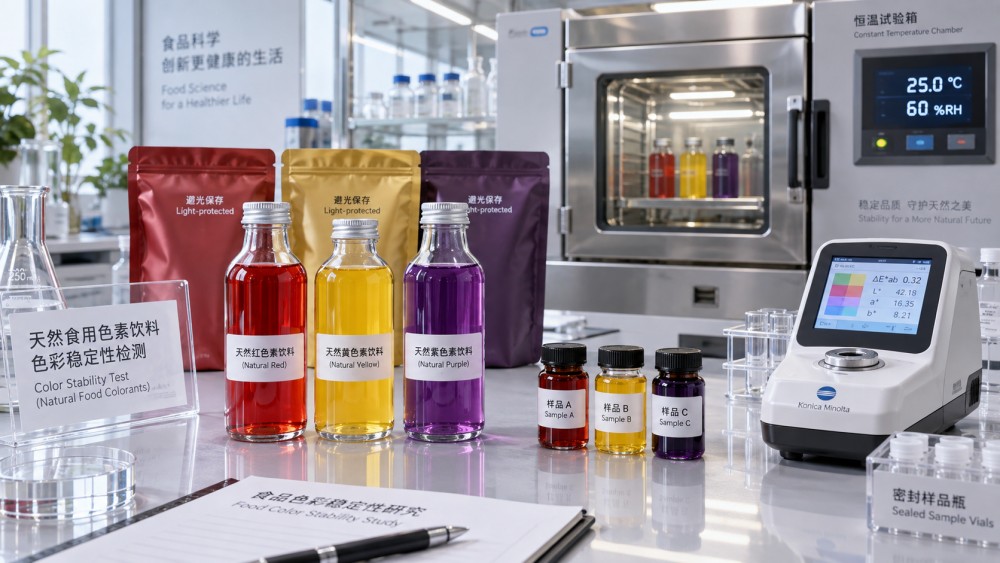
Request evidence that reflects the process, not a marketing condition
A technical data sheet often provides a recommended pH range, shade description, and basic handling guidance. That document is necessary, but it rarely settles a selection decision. Ask how the supplier generated its stability claims: the product matrix used, pigment dosage, light source or exposure method, package type, sample preparation method, storage temperature, and observation period. Results from a simple aqueous solution should be identified as screening information rather than treated as proof for a dairy beverage, emulsion, confectionery, or baked product.
Thermal claims deserve particular scrutiny. Peak temperature alone does not describe thermal load. Residence time, heating rate, shear, local hot spots, moisture level, and whether the color is added before or after a heat step all affect outcome. For a baked product, surface temperature and the drying phase can produce a result unlike the nominal oven setting. For an acidified beverage, a short high-temperature treatment followed by prolonged hot holding may be more severe than either stage evaluated separately.
Light-stability information should also distinguish between direct illumination, diffuse retail light, and dark storage. Clear PET, glass, multilayer cartons, metallized films, and opaque tubs offer very different protection. A package change made for recyclability or shelf presentation can invalidate a stability result generated with an earlier format. Include closure type and expected headspace where oxygen sensitivity is relevant; a sample filled with minimal headspace is not representative of every production fill.
Run a staged application trial
Use a staged study that separates formulation incompatibility from process damage and shelf-life decline. First, prepare a bench sample at the target and boundary dosage levels. The boundary levels matter because a pigment may disperse cleanly at one dosage yet show aggregation, sediment, or unwanted flavor contribution at a higher level. Adjust pH and allow sufficient equilibration before judging shade, especially where hydration, complex formation, or emulsion structure develops over time.
Next, pass the sample through a representative pilot or production process. Record the order of addition, mixing speed, temperature at addition, total thermal history, and any use of vacuum, deaeration, homogenization, or filtration. Adding color before homogenization can give a different result from dosing afterward. Powder pigments may require a separate premix, while oil-dispersible grades need an appropriate phase and mixing regime. Treating a dispersion problem as a pigment-stability problem can lead to unnecessary reformulation.
Then retain packaged samples under the expected storage condition and under selected challenge conditions that reflect plausible abuse, such as elevated temperature or sustained light exposure. Challenge testing is useful for ranking candidates, but it should not replace real-time storage data when the product has a long expected shelf life. Evaluate at planned intervals rather than relying only on the final observation. The timing of degradation offers diagnostic value: immediate change points to processing or compatibility; a gradual decline points more often to light, oxygen, migration, or continuing chemical change.
Separate color degradation from physical instability
Several defects look alike at first glance. Sediment at the base of a beverage may be poor dispersion, density mismatch, protein interaction, or pigment insolubility rather than bleaching. A pale top layer in an emulsion can result from creaming, which redistributes the colored phase without necessarily destroying pigment molecules. Surface fading in a snack may arise from oxidation at exposed fat-rich areas, while the interior remains stable. Each observation requires sampling from more than one location before assigning a cause.
Color measurement should therefore be paired with basic physical observations: sediment, ring formation, phase separation, particle size change where relevant, viscosity drift, and changes after shaking or gentle remixing. A color that returns to uniformity after the specified consumer handling may be acceptable in some formats; a product sold as ready-to-drink has a much narrower tolerance for settling. The acceptance decision belongs to the product presentation, not to a pigment assay in isolation.
Examine batch consistency and traceability
Natural raw materials vary with source material, harvest conditions, extraction, concentration, and standardization method. A stable evaluation sample does not guarantee that all future lots will match it. Request the supplier’s specifications for color strength, moisture, particle characteristics or dispersion quality, microbiological limits where applicable, residual carriers, and permitted shade variation. Understand how incoming botanical or other natural raw materials are qualified and how the final color is standardized.
Ask for certificates of analysis from multiple production lots when available, then verify selected lots in the intended formulation. A color unit or absorbance value alone may not capture hue variation. Two lots with comparable strength can require different dosing to achieve the same visual result, or they can match initially but age differently because of different minor-component profiles. Retain a reference sample from each approved lot and document the lot used in every development and plant trial.
Traceability becomes especially important when a formula is sensitive to pH or oxidation. If a deviation occurs after release, records should make it possible to compare color lot, base ingredients, processing conditions, package source, and storage history. Without that chain of information, a faded product may be attributed to the color ingredient when the actual cause is a change in acid concentration, oxygen pickup, film barrier, or thermal hold.
Evaluate handling and transport as part of stability
Powder, liquid, emulsion, and encapsulated formats need different controls before they enter the formula. Review recommended storage temperature, protection from humidity and light, resealing instructions, allowed freeze-thaw exposure, and the usable period after opening. A light-sensitive liquid color stored in a translucent container may lose performance before production begins. Moisture uptake by a powder can create lumps that compromise dispersion even when pigment chemistry remains intact.
Shipping history can matter for heat-sensitive or oxidation-sensitive materials. Establish whether temperature excursions are monitored or whether protective packaging is used for grades that require it. At receiving, compare the material against the approved reference by appearance and, where feasible, a quick standardized application test. This is more informative than approving material solely because the label and certificate match the purchase specification.
Turn supplier responses into a usable selection record
A strong candidate is supported by transparent, application-relevant evidence and a clear explanation of its limits. The response should identify the recommended addition point, dispersion procedure, compatible pH range for the intended shade, known sensitivities, storage requirements, and the test basis for each stability statement. Vague assurances of “excellent stability” have little value without the matrix and conditions behind them.
Document the final decision against the highest-risk condition rather than the best-looking initial sample. Where two color options perform similarly, favor the one with a wider operational margin around normal variation in pH, heat exposure, oxygen pickup, and storage. That margin reduces the chance that an ordinary production fluctuation changes the product’s appearance before the end of shelf life.
Related News
- How does pH affect plant-based color ingredients in beverages?Nov 11, 2026Food Rheology Expert
- Choosing natural pigments and thickeners for beverages in Southeast AsiaNov 05, 2026Food Rheology Expert
- How to assess color stability from a natural food colors manufacturerOct 06, 2026Food Rheology Expert
- How natural food pigments for bakery hold color during bakingSep 20, 2026Food Rheology Expert
Related News
- 00
0000-00
Wissen Research: Global Cosmetics Market to Reach $497.2 Billion by 2031 - 00
0000-00
Can biomimetic peptides improve skin firmness? - 00
0000-00
China Records 543 New Cosmetic Ingredients, Including 167 in 2026 - 00
0000-00
How to check a fragrance raw material specification for IFRA compliance - 00
0000-00
Australia and New Zealand Weigh Wider Steviol Glycoside Use in Griddle Products
Food Rheology Expert
Weekly Insights
Stay ahead with our curated technology reports delivered every Monday.