





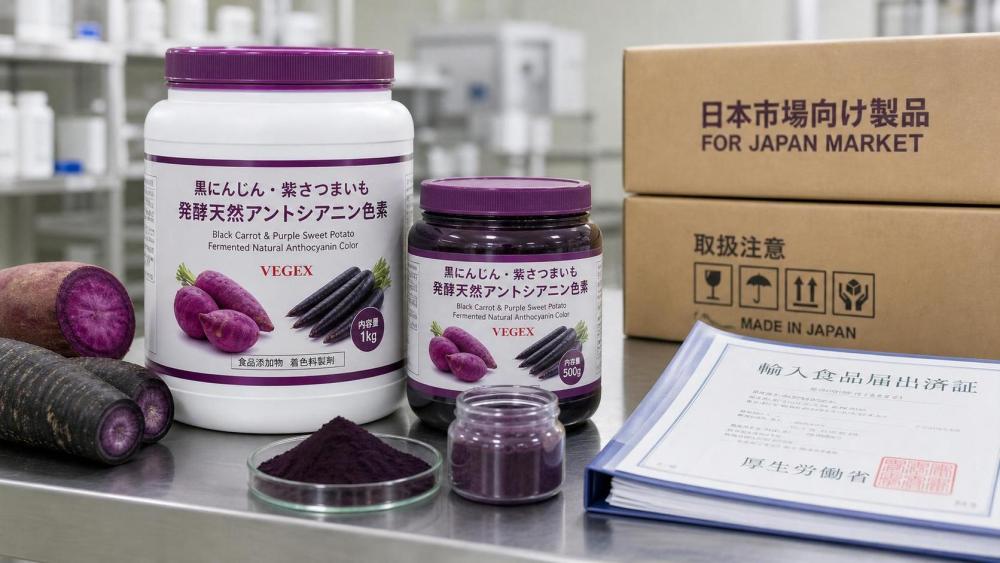
On July 15, 2026, Japan’s Ministry of Health, Labour and Welfare approved JAS Standard No. 2026-08, formally recognizing fermented anthocyanins from black carrot and purple sweet potato as JAS-certified natural colorants. For suppliers, importers, food manufacturers, and labeling teams serving the Japanese market, this is worth close attention because the change does not stop at product positioning: it ties commercial value to certification status and introduces immediate compliance consequences for non-certified imports.
What the approval formally changes
The approved standard is JAS Standard No. 2026-08, effective July 15, 2026. Under this standard, fermented black carrot anthocyanins and fermented purple sweet potato anthocyanins are recognized as “JAS-certified Natural Colorants.”
The approval creates two direct commercial effects stated in the event summary: eligibility for premium pricing and shelf-labeling advantages. At the same time, suppliers must obtain JAS certification through JAS-accredited bodies. Imports that do not hold that certification are subject to mandatory relabeling and a 30-day quarantine.
Where the impact is likely to be felt first
Pressure point for ingredient suppliers entering Japan
From an industry perspective, suppliers are the first group directly affected because access to the JAS-certified claim now depends on certification through accredited bodies. The immediate business issue is not only whether a colorant can be sold, but whether it can be sold with the recognized status that supports higher pricing and labeling advantages.
New checks for import and trade operations
Direct trade companies and import operators may face tighter document and shipment management. Analysis shows that the stated relabeling requirement and 30-day quarantine for non-certified imports could affect customs handling, delivery timing, and inventory planning for products intended for Japan.
Labeling and formulation decisions for food manufacturers
Processors and end-use food manufacturers using these fermented anthocyanins may need to pay closer attention to input sourcing and product claims. What deserves closer attention is whether a purchased ingredient carries JAS certification, because the commercial benefit described in the approved standard is tied to that recognized status rather than to the ingredient name alone.
Procurement and channel coordination
Procurement teams, distributors, and channel partners may also be affected where product listings, packaging, and launch timing depend on certification status. Observably, the issue is less about broad market demand at this stage and more about whether each link in the chain is prepared for different handling between certified and non-certified goods.
Operational issues companies should watch now
Certification status is now a business variable
Analysis shows that companies cannot treat certification as a secondary paperwork matter. Under the approved framework, certification determines whether suppliers can access the premium and labeling advantages attached to the JAS-certified natural colorant category.
Imports need timeline planning, not only regulatory review
For businesses shipping into Japan, the 30-day quarantine point deserves practical attention. Even without adding assumptions about enforcement volume, the stated requirement alone means lead times, delivery commitments, and customer communications may need adjustment if certification is not in place before shipment.
Supplier qualification will matter more in contracting
Companies buying these colorants for use in Japan may need to verify whether suppliers are certified through JAS-accredited bodies. The distinction between a technically relevant ingredient and a certified ingredient is now commercially meaningful, especially where labeling treatment or price positioning is part of the sales plan.
Watch the difference between recognition and implementation
What deserves closer attention is the gap between the standard’s formal approval and the way companies operationalize it. Businesses should monitor how certification documents, import documentation, product labels, and customer-facing claims are aligned, because the summary makes clear that market access conditions differ once certification is absent.
Why this reads as more than a narrow labeling update
Analysis shows that this development is best understood as a targeted regulatory-commercial signal rather than a routine administrative adjustment. The standard does not merely recognize a category of fermented anthocyanin colorants; it connects that recognition to pricing, shelf presentation, certification eligibility, and import handling.
At the same time, it is too early to treat this alone as proof of a wider market shift beyond the scope of the provided information. It is more appropriate to understand this as a concrete rule change with immediate relevance for companies dealing in fermented black carrot and purple sweet potato anthocyanins for Japan, while broader competitive effects still require observation.
How to read the development at this stage
At this stage, the industry significance lies in the fact that certification status now has direct commercial and operational consequences in Japan for the specified fermented anthocyanin colorants. For affected businesses, the key issue is not abstract policy direction but execution: certification route, import readiness, relabeling risk, and timing discipline.
From an editorial perspective, this is better understood as an actionable near-term change with longer-term signaling value. It already creates clear conditions for suppliers and importers, but the broader market meaning should still be judged carefully as implementation develops.
Basis of this article
This article is based on the user-provided news title, event date, and event summary concerning Japan’s approval of JAS Standard No. 2026-08 on July 15, 2026. Typical source types for developments of this kind may include official government notices, standard-setting documents, company disclosures, industry association updates, and reporting by authoritative trade media.
A specific official source link was not provided in the input, so the exact source document should continue to be verified. Follow-up attention should focus on any further official wording, certification practice under JAS-accredited bodies, and implementation details affecting imports, labeling, and supply arrangements.
Related News
- How to assess color stability from a natural food colors manufacturerOct 06, 2026Food Rheology Expert
- How natural food pigments for bakery hold color during bakingSep 20, 2026Food Rheology Expert
- EFSA Tightens MRLs for Natural Food ColorsAug 10, 2026Food Rheology Expert
- EFSA Updates Residue Limits for Natural Colorants, Drawing Attention to China’s Export Compliance PathwaysAug 08, 2026Food Rheology Expert
Related News
- 00
0000-00
Can biomimetic peptides in cosmetics reduce the look of wrinkles? - 00
0000-00
How to assess a bio-based thickener manufacturer's batch consistency - 00
0000-00
Verifying halal status of hydrocolloid ingredients in the Middle East - 00
0000-00
How to interpret active matter on a surfactant specification sheet - 00
0000-00
How Do You Test Hydrocolloid Viscosity After Changing a Thickener?
Food Rheology Expert
Weekly Insights
Stay ahead with our curated technology reports delivered every Monday.