





On July 1, 2026, Japan’s Ministry of Agriculture, Forestry and Fisheries (MAFF) put a revised JAS standard for natural food colorants into effect, adding a mandatory documentation requirement for imported natural colors. For suppliers, importers, manufacturers, and buyers working with ingredients such as anthocyanins, beta-carotene, and Monascus red, the update matters because market access now depends not only on the material itself, but also on whether a qualified third-party declaration on microbial tolerance accompanies the shipment.
What the Revised JAS Requirement Now Demands
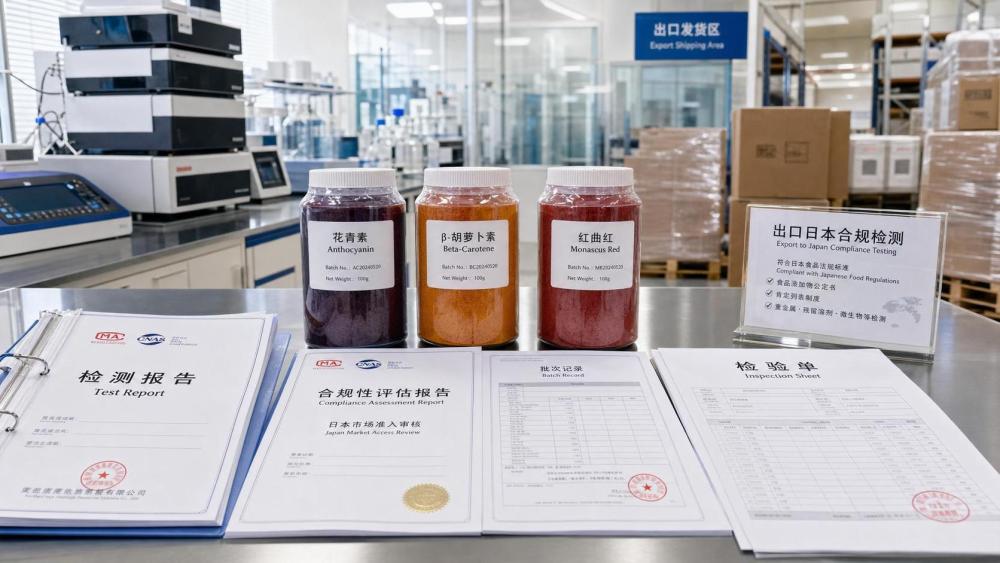
According to the information provided, the revised JAS standard for natural food colorants became effective on July 1, 2026. Under the new mandatory provision, all imported natural colorants must be accompanied by a “microbial tolerance declaration” issued by an institution accredited by JQA or JAB.
The declaration must demonstrate that, in an acidic environment of pH 3.5-4.5, the total viable count does not exceed 10² CFU/g. The scope described in the provided information includes imported natural colorants such as anthocyanins, beta-carotene, and Monascus red. Shipments that do not meet the requirement will be denied entry into Japan.
Where the Immediate Pressure Will Be Felt
Imported ingredient trade now faces a document-linked entry threshold
From an industry perspective, direct trading companies handling natural color imports into Japan are likely to feel the most immediate impact. The reason is straightforward: the new rule ties customs access to a specific third-party declaration. What deserves closer attention is whether the required statement is available at the time of shipment and whether it clearly addresses the specified pH range and microbial limit.
Procurement teams may need to reassess supplier readiness
For raw material buyers and procurement functions, the likely impact is concentrated in supplier qualification and ordering decisions. Analysis shows that the commercial question is no longer limited to price, shade, or application fit; it now also includes whether the supplier can support imports with documentation issued by a JQA- or JAB-accredited institution. This may affect ordering schedules, supplier communication, and approval workflows.
Manufacturers using natural colors may see knock-on effects in production planning
Food and ingredient manufacturers that rely on imported natural colorants may be affected through supply continuity rather than through the standard directly. Observably, if a shipment is refused entry for lack of compliant documentation or failure to meet the stated microbial condition, downstream production planning, reformulation timing, or inventory allocation could come under pressure. The key issue is not only compliance on paper, but also delivery reliability.
Supply chain and service partners may need tighter coordination
Service providers involved in import processing, quality documentation, and shipment coordination may also be affected. From an operational standpoint, the change places more weight on document completeness and timing. What deserves closer attention is how early the declaration is secured in the shipment cycle and how clearly responsibilities are defined among supplier, exporter, importer, and support partners.
What Companies Should Track From Here
Check whether current product lines fall within the affected import scope
Companies dealing in natural food colorants should first identify which imported products are exposed to the new requirement. The provided information explicitly mentions anthocyanins, beta-carotene, and Monascus red as examples, so businesses handling similar materials for the Japanese market should review whether their current shipments require the declaration before dispatch.
Focus on accreditation and statement readiness, not only on test results
Analysis shows that compliance here is tied to both technical performance and document origin. The rule, as provided, requires a declaration issued by an institution accredited by JQA or JAB. That means companies should pay attention not only to whether a material can meet the microbial threshold, but also to whether the supporting statement is issued through the required accreditation pathway.
Prepare for longer coordination cycles in purchasing and delivery
Observably, the new requirement can create additional coordination steps between supplier, laboratory or certifying body, importer, and customer. Businesses should therefore monitor whether lead times, booking decisions, and delivery commitments need adjustment. In practical terms, customer-facing teams may also need to prepare clear explanations for any shipment timing changes linked to compliance documentation.
Watch for any further official clarification in wording or implementation detail
What deserves closer attention is the distinction between the confirmed rule already in force and any future clarification on implementation. The information provided confirms the effective date, the declaration requirement, the pH condition, the microbial limit, the accreditation reference, and the consequence of refused entry for non-compliant goods. Companies should continue tracking whether official language or procedural guidance develops further beyond those confirmed points.
How This Development Is Best Understood Right Now
Analysis shows that this is more than a minor paperwork update, because the rule links import acceptance to a defined third-party microbial tolerance declaration. At the same time, it is more appropriate to understand this as a concrete compliance change already in force rather than as a broad market conclusion. The immediate signal is clear: imported natural colorants entering Japan now face a stricter documentation-and-quality gate under the revised JAS framework.
Observably, the longer-term industry significance still requires continued monitoring. The current information confirms the rule and its enforcement consequence, but it does not by itself establish how widely supply chains will be reshaped, which categories may face the most friction, or whether additional implementation details will emerge. That makes this a live regulatory development with direct operational relevance and open follow-through questions.
A Practical Reading of the Rule’s Industry Meaning
At this stage, the most balanced conclusion is that the revised JAS requirement should be read as an immediate import compliance obligation with broader supply chain implications that are still unfolding. For companies active in natural food color trade and use, the near-term priority is document readiness, accredited third-party support, and shipment planning. From an industry perspective, the rule is already actionable in the short term, while its wider commercial impact remains something to watch rather than assume.
Basis of This Article and What Still Needs Verification
This article is based on the user-provided news title, event date, and event summary concerning the revised JAS requirement for imported natural food colorants in Japan. For developments of this kind, relevant source types typically include official notices, company announcements, industry association updates, authoritative media coverage, and standards-related documents.
No specific official source link was provided in the input, so the exact official publication path still requires ongoing verification. Follow-up attention should remain on any further official clarification, implementation detail, or related documentation guidance connected to the revised JAS standard and its import enforcement.
Related News
- How to assess color stability from a natural food colors manufacturerOct 06, 2026Food Rheology Expert
- How natural food pigments for bakery hold color during bakingSep 20, 2026Food Rheology Expert
- EFSA Tightens MRLs for Natural Food ColorsAug 10, 2026Food Rheology Expert
- EFSA Updates Residue Limits for Natural Colorants, Drawing Attention to China’s Export Compliance PathwaysAug 08, 2026Food Rheology Expert
Related News
- 00
0000-00
Can biomimetic peptides in cosmetics reduce the look of wrinkles? - 00
0000-00
How to assess a bio-based thickener manufacturer's batch consistency - 00
0000-00
Verifying halal status of hydrocolloid ingredients in the Middle East - 00
0000-00
How to interpret active matter on a surfactant specification sheet - 00
0000-00
How Do You Test Hydrocolloid Viscosity After Changing a Thickener?
Food Rheology Expert
Weekly Insights
Stay ahead with our curated technology reports delivered every Monday.