





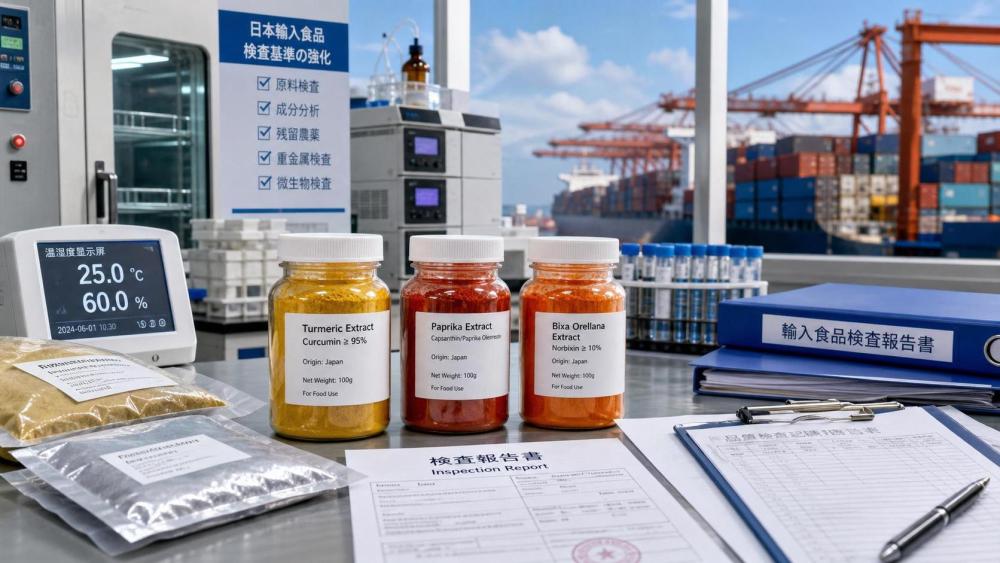
On July 1, 2026, Japan introduced a more specific compliance requirement for imported natural food colorants through a revision to JAS Standard No. 102 by MAFF. The change is particularly relevant to annatto (bixin), paprika (capsanthin), and turmeric (curcumin), because shipments now need third-party test reports showing microbial tolerance under accelerated storage conditions. For exporters, importers, procurement teams, and quality compliance functions, the point worth watching is not only the updated standard itself, but also the immediate trade consequence: non-compliant cargo may be quarantined or destroyed at Japanese ports.
What the revised JAS requirement now makes explicit
According to the provided information, MAFF revised JAS Standard No. 102 on July 1, 2026. Under this revision, all imported natural food colorants must provide third-party test reports demonstrating microbial tolerance under accelerated storage conditions of 37°C and 75% RH for 14 days.
The requirement is described as especially relevant to annatto (bixin), paprika (capsanthin), and turmeric (curcumin). The same provided information also states that shipments that do not comply may face quarantine or destruction at Japanese ports.
Where the operational pressure is likely to appear first
For exporters shipping into Japan
From an industry perspective, exporters are likely to feel the impact first because the rule change is tied directly to import entry conditions. The practical issue is whether shipment files can include acceptable third-party testing evidence before cargo reaches port. What deserves closer attention is the risk that a documentation gap may become a delivery risk, rather than remaining only a technical compliance issue.
For importers and procurement teams
Importers and buyers may need to reassess supplier readiness for the covered colorants, especially where annatto, paprika, or turmeric extracts are involved. Analysis shows that procurement attention may shift toward report availability, document validity, and whether testing timelines can fit ordering and shipping schedules. In this context, compliance review becomes part of purchasing execution, not only a downstream quality check.
For processors and manufacturers using natural colorants
Manufacturers that rely on imported natural food colorants may need to watch how the revised requirement affects incoming material planning and delivery predictability. Observably, if a shipment cannot clear port because supporting test reports are missing or insufficient, the effect may move quickly into production scheduling, inventory planning, and customer delivery commitments. That does not confirm disruption, but it does raise the compliance relevance of raw material intake.
For testing and compliance service functions
Testing-related service providers and internal regulatory teams may also see a more central role in transaction readiness. The provided facts confirm the need for third-party test reports, which means document preparation, report review, and traceable technical records may become more visible parts of trade execution for affected products.
What companies should track in the near term
Whether product files are aligned with the new testing expectation
Analysis shows that companies dealing in the covered colorants should first verify whether existing product documentation already includes third-party evidence matching the stated microbial tolerance requirement under accelerated storage. This is a document and specification review issue before it becomes a port clearance issue.
How shipment documentation is organized before dispatch
What deserves closer attention is the timing of document readiness. Because the consequence mentioned in the provided information includes quarantine or destruction for non-compliant shipments, exporters and import-side coordinators should closely review whether testing records are prepared and attached in a way that supports customs and port-side compliance checks. The input does not provide detailed filing procedures, so this remains a point to monitor rather than a confirmed procedural requirement.
Which product categories need tighter supplier screening
The change specifically highlights annatto, paprika, and turmeric extracts, so these categories may warrant more immediate supplier qualification review. Observably, businesses may need to pay closer attention to whether suppliers can consistently provide third-party reports that match the revised standard requirement, especially where orders are time-sensitive or tied to fixed delivery windows.
Whether execution language becomes more detailed over time
The current information confirms the rule change and the compliance consequence, but it does not provide fuller detail on enforcement interpretation, review format, or any expanded documentary guidance. For that reason, companies should continue watching for more precise official wording, customer compliance requests, tender document updates, or market-side implementation signals before treating every operational detail as settled.
How this change is best understood at this stage
Analysis shows that this development is better understood as an implemented compliance signal rather than a distant policy discussion, because the provided summary ties the revised JAS requirement directly to import conditions and port consequences. At the same time, it is not yet possible, based on the supplied information alone, to draw firm conclusions about enforcement rhythm, review intensity, or how uniformly market participants will adapt. That is why continued attention to execution wording and trade practice matters as much as the headline rule change.
Why the market should read this carefully
From an industry perspective, the significance of this update lies in how a technical testing requirement can move upstream into sourcing decisions and downstream into customs clearance and delivery risk. The most reasonable reading at present is that Japan has raised the compliance threshold for imported natural food colorants in a way that is already actionable, while several practical details of implementation still need ongoing observation through actual market execution and further clarifications, if any emerge.
Basis of this article and what still needs verification
This article is based on the user-provided news title, event date, and event summary. For developments of this type, commonly relevant source categories may include official announcements, regulatory releases, customs or trade authority information, industry association updates, standard-setting documents, and reporting by authoritative media. A specific official source link was not provided in the input, so the original release path still requires continued verification.
Further observation is still needed on any detailed implementation language, certification or compliance interpretation, tender document changes, market feedback, and how affected companies actually adjust documentation and shipment practices in response to the revised JAS requirement.
Related News
- How to assess color stability from a natural food colors manufacturerOct 06, 2026Food Rheology Expert
- How natural food pigments for bakery hold color during bakingSep 20, 2026Food Rheology Expert
- EFSA Tightens MRLs for Natural Food ColorsAug 10, 2026Food Rheology Expert
- EFSA Updates Residue Limits for Natural Colorants, Drawing Attention to China’s Export Compliance PathwaysAug 08, 2026Food Rheology Expert
Related News
- 00
0000-00
Can biomimetic peptides in cosmetics reduce the look of wrinkles? - 00
0000-00
How to assess a bio-based thickener manufacturer's batch consistency - 00
0000-00
Verifying halal status of hydrocolloid ingredients in the Middle East - 00
0000-00
How to interpret active matter on a surfactant specification sheet - 00
0000-00
How Do You Test Hydrocolloid Viscosity After Changing a Thickener?
Food Rheology Expert
Weekly Insights
Stay ahead with our curated technology reports delivered every Monday.