





On June 21, 2026, Mercosur introduced a new compliance requirement for imported natural food colorants, linking customs clearance to a biodegradation test issued by a Mercosur-recognized laboratory. For traders, ingredient buyers, manufacturers, and compliance teams handling products such as beet red, curcumin, and anthocyanins, the short 60-day transition period makes this a practical trade and documentation issue rather than a distant policy signal.
A new document threshold before customs release
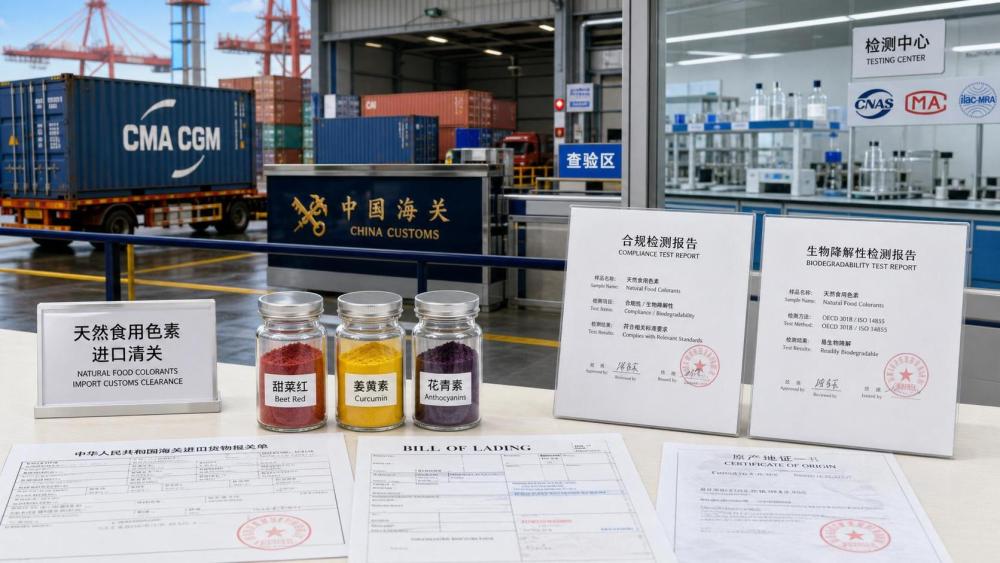
Mercosur issued Resolution GMC No. 34/2026 on June 21, 2026. According to the information provided, all imported natural food colorants, including beet red, curcumin, and anthocyanins, must be supported by an ISO 14852 biodegradation report issued by a Mercosur-recognized laboratory.
The required result is a biodegradation rate of at least 60% in 28 days. If this documentation is not provided, the goods will not be cleared through customs.
The transition period is 60 days, and full implementation begins on August 22, 2026.
Where the operational pressure is likely to appear
Import transactions may face a stricter pre-shipment gate
Analysis shows that companies directly involved in import trade may be affected first because the rule is tied to customs release. The practical impact is likely to center on whether shipment files are complete before dispatch and whether the required report can be presented in a form accepted at clearance.
What deserves closer attention is the shift from a product-only transaction to a document-linked transaction. For importers and exporters, this raises the importance of checking report availability, laboratory recognition status, and document readiness before cargo arrival.
Procurement teams may need to reassess supplier readiness
From an industry perspective, raw material buyers and procurement teams may need to look beyond price and specification alignment. If a supplier cannot provide a report from a Mercosur-recognized laboratory showing compliance with ISO 14852 at the stated threshold, supply continuity may be affected even when the product itself is commercially acceptable.
This means procurement review may increasingly involve compliance documentation, supplier qualification checks, and timing coordination tied to the new execution date.
Manufacturing and delivery schedules could become more document-dependent
For processors and manufacturers using imported natural food colors, the rule may affect incoming material planning and delivery reliability. Observably, the immediate issue is not only product selection, but whether supporting test records are available in time to avoid customs disruption.
Supply chain service providers and logistics coordinators may also need to pay closer attention to document completeness because missing compliance files could directly affect release timing.
What companies should review now
Check whether existing product files match the new entry condition
Analysis shows that companies handling relevant colorants should review whether current technical and shipment files already include an ISO 14852 biodegradation report and whether that report is issued by a Mercosur-recognized laboratory. Where such records are absent, the issue is not merely administrative, because the consequence stated in the rule is denial of customs clearance.
Revisit supplier communication and purchase timing
With full implementation set for August 22, 2026, companies may need to revisit ordering schedules, shipment timing, and supplier communication. What deserves closer attention is whether documentation can be prepared within the short transition window, especially for transactions already in motion.
Watch for how the requirement is reflected in trade paperwork
Although the provided information does not describe detailed enforcement procedures, companies should monitor how this requirement is carried into trade documents, internal compliance checklists, and any customer-facing technical file requests. It is more appropriate to understand this stage as one where document alignment matters, even if full execution practice is still being observed.
Track any clarification around recognition and acceptance
The summary provided confirms the need for a report from a Mercosur-recognized laboratory, but it does not include further operational detail. For that reason, companies should continue to watch for clarification in execution language, acceptance criteria, and any downstream use of the requirement in procurement or delivery conditions.
Why this reads as an execution signal, not just a policy note
From an editorial perspective, this update is better understood as a near-term market access condition because the rule is directly tied to customs clearance and carries a defined implementation date after a short transition period. That makes it more concrete than a general regulatory discussion.
At the same time, observably, the available information remains limited to the published requirement, the testing standard, the threshold, and the implementation timetable. For that reason, the market still needs to watch how consistently the requirement is interpreted in practice and how quickly affected businesses can adapt their document flows.
How the market may best read this change for now
Based on the confirmed information, this development signals a real compliance checkpoint for imported natural food colorants entering the Mercosur framework. The most reasonable reading at this stage is that the rule has already moved beyond a general policy direction and into an actionable trade requirement, while some operational details still warrant close observation.
For companies exposed to the affected product category, the immediate task is not broad strategic repositioning, but careful review of testing records, supplier readiness, and shipment documentation against the August 22, 2026 deadline.
Basis of this article and what still needs verification
This article is generated from the user-provided title, event date, and event summary. For developments of this kind, relevant source types typically include official notices, regulatory releases, customs or trade authority updates, industry association communications, standard-related documents, and reporting by authoritative media.
No specific official source link was provided in the input, so the exact official publication path still needs ongoing verification. Analysis shows that follow-up attention should remain on any detailed implementation language, certification and laboratory acceptance practice, changes in procurement or tender documents, market feedback, and how companies execute against the new requirement in actual trade operations.
Related News
- How to assess color stability from a natural food colors manufacturerOct 06, 2026Food Rheology Expert
- How natural food pigments for bakery hold color during bakingSep 20, 2026Food Rheology Expert
- EFSA Tightens MRLs for Natural Food ColorsAug 10, 2026Food Rheology Expert
- EFSA Updates Residue Limits for Natural Colorants, Drawing Attention to China’s Export Compliance PathwaysAug 08, 2026Food Rheology Expert
Related News
- 00
0000-00
Verifying halal status of hydrocolloid ingredients in the Middle East - 00
0000-00
How to interpret active matter on a surfactant specification sheet - 00
0000-00
What Quality Checks Should You Run on Fragrance Ingredient Suppliers? - 00
0000-00
How to assess a flavor chemistry manufacturer's batch consistency - 00
0000-00
What drives fragrance ingredients price changes in bulk orders?
Food Rheology Expert
Weekly Insights
Stay ahead with our curated technology reports delivered every Monday.