





Selecting natural food pigments for dairy has moved far beyond simple color matching. In milk-based systems, shade performance is tied to heat exposure, light stability, fat interaction, pH drift, and shelf-life behavior.
That makes color a formulation and compliance issue as much as a branding choice. A yogurt cup, flavored milk, ice cream, or processed cheese can look attractive at filling, then fade, brown, separate, or turn dull during storage.
For sectors tracked by FFAI, this sits at the intersection of clean label demand, preservation strategy, rheology control, and sensory consistency. The question is not only which pigment creates the right tone, but which one survives the dairy matrix without creating downstream risk.
Why dairy makes color selection unusually sensitive
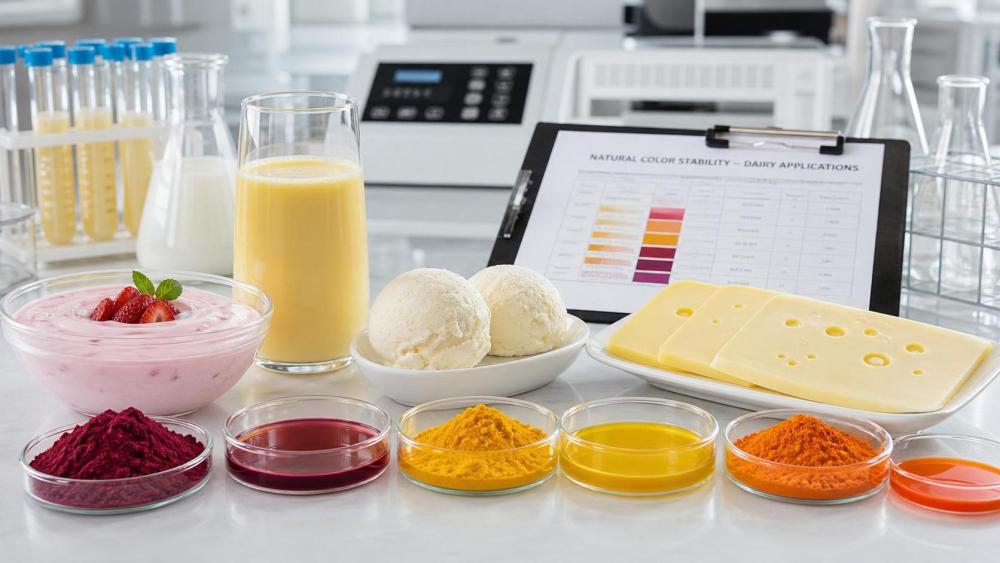
Dairy products are not neutral carriers. Proteins, fat globules, minerals, oxygen exposure, and processing temperatures all influence the appearance of natural food pigments for dairy.
A pigment that performs well in beverages may fail in cultured yogurt. Another may hold color in frozen desserts but break down during UHT treatment or long ambient storage.
White dairy bases also amplify small color shifts. Minor fading, uneven dispersion, or a change from bright to grayish tones becomes visible quickly, especially in products marketed as fruit-forward, premium, or minimally processed.
This is why stability testing for natural food pigments for dairy must be product-specific. A generic supplier shade card is only a starting point.
What “natural” means in practical formulation terms
In commercial dairy development, natural pigments usually refer to colors sourced from plants, algae, fruits, vegetables, or certain permitted biological materials. Yet the operational question is less philosophical and more technical.
The real issue is whether the ingredient meets the target market’s labeling rules, consumer expectations, and process conditions. Clean label acceptance in one region may not translate directly to another.
FFAI’s broader focus on food preservation and sensory ingredients is useful here. Color stability is rarely isolated. It is connected to antioxidants, emulsification, texture systems, packaging choices, and the intended distribution route.
A stable natural shade often depends on the surrounding formula being equally disciplined.
The main instability triggers to evaluate first
When screening natural food pigments for dairy, several stress points deserve early attention. Missing any one of them can lead to a visually acceptable pilot batch and a failed market product.
Heat and process load
Pasteurization, UHT, hot filling, and melt processing can degrade sensitive pigments. Anthocyanins and some carotenoid systems may respond very differently under equivalent thermal load.
Light and oxygen exposure
Retail refrigeration with transparent packaging can accelerate fading. Riboflavin-driven photooxidation in dairy systems may also alter perceived shade over time.
pH and fermentation behavior
Fermented dairy is especially demanding. As pH drops, some pigments intensify, while others destabilize or shift hue. That matters in drinkable yogurt, fruit preps, and probiotic formats.
Fat content and dispersion
Oil-dispersible and water-dispersible pigments do not behave the same way. Ice cream, cream liqueur bases, and cheese spreads often expose poor dispersion more clearly than low-fat milk drinks.
Interaction with thickeners and stabilizers
Hydrocolloids can protect appearance, but they can also trap, dull, or unevenly suspend color. In FFAI’s ingredient context, pigment and thickener should be assessed together, not in separate workstreams.
Shade selection is about lifecycle appearance, not day-one brightness
Many dairy teams still approve color too early. The most attractive fresh sample may become the least reliable option after transport, chilled display, or freeze-thaw stress.
A more durable decision starts with the target sensory message. Strawberry yogurt rarely needs an intense candy pink. Mango lassi does not benefit from an artificial neon orange. Vanilla dairy desserts often require warm cream notes, not pure white.
Natural food pigments for dairy should support flavor cues and consumer expectations without overshooting them. Slightly muted but stable shades often perform better commercially than brighter unstable ones.
Typical pigment families and where caution is needed
No single source solves every dairy color challenge. Each pigment family offers useful shades, but each carries a distinct risk profile.
Anthocyanins
Useful for red, purple, and berry shades. They can fit acidic fermented products, yet often remain sensitive to pH variation, heat, and long light exposure.
Carotenoids
Common for yellow, orange, and cream tones. They are popular in cheese, butter-like systems, and desserts, but oxidation and dispersion quality are critical.
Curcumin and turmeric-derived options
These can deliver vivid yellow shades, although light stability may be limiting in transparent packs.
Chlorophyll and spirulina-based systems
These help create green or blue-adjacent novelty shades. They may be attractive in limited editions, but processing tolerance and regional acceptance require careful review.
That review should always include legal status, specification consistency, heavy metal limits, microbiological quality, and carrier composition.
A workable evaluation framework for product approval
A disciplined screening process reduces surprises later. For natural food pigments for dairy, the most useful approach combines appearance, safety, and process realism.
- Test in the final dairy matrix, not in water or a neutral lab base.
- Compare color before and after full thermal processing.
- Review pH movement across production and shelf life.
- Check light stability in intended packaging.
- Measure sedimentation, ring formation, and phase separation.
- Confirm supplier documentation for compliance and traceability.
- Run accelerated and real-time storage together.
This is where intelligence-led review becomes valuable. FFAI’s emphasis on regulatory tracking, preservation chemistry, and ingredient interaction mirrors how successful approvals are actually made.
Color cannot be signed off independently from shelf-life strategy or formulation architecture.
Business impact goes beyond visual appeal
Choosing the wrong pigment can trigger reformulation costs, claim risk, customer complaints, and batch inconsistency. In export markets, it may also create labeling or market-entry delays.
The right choice supports cleaner positioning, steadier sensory performance, and fewer post-launch corrections. It also helps align R&D, quality, and commercial teams around the same standard of acceptability.
In dairy, a stable color system quietly protects trust. Consumers may not know which pigment was used, but they notice when a strawberry yogurt looks beige, a vanilla drink turns gray, or an orange cheese sauce loses appetite appeal.
What to review next before locking a color system
Before final approval, narrow the decision to a few questions. Does the selected pigment stay within target shade at end of shelf life? Does it remain compliant across intended markets? Does it tolerate the real factory process?
Also review how the pigment behaves with preservatives, antioxidants, flavors, and texture systems. Those surrounding ingredients often determine whether natural food pigments for dairy remain stable or become a recurring deviation source.
A strong next step is to build a simple internal scorecard covering shade fidelity, stability, documentation quality, and packaging fit. That creates a repeatable standard for future launches rather than a one-off color decision.
For teams following ingredient intelligence through platforms like FFAI, the real advantage comes from connecting color choice to the whole formula environment. That is usually where better decisions start and where fewer problems appear later.
Related News
- How to assess color stability from a natural food colors manufacturerOct 06, 2026Food Rheology Expert
- How natural food pigments for bakery hold color during bakingSep 20, 2026Food Rheology Expert
- EFSA Tightens MRLs for Natural Food ColorsAug 10, 2026Food Rheology Expert
- EFSA Updates Residue Limits for Natural Colorants, Drawing Attention to China’s Export Compliance PathwaysAug 08, 2026Food Rheology Expert
Related News
- 00
0000-00
Verifying halal status of hydrocolloid ingredients in the Middle East - 00
0000-00
How to interpret active matter on a surfactant specification sheet - 00
0000-00
What Quality Checks Should You Run on Fragrance Ingredient Suppliers? - 00
0000-00
How to assess a flavor chemistry manufacturer's batch consistency - 00
0000-00
What drives fragrance ingredients price changes in bulk orders?
Food Rheology Expert
Weekly Insights
Stay ahead with our curated technology reports delivered every Monday.