





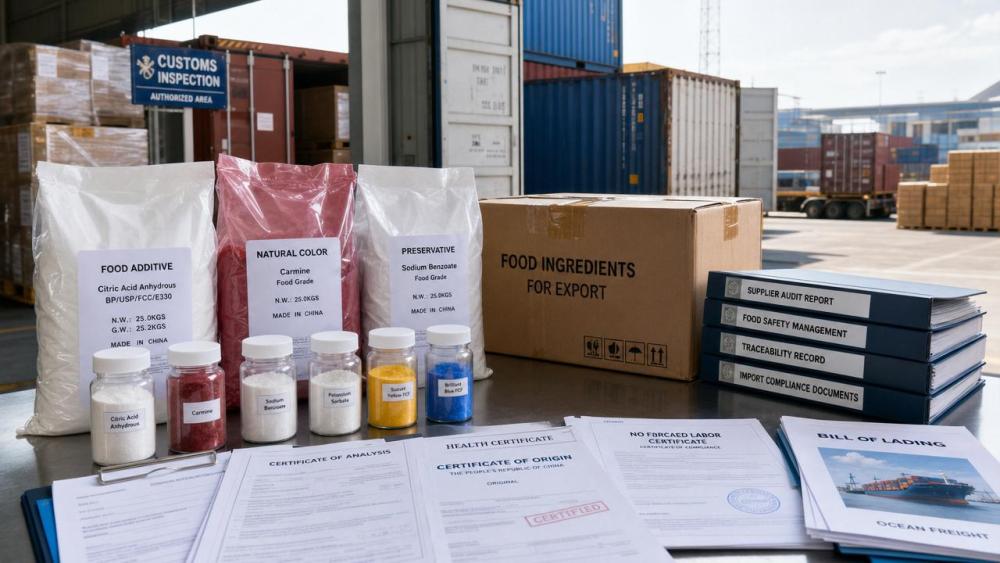
On April 28, 2026, Pakistan revised its Import Policy Order (2022) to bar the import of goods involving forced labor and to require importers to submit written compliance proof to the federal government. For the food trade, this is not just a policy headline but a practical compliance change that can affect supplier screening, sourcing documentation, shipment preparation, and buyer review processes, especially for exporters of food additives, natural colors, water-soluble flavors, and preservatives.
What the rule change confirms
The confirmed information is limited but clear. Pakistan’s Ministry of Commerce revised the Import Policy Order (2022) on April 28, 2026. The revised rule explicitly prohibits the import of goods that contain a forced labor component. It also requires importers to provide written compliance evidence to the federal government.
The change directly affects exporters of food-related inputs such as food additives, natural colors, water-soluble flavors, and preservatives. The summary provided also indicates that overseas buyers need to immediately review supplier ESG statements and production traceability capabilities.
Where the pressure is likely to appear first in the supply chain
Exporters face a higher documentation threshold before shipment
From an industry perspective, exporters selling into Pakistan may be affected first through pre-shipment compliance preparation rather than through product formulation changes alone. The key issue is whether suppliers can support their customers with written materials that help demonstrate the absence of forced labor risks in the supply chain. For Chinese exporters in the named categories, this makes due diligence records and traceability materials more relevant to trade execution.
Importers and overseas buyers will need stronger supplier review
Because the rule requires written compliance proof to be submitted by importers, buyers are likely to place greater attention on upstream supplier declarations, ESG-related statements, and production traceability. What deserves closer attention is that this may shift part of the compliance burden upstream, even when the legal filing obligation sits with the importer.
Procurement and supply chain teams may need to reassess vendor readiness
For procurement functions, the practical impact may appear in supplier onboarding, annual reviews, contract documentation, and source verification. If a supplier cannot provide sufficiently clear origin and production-chain records, the purchasing side may need to reassess continuity, timing, or document completeness before confirming orders and delivery schedules.
Service providers around compliance may see new requests
Analysis shows that supply chain service firms and compliance-related support providers may receive more requests tied to document review, traceability support, and evidence organization. However, because the input does not provide detailed enforcement procedures, this should be understood as a likely operational direction rather than a confirmed implementation outcome.
What companies should examine now
Review whether existing supplier statements are usable for trade filing
Companies involved in the affected product categories should first check whether their current supplier declarations and ESG statements are specific enough to support an importer’s written compliance submission. General policy language may not be sufficient if buyers begin asking for clearer chain-of-custody or production-source explanations.
Check traceability depth across raw materials and production links
Observably, the issue is not limited to final goods. Firms should pay attention to whether traceability can extend across relevant raw materials, processing links, and production records. This is especially relevant where multiple upstream suppliers are involved and document consistency may affect shipment readiness.
Prepare for buyer-side document requests and longer review cycles
Companies should be alert to the possibility that overseas buyers may add new document requests before purchase confirmation or shipment release. Since the summary does not provide detailed execution standards, it would be premature to assume a fixed review format. Still, exporters should monitor whether customer questionnaires, compliance appendices, and sourcing declarations begin to change.
Track follow-up wording and execution practice
What deserves closer attention is not only the revised rule itself, but also how the requirement is described in later trade practice. Businesses should continue watching for any clearer wording on filing expectations, document scope, and practical review standards from market participants or relevant authorities, if and when such details appear.
How this should be read at the current stage
Analysis shows that this development is best understood as an executed policy change with immediate compliance signaling value, rather than as a distant regulatory discussion. At the same time, the available information is still limited on detailed enforcement practice. That means the market already has a clear direction of travel: forced-labor-related compliance is moving closer to import access and trade documentation. But it also means companies should avoid assuming details that have not yet been confirmed.
From an industry perspective, the most relevant point is that ESG language is no longer only reputational in this context. It is becoming connected to import documentation expectations and supplier traceability capacity. That can affect who is considered a lower-risk supplier and how quickly orders move through buyer approval.
Why the development matters beyond the headline
This update matters because it shifts the discussion from broad ethical sourcing expectations to a more concrete import compliance requirement tied to written proof. For affected food-related exporters and their buyers, the immediate issue is less about public positioning and more about whether internal records, supplier declarations, and traceability support are ready for real transaction use. It is more appropriate to understand this as a live compliance signal that has already entered the trade rule framework, while detailed execution practice still needs continued observation.
Basis of this article and what still needs verification
This article is based on the user-provided news title, event date, and event summary. For events of this type, commonly relevant source categories may include official notices, releases from regulatory authorities, customs or trade administration information, industry association updates, standard-setting documents, and reporting by authoritative media. No specific official source link was provided in the input, so the exact official link still needs to be verified on an ongoing basis.
Further observation is still needed on any detailed policy language, compliance interpretation, document expectations, buyer-side implementation, tender or procurement document changes, market feedback, and how affected companies adapt their supplier review and traceability practices.
Related News
- How to assess color stability from a natural food colors manufacturerOct 06, 2026Food Rheology Expert
- How natural food pigments for bakery hold color during bakingSep 20, 2026Food Rheology Expert
- EFSA Tightens MRLs for Natural Food ColorsAug 10, 2026Food Rheology Expert
- EFSA Updates Residue Limits for Natural Colorants, Drawing Attention to China’s Export Compliance PathwaysAug 08, 2026Food Rheology Expert
Related News
- 00
0000-00
Verifying halal status of hydrocolloid ingredients in the Middle East - 00
0000-00
How to interpret active matter on a surfactant specification sheet - 00
0000-00
What Quality Checks Should You Run on Fragrance Ingredient Suppliers? - 00
0000-00
How to assess a flavor chemistry manufacturer's batch consistency - 00
0000-00
What drives fragrance ingredients price changes in bulk orders?
Food Rheology Expert
Weekly Insights
Stay ahead with our curated technology reports delivered every Monday.