





On June 15, 2026, the Office of the United States Trade Representative announced a Section 301 review focused on alleged forced-labor risks across supply chains in 60 economies. The move, which may lead to additional tariffs of 10% to 12.5%, deserves close attention from exporters, ingredient suppliers, sourcing teams, manufacturers, and compliance functions, especially where shipments involve Chinese raw materials such as natural colorants, botanical extracts, and water-soluble flavor ingredients that may now face more demanding certification preparation.
What the U.S. Announced on June 15
According to the information provided, the U.S. side has initiated a forced-labor supply chain review covering 60 economies under Section 301. The proposed trade measure is an additional tariff in the range of 10% to 12.5%.
South Korea was specifically identified as having weak enforcement and could face the highest tariff level under the proposed framework. The new requirement would also ask exporters to provide labor-compliance proof across the full supply chain.
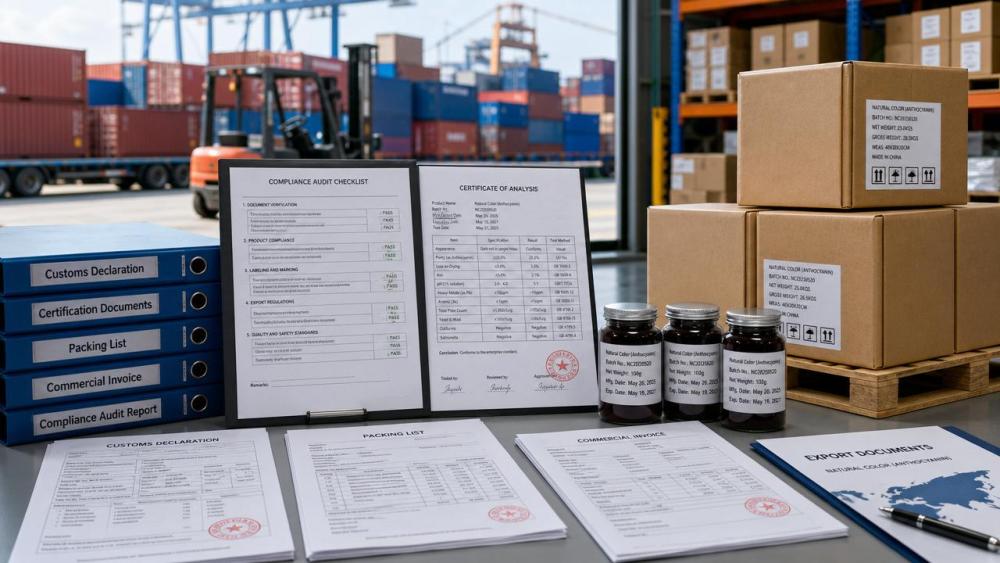
The summary further indicates that this requirement directly affects certification preparation for Chinese raw materials used in products containing natural colorants, plant extracts, and water-soluble flavors.
Where the pressure may appear first in the supply chain
Export documentation moves to the front of the transaction
From an industry perspective, direct trading companies may feel the impact first because the new requirement is tied to full-chain labor compliance proof rather than a single shipment document. The immediate pressure point is likely to be document readiness, consistency across supplier tiers, and the ability to support certification preparation for covered ingredient categories.
Raw material sourcing may face tighter qualification checks
For ingredient buyers and procurement teams, the issue is not only tariff exposure but also whether upstream suppliers can support traceable labor-compliance records. This matters in procurement planning for natural colorants, botanical extracts, and water-soluble flavor materials, where certification preparation could become a gating item for export-related orders.
Manufacturing schedules could be affected by compliance timing
Processors and manufacturers may be affected if upstream raw materials are delayed by additional review or by incomplete compliance files. What deserves closer attention is the connection between supplier qualification, document turnaround, and delivery commitments, especially for production plans tied to export markets.
Supply chain service providers may see higher verification demands
Service providers involved in trade support, documentation, and shipment coordination may need to manage more requests related to chain-of-custody records and supporting paperwork. Observably, the operational impact may show up in pre-shipment checks, customer communication, and exception handling when documents do not align across the chain.
What companies should watch now
Watch for changes in official wording and implementation detail
Analysis shows that the current signal is important, but the practical burden will depend on how the review language, tariff scope, and evidence requirements are further expressed by the relevant authorities. Companies should therefore separate the headline announcement from the still-developing operational rules.
Prioritize product lines with certification exposure
Businesses handling Chinese raw materials linked to natural colorants, plant extracts, and water-soluble flavors should review which product lines are most exposed to additional certification preparation. The key issue is not only whether a product is traded into the U.S. market, but whether its documentation can support full-chain labor compliance claims.
Check supplier records before customer requests intensify
What deserves closer attention is the readiness of supplier qualifications, declarations, and supporting records before customers ask for them on short notice. For commercial teams, this is also a communication issue: delivery promises, quotation assumptions, and documentation commitments may need to be aligned internally.
Prepare for a difference between policy signal and transaction reality
From an industry perspective, a policy announcement does not automatically mean the same level of immediate impact across every shipment. Companies should pay attention to where the rule becomes enforceable in actual order processing, certification review, and customs-facing documentation, rather than treating all exposures as identical.
Why this looks like a policy signal that still needs tracking
Analysis shows that this development should not be read only as a tariff story. It also signals a compliance shift in which labor-related proof may become more central to market access discussions for affected supply chains. At the same time, it is more appropriate to understand this as an active policy development rather than a fully settled end state, because the provided information points to proposed tariffs and new proof requirements, not a completed final outcome for every case.
Observably, the importance for industry lies in the combination of trade review, documentation burden, and category-specific certification preparation. That combination can affect commercial timing even before final trade consequences are fully clear.
How the market may best interpret this stage
The immediate significance of this update is that labor-compliance documentation is moving closer to the center of supply chain risk management for certain export-linked ingredient categories. A neutral reading is that the market is facing a meaningful warning signal with potential operational consequences, but one that still requires continued verification as official wording, scope, and implementation develop.
It is more appropriate to understand this update as a near-term compliance and preparation issue, and also as a longer-term policy signal that supply chain evidence standards may be tightening in trade-facing transactions.
Basis of this article and what still needs verification
This article is based on the user-provided news title, event date, and event summary. No specific official source link was included in the input, so the exact official reference still needs ongoing verification.
For this type of development, relevant source categories typically include official government announcements, company disclosures, industry association updates, authoritative media reporting, and standards or compliance-related documents. Further attention should focus on whether the official wording changes, how tariff measures are defined in practice, and how full-chain labor-compliance proof is applied in actual export certification and transaction workflows.
Related News
- How to assess color stability from a natural food colors manufacturerOct 06, 2026Food Rheology Expert
- How natural food pigments for bakery hold color during bakingSep 20, 2026Food Rheology Expert
- EFSA Tightens MRLs for Natural Food ColorsAug 10, 2026Food Rheology Expert
- EFSA Updates Residue Limits for Natural Colorants, Drawing Attention to China’s Export Compliance PathwaysAug 08, 2026Food Rheology Expert
Related News
- 00
0000-00
Can biomimetic peptides in cosmetics reduce the look of wrinkles? - 00
0000-00
How to assess a bio-based thickener manufacturer's batch consistency - 00
0000-00
Verifying halal status of hydrocolloid ingredients in the Middle East - 00
0000-00
How to interpret active matter on a surfactant specification sheet - 00
0000-00
How Do You Test Hydrocolloid Viscosity After Changing a Thickener?
Food Rheology Expert
Weekly Insights
Stay ahead with our curated technology reports delivered every Monday.