





For procurement teams balancing cost control, clean-label demand, and formulation performance, choosing between bio-based thickeners and modified starches is rarely straightforward. This article examines how bio-based thickeners compare in pricing, supply resilience, process compatibility, and long-term stability, helping buyers make smarter sourcing decisions across food, fragrance, and personal care applications.
Understanding bio-based thickeners and modified starches
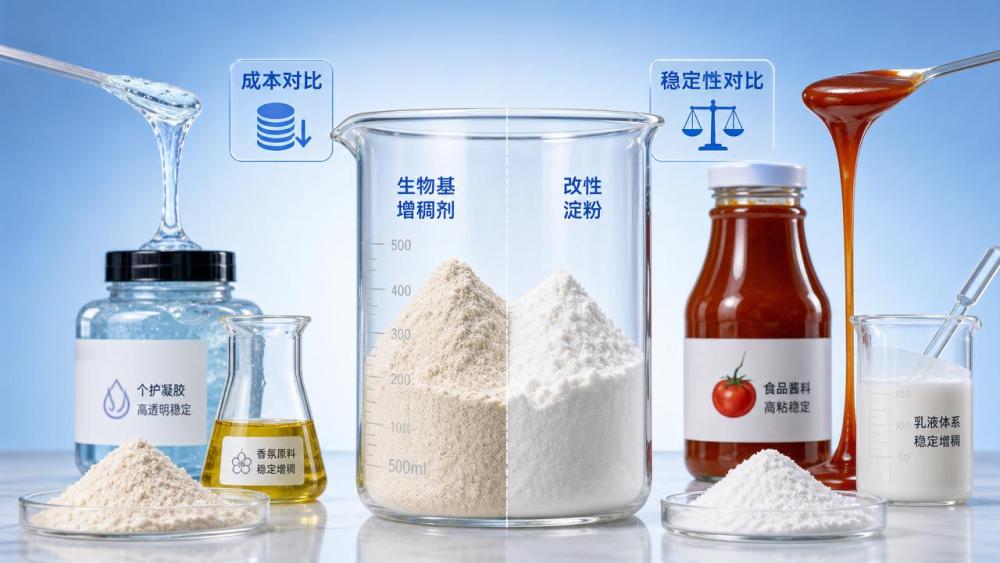
Bio-based thickeners are viscosity-building ingredients derived from renewable biological sources. Common examples include xanthan gum, guar gum, pectin, carrageenan, cellulose derivatives, and fermented hydrocolloids.
Modified starches begin with native starch from corn, tapioca, potato, or waxy maize. They are then physically, enzymatically, or chemically adjusted to improve texture, heat tolerance, shear resistance, or freeze-thaw behavior.
In practical formulation work, both categories can deliver thickening, suspension, mouthfeel, and stability. However, their economics and performance profiles differ across process conditions and end-use requirements.
The phrase bio-based thickeners often overlaps with clean-label positioning. Yet clean-label status depends on processing history, labeling laws, region, and application category rather than source alone.
Where the distinction matters most
- Ingredient cost per functional dosage
- Tolerance to heat, acid, salt, and shear
- Label declaration and consumer perception
- Availability across crop cycles and regions
- Texture profile in food, home care, and personal care
Current industry signals shaping the comparison
Across the broader FMCG value chain, bio-based thickeners are gaining attention because sustainability claims now influence product briefs as much as cost targets and process efficiency.
At the same time, modified starches remain deeply entrenched. They offer familiar handling, broad supplier bases, and competitive economics in many high-volume systems.
This is why the debate is not simply natural versus engineered. It is about total value under real manufacturing and commercial constraints.
Cost structure: price per kilogram is only the starting point
Modified starches often appear cheaper on a price-per-kilogram basis. For bulk food applications, this can make them attractive during initial specification reviews.
However, bio-based thickeners frequently work at lower dosage levels. A gum used at 0.2% may outperform a starch system used at 2% or higher.
That difference changes the cost calculation dramatically. Freight, warehousing, dosing accuracy, hydration time, and yield loss can offset an apparently higher unit price.
Key cost elements to compare
- Delivered cost per functional batch, not per kilogram alone
- Required inclusion rate for target viscosity
- Need for co-stabilizers or texture modifiers
- Hydration energy, mixing time, and process hold time
- Scrap risk from lumping, thinning, or phase instability
- Brand value from clean-label or plant-based claims
In many premium systems, bio-based thickeners generate lower total formulation cost because they reduce dosage and improve process robustness. In value segments, modified starches may still win.
Stability trade-offs across heat, acid, shear, and time
Stability is where the comparison becomes application-specific. No single thickener family dominates every condition.
Many bio-based thickeners perform exceptionally under low dosage and high suspension demand. Xanthan gum, for example, is valued for pseudoplastic flow and particle suspension.
Modified starches are often favored when a fuller body, opaque appearance, or cooked texture is desired. They can also provide excellent stability in retorted or frozen systems.
The practical lesson is simple. Stability depends on matrix chemistry, processing sequence, water activity, and storage profile. Bio-based thickeners should be tested as systems, not as isolated ingredients.
Application value across food, fragrance, and personal care
In food, bio-based thickeners support clean texture, suspension, and label appeal. They are common in sauces, dairy alternatives, dressings, desserts, and beverage concentrates.
In fragrance and home care, they help suspend insoluble components, improve pour control, and stabilize visual aesthetics. Clarity and salt tolerance become important selection factors.
In personal care, bio-based thickeners can support sensory elegance and natural positioning. They are frequently evaluated in serums, gels, masks, and sulfate-free cleansing systems.
Typical fit by use case
- Spoonable foods: modified starches for body, bio-based thickeners for gloss and stability
- Drinkable emulsions: bio-based thickeners for suspension at low viscosity
- Acid sauces: blended systems often outperform single ingredients
- Transparent gels: selected bio-based thickeners may provide better clarity
- Frozen or reheated foods: modified starches can offer dependable texture retention
For many developers, the winning approach is not either-or. A hybrid system can deliver lower cost, stronger resilience, and better sensory balance.
Supply resilience and sourcing risk
Supply stability is increasingly important when comparing bio-based thickeners with modified starches. Crop origin, fermentation capacity, geopolitical exposure, and logistics routes all affect continuity.
Some starches benefit from large agricultural ecosystems and diversified processors. Some gums depend on narrower geographies or weather-sensitive yields. Fermentation-derived thickeners face energy and substrate cost shifts.
This means resilience cannot be assumed from ingredient category. It must be mapped supplier by supplier, grade by grade.
Useful sourcing checkpoints
- Review multi-origin availability and backup plants.
- Confirm viscosity specification ranges and lot consistency.
- Check allergen, GMO, solvent, and certification status.
- Assess regional labeling acceptance for bio-based thickeners.
- Model lead time risk alongside reformulation cost.
Practical guidance for selecting the right thickening strategy
Start with the target texture and failure mode. If the main risk is syneresis, sedimentation, or viscosity loss, test for that endpoint first.
Then compare bio-based thickeners and modified starches using equal-performance benchmarks. Matching only percentage addition creates misleading cost conclusions.
Short pilot trials should include heat history, pH drift, salt load, fragrance oil interaction, and accelerated shelf-life checks. Small formulation details often decide the winner.
- Use total cost-in-use models, not raw material quotes alone
- Test single ingredients against realistic blends
- Align thickener choice with regional compliance and claims
- Document process sensitivity during scale-up
Bio-based thickeners are often the better option when low dosage, clean-label language, and advanced rheology matter most. Modified starches remain strong where body, familiarity, and volume economics dominate.
Next-step evaluation framework
The most reliable path is a side-by-side scorecard covering cost-in-use, texture, stability, label fit, and sourcing resilience. This avoids overvaluing a single metric.
For organizations tracking clean-label innovation, bio-based thickeners deserve close attention. Their value becomes strongest when performance and branding goals need to move together.
FFAI continues to monitor hydrocolloid innovation, starch modification trends, and compliance shifts across food, fragrance, and active ingredient markets. A disciplined comparison now reduces reformulation risk later.
Related News
- Functional Food Additives for Bakery: Performance and Labeling BasicsJul 09, 2026Food Rheology Expert
- Bio-Based Thickeners: Cost and Performance in Food FormulationJun 25, 2026Food Rheology Expert
- Indonesia Duties Chinese PP, Affecting Starch and Flavor CarriersJun 21, 2026Food Rheology Expert
- Argentina Tightens Inorganic Arsenic LimitsJun 18, 2026Food Rheology Expert
Related News
- 00
0000-00
What drives fragrance ingredients price changes in bulk orders? - 00
0000-00
How to assess a food antioxidants distributor’s traceability practices - 00
0000-00
How minimum order quantities shape private label ingredient sourcing costs - 00
0000-00
What drives personal care ingredient price volatility in sourcing - 00
0000-00
What drives micelles price differences in cosmetic formulations?
Food Rheology Expert
Weekly Insights
Stay ahead with our curated technology reports delivered every Monday.