





On May 9, 2026, China’s General Administration of Customs issued Announcement No. 60 (2026), imposing new mandatory mycotoxin testing and traceability code requirements on imported Ukrainian wheat flour. The measure has triggered a rapid shift among European bakery ingredient buyers toward Chinese suppliers of modified starches — particularly for applications requiring functional substitutes in dough conditioning, texture stabilization, and moisture retention.
Event Overview
Customs General Administration of China released Announcement No. 60 on May 9, 2026, mandating additional aflatoxin B1, deoxynivalenol (DON), and zearalenone testing for all Ukrainian wheat flour imports, alongside implementation of a digital traceability code system prior to customs clearance. The announcement took immediate effect upon publication. Exporters from Ukraine confirmed receipt of updated compliance guidance from Chinese customs authorities the same day. EU-based baking ingredient importers began redirecting procurement inquiries to Chinese starch producers within 48 hours.
Industries Affected
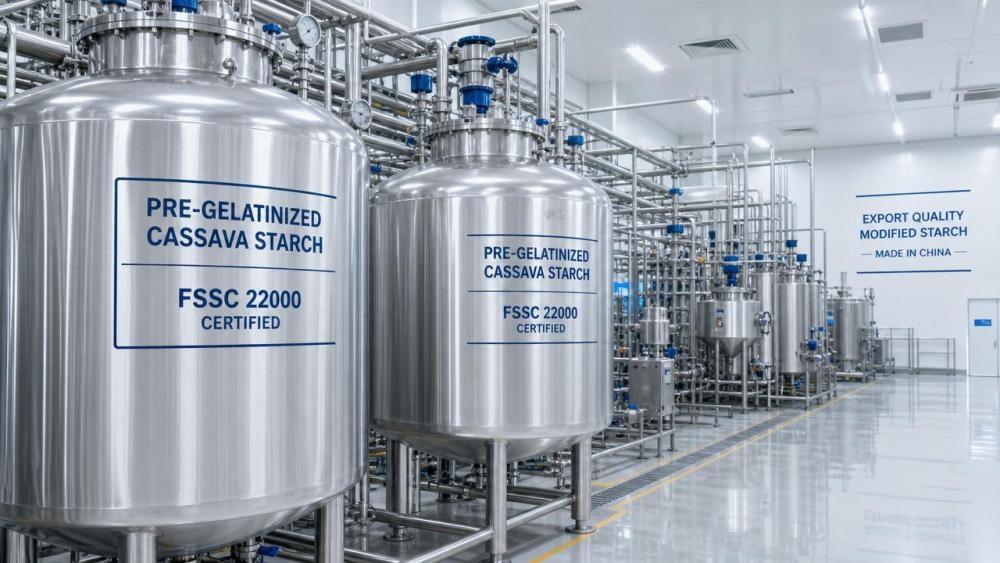
Direct Trading Enterprises: Chinese export traders specializing in food-grade industrial starches are experiencing surging demand for pre-gelatinized cassava starch and oxidized corn starch. Impact manifests as a 210% week-on-week increase in urgent inquiry volume from EU clients, with requests now consistently specifying dual certification (ISO 22000 and FSSC 22000) — a requirement not previously emphasized in routine orders.
Raw Material Procurement Enterprises: EU-based food ingredient distributors and contract sourcing agents face tightened lead times and heightened documentation scrutiny. Their ability to fulfill bakery customers’ formulation continuity depends on verifying origin traceability and batch-level toxin test reports — capabilities many Chinese suppliers are still scaling up to deliver at scale.
Processing & Manufacturing Enterprises: Domestic Chinese starch processors — especially those in Guangdong and Shandong provinces — report intensified pressure to accelerate third-party certification audits and upgrade lab capacity for regulated mycotoxin analysis. Some are temporarily prioritizing export orders over domestic ones due to higher margins and faster payment terms associated with EU contracts.
Supply Chain Service Providers: Logistics firms offering cold-chain documentation support, customs brokerage for food imports/exports, and certification consulting services are seeing increased engagement from starch exporters seeking help with EU-compliant labeling, digital traceability integration, and audit readiness preparation — particularly around FSSC 22000 Clause 8.5.2 (traceability system validation).
Key Focus Areas and Response Measures
Verify and Upgrade Certification Alignment
Exporters must confirm whether existing ISO 22000 and FSSC 22000 certifications cover the specific starch variants being quoted (e.g., pre-gelatinized cassava starch, oxidized corn starch), including scope statements for production processes and final product specifications. Gaps may require scope extension audits — not just surveillance visits.
Implement Batch-Level Digital Traceability
EU buyers now explicitly reference the Ukrainian wheat flour regulation’s traceability code model as a benchmark. Suppliers should assess whether their current ERP or MES systems can generate unique, tamper-evident batch codes linked to raw material intake, processing parameters, and lab test results — with export-ready data export formats (e.g., JSON-LD, GS1 EPCIS).
Prioritize Mycotoxin Testing Capacity
Given the regulatory trigger was mycotoxin control, laboratories supporting starch exports must demonstrate accredited capability for quantifying aflatoxin B1, DON, and zearalenone per ISO/IEC 17025 — with documented method validation data available for buyer review. Outsourced testing requires formal service-level agreements covering turnaround time and report formatting.
Editorial Perspective / Industry Observation
Observably, this is not merely a short-term substitution effect driven by a single regulatory change. Analysis shows that EU bakery ingredient buyers have long sought more resilient, non-wheat-based functional alternatives amid climate-related volatility in cereal harvests — but lacked commercial-scale, certified supply options outside traditional starch hubs like Thailand or the U.S. China’s recent infrastructure investments in food-grade starch R&D and certification readiness now coincide with a policy-induced market opening. That convergence makes the current shift more structural than cyclical — though scalability and consistency remain unproven at volumes exceeding 500 MT/month per supplier.
Conclusion
This development signals a recalibration in global functional starch sourcing — one where regulatory rigor in one commodity stream (wheat flour) indirectly validates alternative ingredients under equivalent safety and transparency standards. For Chinese starch exporters, it presents both opportunity and inflection: success hinges less on price competitiveness alone and more on verifiable, auditable, and interoperable food safety infrastructure.
Source Attribution
Official source: General Administration of Customs of the People’s Republic of China, Announcement No. 60 (2026), published May 9, 2026. Confirmed via GACC’s official website (www.customs.gov.cn) and verified against EU Commission Notice SANTE/2026/7821 (issued May 10, 2026, referencing alignment with Regulation (EC) No 1881/2006 on mycotoxin limits). Ongoing monitoring is advised for potential extension of similar traceability requirements to other cereal-derived food imports, including barley and rye flours — currently under consultation by the GACC Food Safety Bureau.
Related News
- Functional Food Additives for Bakery: Performance and Labeling BasicsJul 09, 2026Food Rheology Expert
- Bio-Based Thickeners: Cost and Performance in Food FormulationJun 25, 2026Food Rheology Expert
- Indonesia Duties Chinese PP, Affecting Starch and Flavor CarriersJun 21, 2026Food Rheology Expert
- Argentina Tightens Inorganic Arsenic LimitsJun 18, 2026Food Rheology Expert
Related News
- 00
0000-00
Verifying halal status of hydrocolloid ingredients in the Middle East - 00
0000-00
How to interpret active matter on a surfactant specification sheet - 00
0000-00
What Quality Checks Should You Run on Fragrance Ingredient Suppliers? - 00
0000-00
How to assess a flavor chemistry manufacturer's batch consistency - 00
0000-00
What drives fragrance ingredients price changes in bulk orders?
Food Rheology Expert
Weekly Insights
Stay ahead with our curated technology reports delivered every Monday.