





Choosing the right rheology modifiers for nutraceuticals shapes far more than thickness. It affects suspension stability, mouthfeel, dose accuracy, filling efficiency, and how a formula performs after transport, storage, and repeated use.
That is why stable nutraceutical formulas now sit at the intersection of health, FMCG quality, and clean-label expectations. In practical terms, the best choice is rarely the thickest option, but the one that stays compatible with actives, process conditions, and compliance targets.
Across the broader ingredient landscape, FFAI tracks this shift closely. Its focus on food preservation, natural thickeners, sensory performance, and safe formulation makes rheology a strategic topic rather than a minor processing detail.
Why rheology matters in nutraceutical stability
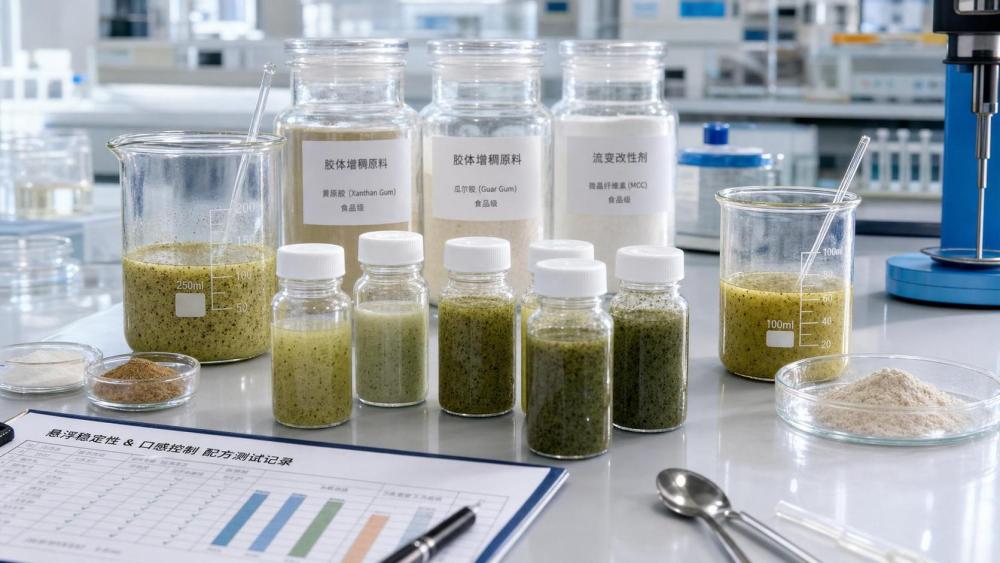
Many nutraceutical products contain insoluble powders, botanical extracts, proteins, vitamins, minerals, sweeteners, and flavor systems in one formula. Without controlled flow behavior, those components separate, settle, clump, or create uneven dosing.
Rheology modifiers for nutraceuticals help manage how a product pours, pumps, rests, coats, and recovers. In a liquid shot, that may mean keeping plant particles suspended. In a gummy slurry, it may mean controlling deposit accuracy before setting.
The same modifier can improve one parameter while hurting another. A system that holds solids well may feel slimy in the mouth. Another may support a clean texture but lose viscosity under heat or low pH.
Understanding what a modifier is actually doing
A useful starting point is to stop thinking only in terms of thickening. Rheology modifiers for nutraceuticals are selected to build a flow profile, not just a viscosity number.
Some systems create high low-shear viscosity, which slows sedimentation during storage. Some are shear-thinning, which means they thin during mixing or pouring and rebuild afterward. Others add gel structure or improve cling.
That distinction matters in daily operation. A product may need to remain still on the shelf, then flow easily through nozzles, and finally feel smooth when consumed. One modifier rarely solves every requirement alone.
Common functional targets
- Reduce particle settling in suspensions and ready-to-drink formats.
- Support texture in syrups, emulsions, gels, chews, and liquid sachets.
- Improve process control during blending, pumping, filling, and heat treatment.
- Protect sensory quality by avoiding grittiness, syneresis, or phase separation.
- Maintain consistency across shelf life, including temperature shifts.
What the market is paying attention to now
Current interest in rheology modifiers for nutraceuticals is driven by three connected pressures. The first is clean label. The second is more complex active systems. The third is the need for global compliance with stable sensory performance.
Natural hydrocolloids remain attractive because consumers increasingly associate familiar ingredients with safety and trust. Xanthan gum, pectin, guar gum, gellan gum, and cellulose derivatives each fit different formulation needs.
At the same time, fortified products are becoming more difficult to stabilize. Protein, collagen, fibers, probiotics, minerals, and botanical extracts all influence ionic balance, pH, turbidity, and hydration behavior.
This is where FFAI’s broader ingredient intelligence becomes relevant. Rheology cannot be separated from preservative strategy, flavor release, antioxidant protection, or the economics of premium positioning in the FMCG and health sectors.
Choosing by formula type, not by habit
A practical selection process starts with the finished format. Different delivery forms place different stress on the rheology system, even when the active blend looks similar on paper.
This format-first approach prevents a common mistake: choosing one of the familiar rheology modifiers for nutraceuticals simply because it worked in a different product family.
Key decision points during selection
The most reliable decisions come from matching ingredient behavior with operating conditions. Small formulation details often determine whether a modifier performs consistently or fails late in development.
pH, ions, and active load
Acidic nutraceutical drinks behave very differently from neutral protein systems. Calcium, magnesium, and electrolytes can weaken or strengthen certain hydrocolloids, sometimes unpredictably.
Thermal and mechanical stress
Pasteurization, hot fill, high shear mixing, and recirculation all change structure. A modifier that looks ideal in a bench beaker may break down during full-scale production.
Hydration behavior
Some gums hydrate quickly and create fish-eyes if added poorly. Others need controlled dispersion systems. Process order can be as important as ingredient choice.
Sensory fit
Texture must support the brand promise. A wellness shot may need a light, fast finish. A meal-support beverage may benefit from more body. Rheology should reinforce the intended experience.
Label and regional acceptance
GRAS status, regional permissions, declaration names, and consumer familiarity all shape final selection. This is especially important for exports and multi-market launches.
How stable systems are usually built in practice
In real production, stable rheology often comes from combinations rather than single ingredients. One component may create suspension stability, while another adjusts mouthfeel or process flow.
For example, rheology modifiers for nutraceuticals are frequently paired with sweetener systems, proteins, preservatives, flavors, and acidulants. Each addition shifts water binding, perceived thickness, and physical stability.
This is where a broader formulation view matters. FFAI’s coverage of thickeners, preservatives, and sensory ingredients reflects a useful industry reality: formula success depends on how systems interact, not how ingredients perform alone.
- Start with the target texture and shelf-life condition, not just a raw material list.
- Screen under real pH, mineral load, and thermal treatment.
- Measure both immediate viscosity and time-based stability.
- Check sensory performance after storage, not only on day one.
- Confirm that filling, pumping, and cleaning remain manageable.
A practical way to narrow the options
When several rheology modifiers for nutraceuticals look promising, a short decision framework helps reduce trial-and-error. It also keeps development aligned with operational reality.
First, define the failure mode that matters most. It may be settling, poor pour, unstable filling, weak suspension, or unacceptable mouthfeel. That priority changes the screening logic.
Next, compare candidates under actual stress conditions. Bench viscosity alone is not enough. Evaluate cold storage, heat exposure, transport shock, and reopening behavior where relevant.
Then review formulation fit beyond performance. Cost-in-use, supply reliability, hydration method, and declaration impact often decide the final choice between technically similar systems.
A well-chosen modifier should make the product easier to run and easier to trust. If it only looks good in a lab sample, it is not yet the right answer.
Where to focus next
Choosing rheology modifiers for nutraceuticals is ultimately about building a stable relationship between actives, process, texture, and shelf life. The strongest decisions come from seeing rheology as part of a full ingredient system.
The next step is usually straightforward: map the product format, define the most critical stability risk, and test a short list of modifiers under realistic manufacturing and storage conditions.
From there, it becomes easier to compare clean-label fit, sensory impact, and compliance requirements with confidence. That kind of structured evaluation is where stable formulas move from acceptable to repeatable.
Related News
- How to assess a bio-based thickener manufacturer's batch consistencyOct 16, 2026Food Rheology Expert
- Verifying halal status of hydrocolloid ingredients in the Middle EastOct 15, 2026Food Rheology Expert
- How Do You Test Hydrocolloid Viscosity After Changing a Thickener?Oct 17, 2026Food Rheology Expert
- Which Natural Hydrocolloid Works Best in Acidic Cosmetic Formulas?Oct 16, 2026Food Rheology Expert
Related News
- 00
0000-00
Can biomimetic peptides in cosmetics reduce the look of wrinkles? - 00
0000-00
How to assess a bio-based thickener manufacturer's batch consistency - 00
0000-00
Verifying halal status of hydrocolloid ingredients in the Middle East - 00
0000-00
How to interpret active matter on a surfactant specification sheet - 00
0000-00
How Do You Test Hydrocolloid Viscosity After Changing a Thickener?
Food Rheology Expert
Weekly Insights
Stay ahead with our curated technology reports delivered every Monday.