





On June 26, 2026, the European Commission issued a draft amendment to Regulation (EU) No 1333/2008 that adds a new compliance focus for approved natural food colors used in blended ingredients. Beyond purity requirements for the color itself, the draft points to stricter documentation for thickening agents such as xanthan and alginate when they are used in compounded systems. For exporters supplying natural color plus water-soluble hydrocolloid blends into the EU, especially Chinese suppliers, this matters because the compliance path and certification timeline may become more document-intensive.
What the Draft Specifically Requires
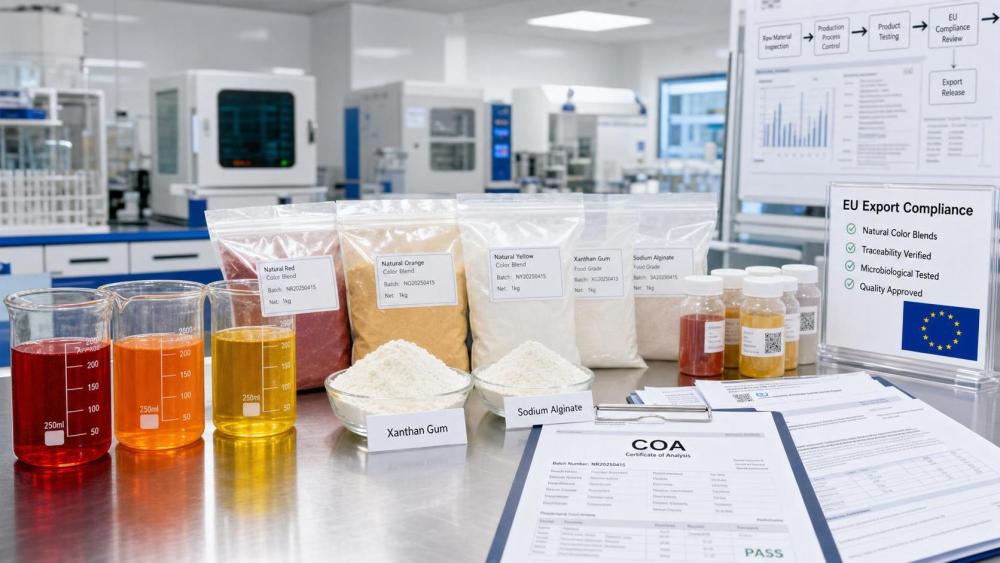
According to the information provided, the draft amendment released by the EC on June 26, 2026 requires that all approved natural food colors must continue to meet purity standards. In addition, when these colors are compounded with thickening agents such as xanthan gum or alginates, the supporting materials must include a complete traceable declaration of plant origin and a microbial load testing report for those hydrocolloids.
The draft is described as directly affecting the compliance route and certification cycle for Chinese exporters supplying composite ingredients that combine natural food colors with water-soluble gums for the EU market.
Where the Pressure May Appear First in the Supply Chain
Exporters shipping compounded color systems
From an industry perspective, exporters of blended natural color ingredients are likely to feel the most immediate impact because the draft targets not only the color component but also the thickening agents used in the formulation. The main pressure point may be documentation readiness, especially where one shipment depends on multiple upstream material declarations and test records.
Procurement teams managing hydrocolloid inputs
Procurement functions may be affected because xanthan and alginate can no longer be treated as routine formulation aids from a paperwork standpoint. What deserves closer attention is whether suppliers can provide traceable plant-origin statements and microbial testing records in a form that supports downstream EU compliance reviews.
Manufacturers producing export-ready formulations
Processing and manufacturing businesses may need to pay closer attention to formula design, batch documentation, and technical files for blended ingredients intended for the EU. The impact is likely to be concentrated in specification management, release documentation, and coordination between formulation, quality, and regulatory teams.
Compliance and certification service providers
Service providers involved in testing, dossier preparation, and export compliance may also see changes in workflow. Analysis shows that where a product combines natural colorants with water-soluble hydrocolloids, supporting files may need to be assembled more carefully and reviewed against the draft's documentation expectations.
What Companies Should Watch Now
Track the draft language and any subsequent clarification
Analysis shows that the immediate issue is not only the existence of the draft, but how its wording may be interpreted in later official communication. Companies involved in EU-bound blended color ingredients should watch for any clarification on documentation scope, acceptable forms of traceability, and how microbial reports are expected to support compliance review.
Review hydrocolloid-backed product lines first
What deserves closer attention is the subset of products where natural colors are already sold together with xanthan, alginate, or similar water-soluble gums. These products may require the fastest internal review because the draft directly links compliance risk to the compounded portion of the formulation, not only to the color itself.
Check supplier files before customer requests escalate
Observably, one practical issue for exporters is timing. If downstream EU customers begin asking for plant-origin traceability statements and microbial load reports before internal files are complete, order handling and certification progress may slow. This makes supplier qualification documents, testing records, and file consistency a near-term operational priority.
Prepare for longer communication and approval cycles
It is more appropriate to understand this as a documentation and verification issue rather than only a formula issue. For sales, regulatory, and customer service teams, that means preparing for more back-and-forth on supporting documents, technical questionnaires, and approval lead times for EU-bound shipments.
Why This Looks Like a Regulatory Signal, Not Yet a Final Outcome
Analysis shows that this development should currently be read as an important regulatory signal rather than a final settled result. The draft clearly indicates that the EC is looking beyond the purity of natural food colors alone and paying closer attention to the compliance status of accompanying hydrocolloids in compounded ingredients. At the same time, because the information provided refers to a draft amendment, the market still needs to watch how the rule progresses and whether any details are refined.
From an industry perspective, the broader message is that blended ingredient compliance may be assessed more holistically. That is particularly relevant for suppliers whose EU business depends on formulations where the color system and carrier or thickening system are marketed together.
How the Market May Best Read This Stage
At this stage, the news is most usefully understood as an early but concrete compliance development for natural food color blends entering the EU. It does not by itself confirm the final regulatory outcome, but it does indicate that traceability and microbial verification for xanthan, alginate, and similar hydrocolloids are becoming more central in market access discussions. For affected exporters and supply chain participants, the rational response is to treat this as a live compliance issue that still requires continued monitoring.
Basis of This Article and What Still Needs Verification
This article is based on the user-provided news title, event date, and event summary concerning the EC draft amendment issued on June 26, 2026. For this type of development, commonly relevant source categories may include official regulatory notices, company disclosures, industry association updates, authoritative media coverage, and standards-related documents.
No specific official source link was provided in the input, so the precise text of the draft and any later updates still need to be continuously verified. Follow-up attention should focus on later official wording, interpretive clarification, and any changes that affect documentation expectations, certification timing, or export compliance procedures for compounded natural color ingredients.
Related News
- How cassava costs shape Thailand xanthan gum market pricesSep 29, 2026Food Rheology Expert
- Can Thailand's xanthan gum market support stable export supply?Sep 28, 2026Food Rheology Expert
- How food hydrocolloids prevent ice crystals in frozen dessertsSep 14, 2026Food Rheology Expert
- Which food texture modifiers for sauces prevent thinning after reheating?Sep 13, 2026Food Rheology Expert
Related News
- 00
0000-00
What drives fragrance ingredients price changes in bulk orders? - 00
0000-00
How to assess a food antioxidants distributor’s traceability practices - 00
0000-00
How minimum order quantities shape private label ingredient sourcing costs - 00
0000-00
What drives personal care ingredient price volatility in sourcing - 00
0000-00
What drives micelles price differences in cosmetic formulations?
Food Rheology Expert
Weekly Insights
Stay ahead with our curated technology reports delivered every Monday.