





On June 28, 2026, the European Commission released a new import compliance guideline for Xanthan/Alginate Hydrocolloids that changes what must accompany shipments entering the EU. From October 1, 2026, imported batches will need a full toxicological dossier rather than the simplified filing route used under the 2023 version. For exporters, buyers, laboratories, and supply chain teams working with food hydrocolloids, this matters because the change reaches beyond paperwork and may affect customs handling, document readiness, supplier coordination, and compliance costs.
What the New Guideline Confirms
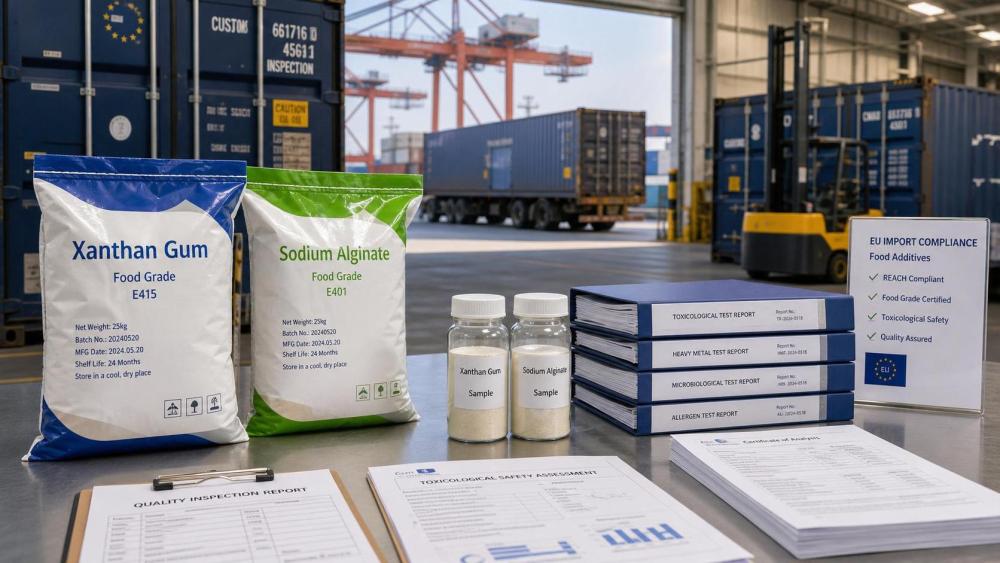
The confirmed facts are limited but commercially significant. The European Commission issued the document titled Import Compliance Implementation Guidance for Xanthan/Alginate Hydrocolloids on June 28, 2026. The guidance states that, starting October 1, 2026, every imported batch must be accompanied by a full-component toxicological dossier. The dossier must include microbial metabolic pathways, residual solvent profiles, and allergenicity cross-validation reports. The new document replaces the simplified filing process set out in the 2023 version. The change directly affects customs clearance efficiency and compliance costs for global exporters of food hydrocolloids shipping to the EU.
Where the Pressure Is Likely to Appear First
Export documentation moves from supporting file to shipment prerequisite
From an industry perspective, exporters are likely to feel the first impact because the rule is tied to each import batch. That shifts toxicological materials from a background compliance file to a shipment-linked requirement. What deserves closer attention is whether current export documentation sets are organized in a way that can reliably travel with each batch without creating delays at dispatch or import entry.
Procurement teams may need deeper supplier-side technical visibility
Analysis shows that procurement functions dealing with Xanthan/Alginate Hydrocolloids may need to look beyond price and availability. If full-component toxicological dossiers are now mandatory for import, supplier qualification may increasingly depend on whether upstream partners can provide consistent data on microbial metabolic pathways, residual solvent profiles, and allergenicity cross-validation. The practical issue is less about headline compliance and more about document completeness before orders are locked in.
Manufacturing and quality teams may face tighter record alignment
Observably, manufacturers and quality teams involved in export-facing production could be affected where internal batch records, testing outputs, and technical files are not aligned to dossier-based review. The rule change does not itself describe operational outcomes beyond compliance requirements, but it signals that document consistency across production, quality, and release functions may become more important in supporting shipment readiness.
Testing and compliance service providers may see expanded review scope
For laboratories and compliance support providers, the stated dossier elements point to a broader technical review burden than a simplified filing process would require. Analysis shows that service demand may shift toward report preparation, cross-checking, and document coordination tied to batch-level import support. That remains an observation rather than a confirmed market outcome, but it is a logical area for industry attention.
What Companies Should Track Before October
Check whether current files meet the new dossier structure
Companies shipping into the EU should review whether their present technical files actually cover the newly stated dossier elements. The key issue is not only whether data exists, but whether it is assembled in a form that can support batch-by-batch import compliance after October 1, 2026.
Review supplier qualification against documentation reliability
What deserves closer attention is the reliability of upstream documentation. Where suppliers can provide product materials but not stable supporting toxicological records, buyers and exporters may face avoidable friction in procurement planning, customs preparation, or delivery scheduling. At this stage, the input does not provide a detailed enforcement method, so the prudent focus is on document readiness rather than assumptions about exact clearance outcomes.
Revisit delivery planning and contract documentation
Analysis shows that companies may need to revisit shipping timelines, document submission sequences, and technical attachments in contracts or order documents. Because the simplified 2023 route is being replaced, businesses should pay attention to whether existing document checklists and handoff routines still match the new compliance expectation.
Watch for further clarification in execution language
It is more appropriate to understand this as a rule change with immediate operational relevance, while still recognizing that execution language may continue to matter. Companies should therefore monitor follow-up official wording, importer-facing compliance interpretation, and any downstream changes in customer technical requests or tender documentation where applicable.
Why This Looks More Like an Execution Signal Than a Distant Policy Theme
Observation and analysis suggest that this update is better read as an execution-level compliance signal rather than a general policy discussion. The reason is straightforward: the guidance sets a clear future date, defines required dossier content, and replaces an earlier simplified pathway. At the same time, it would be premature to treat all market consequences as settled facts, because the input does not provide detailed enforcement practice, review timelines, or field-level interpretation. Continued attention is therefore warranted on how the requirement is applied in real transactions and documentation workflows.
How the Market May Need to Read This Update
In practical terms, this development indicates a higher documentary threshold for Xanthan/Alginate Hydrocolloids entering the EU. The confirmed change is already clear enough for exporters, buyers, and compliance teams to begin internal review. Analysis shows that the most reasonable reading today is that this is a concrete compliance tightening with near-term effects on preparation, coordination, and shipment support, while some aspects of implementation still need to be watched through actual market practice.
Basis of This Article
This article is based on the user-provided news title, event date, and event summary relating to the European Commission's June 28, 2026 guidance on Xanthan/Alginate Hydrocolloids import compliance. For events of this type, commonly relevant source categories may include official announcements, regulatory publications, customs or trade authority notices, industry association updates, standards-related documents, and reporting from established trade media. A specific official source link was not provided in the input, so the underlying document path still requires continued verification. What should continue to be monitored includes detailed implementation wording, certification and compliance interpretation, changes in tender or technical document requirements, industry feedback, and how companies execute against the new dossier requirement in practice.
Related News
- How cassava costs shape Thailand xanthan gum market pricesSep 29, 2026Food Rheology Expert
- Can Thailand's xanthan gum market support stable export supply?Sep 28, 2026Food Rheology Expert
- How food hydrocolloids prevent ice crystals in frozen dessertsSep 14, 2026Food Rheology Expert
- Which food texture modifiers for sauces prevent thinning after reheating?Sep 13, 2026Food Rheology Expert
Related News
- 00
0000-00
What drives fragrance ingredients price changes in bulk orders? - 00
0000-00
How to assess a food antioxidants distributor’s traceability practices - 00
0000-00
How minimum order quantities shape private label ingredient sourcing costs - 00
0000-00
What drives personal care ingredient price volatility in sourcing - 00
0000-00
What drives micelles price differences in cosmetic formulations?
Food Rheology Expert
Weekly Insights
Stay ahead with our curated technology reports delivered every Monday.