





On June 18, 2026, the European Food Safety Authority (EFSA) announced that the transition period for the safety re-evaluation of Xanthan Gum will be extended to the first quarter of 2027. During this period, already authorized Chinese producers may continue exporting within the scope of their current approvals. For exporters of Xanthan and Alginate hydrocolloids, this is worth close attention because it affects short-term shipment continuity while also shifting compliance focus toward the documentation and toxicology preparation needed before the final review stage.
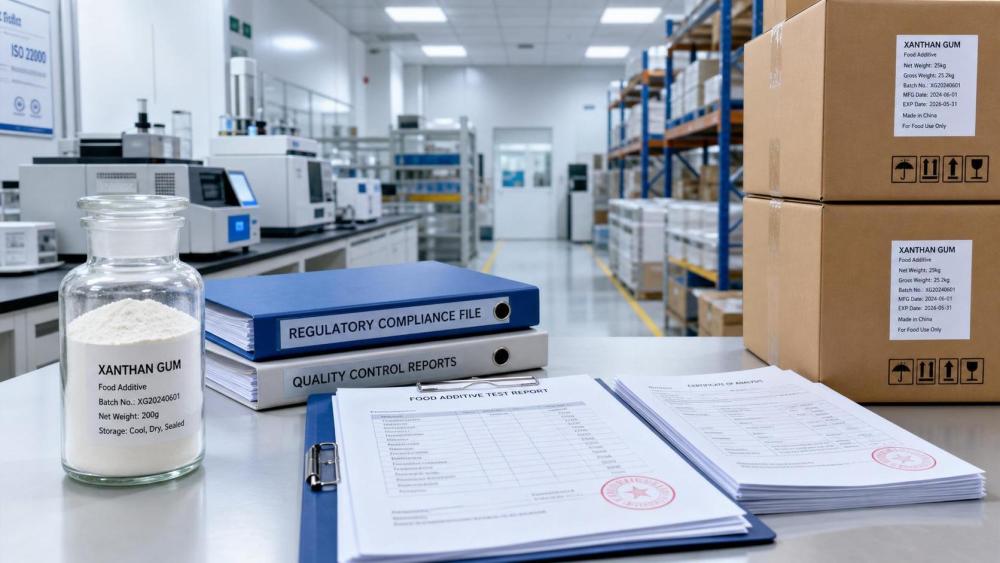
What the June 18 announcement clearly changes
The confirmed change is the extension of the Xanthan Gum safety re-evaluation transition period to Q1 2027.
EFSA stated this on June 18, 2026, and the practical effect described in the event summary is that Chinese producers that have already been authorized may continue to export under the range covered by their existing permissions during the extended transition period.
The same event summary also makes clear that export quotas are not currently restricted under this change, while companies are expected to prepare new toxicology data packages for the final review in Q1 2027.
Where the pressure shifts across the business chain
For current exporters, near-term shipping remains more stable
From an industry perspective, the most direct impact falls on companies already exporting authorized Xanthan-related products. The extension reduces immediate registration anxiety in the short term because current export activity can continue within the existing authorization scope. What deserves closer attention is not only shipment continuity, but also whether internal compliance files, product scope descriptions, and customer-facing technical documentation remain aligned with the current approval boundaries.
For buyers and procurement teams, supplier continuity matters more than new assumptions
Procurement teams using Xanthan or Alginate hydrocolloids may read this as a signal of reduced short-term disruption risk, especially where approved Chinese suppliers are already part of active supply arrangements. Analysis shows that buyers should pay attention to whether suppliers can demonstrate ongoing authorization status under the current permission scope and whether future documentation requests may affect qualification reviews, specification checks, or order scheduling ahead of the Q1 2027 final review point.
For compliance and documentation functions, the workload is delayed rather than removed
For regulatory, certification, and technical documentation teams, the extension does not remove the underlying review requirement. It is more appropriate to understand this as additional preparation time. The event summary specifically points to the need for new toxicology data packages, which means the operational focus may shift toward dossier readiness, internal evidence organization, and coordination between export, quality, and technical teams before the final assessment stage.
What companies should track from now to Q1 2027
Keep the authorization scope under close review
Analysis shows that companies should avoid treating the transition extension as a blanket expansion of business conditions. The confirmed fact is limited to continued exports by already authorized Chinese producers within the current approval scope. In practice, businesses should monitor whether contracts, product descriptions, and shipment documents remain consistent with that boundary.
Prepare toxicology materials early
What deserves closer attention is the requirement to prepare new toxicology data packages for the final review in Q1 2027. The input does not provide execution details, so this should not be treated as a finalized checklist. Still, companies involved in export, regulatory affairs, and technical support should be alert to upcoming document, testing, and dossier expectations.
Watch for changes in customer-side documentation requests
Observably, even when export quotas are not currently limited, downstream customers may tighten their document review approach as the final review window approaches. That may affect technical file requests, supplier qualification updates, or additional compliance confirmations tied to purchasing and delivery decisions.
Link compliance planning with delivery planning
From an industry perspective, this development is not only a regulatory matter. It may also affect procurement timing, production scheduling, and delivery commitments if companies wait too long to organize materials for the final review phase. The extension offers time, but it also creates a clearer countdown to Q1 2027.
Why this looks more like an execution signal than a final resolution
Analysis shows that this development is best understood as a transitional regulatory signal rather than a closed policy outcome. The immediate pressure on approved exporters appears to ease because current exports can continue within existing permissions, but the requirement to prepare new toxicology data means the underlying review process remains active.
Observably, the market should not read the absence of current export quota restrictions as the end of compliance risk. It is more appropriate to understand this as a period in which execution details, review expectations, and market responses still need continued observation.
How to read the current stage of this change
At this stage, the industry can read the EFSA announcement as a limited but practical extension of operating certainty for already authorized exporters, rather than as a permanent easing of review requirements. The short-term benefit lies in continuity under existing permissions; the medium-term issue remains readiness for the Q1 2027 final review. A rational reading is that the rule dynamic has not ended, and companies should balance ongoing trade execution with compliance preparation.
Basis of this article and points still requiring verification
This article is generated from the user-provided news title, event date, and event summary. For developments of this kind, relevant source categories typically include official notices, regulatory authority releases, customs or trade-administration information, industry association updates, standard-setting documents, and reporting by authoritative media.
A specific official source link was not provided in the input, so the exact official publication path still requires follow-up verification. Observably, the next items worth tracking include any further policy detail, review-related compliance interpretation, changes in buyer or tender documentation requirements, industry feedback, and how companies implement preparation for the Q1 2027 final review.
Related News
- How cassava costs shape Thailand xanthan gum market pricesSep 29, 2026Food Rheology Expert
- Can Thailand's xanthan gum market support stable export supply?Sep 28, 2026Food Rheology Expert
- How food hydrocolloids prevent ice crystals in frozen dessertsSep 14, 2026Food Rheology Expert
- Which food texture modifiers for sauces prevent thinning after reheating?Sep 13, 2026Food Rheology Expert
Related News
- 00
0000-00
How to interpret active matter on a surfactant specification sheet - 00
0000-00
What Quality Checks Should You Run on Fragrance Ingredient Suppliers? - 00
0000-00
How to assess a flavor chemistry manufacturer's batch consistency - 00
0000-00
What drives fragrance ingredients price changes in bulk orders? - 00
0000-00
How to assess a food antioxidants distributor’s traceability practices
Food Rheology Expert
Weekly Insights
Stay ahead with our curated technology reports delivered every Monday.