





On June 27, 2026, the European Commission issued Regulation (EU) 2026/1389, setting a new compliance threshold for imported food-grade xanthan and alginate hydrocolloids. From July 1, 2026, suppliers must submit full-component toxicological dossiers aligned with the latest EFSA guidance. For exporters, importers, and compliance teams handling these hydrocolloids, the development is worth close attention because it directly affects customs clearance efficiency and compliance cost, especially for Chinese suppliers serving the EU market.
What the new filing requirement covers
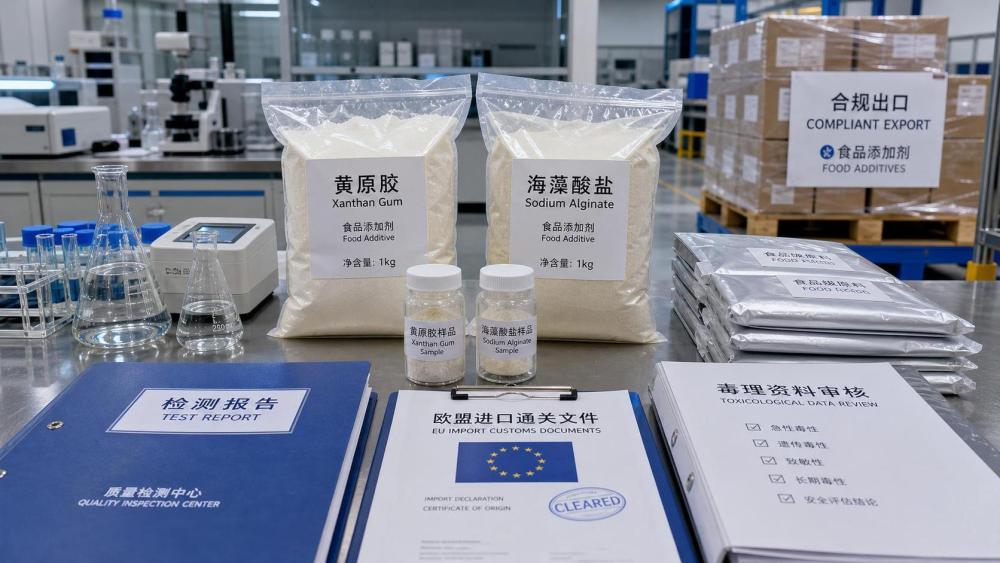
According to the information provided, the new EU requirement applies to all imported food-grade Xanthan/Alginate Hydrocolloids. The required dossier must follow the latest EFSA guidance and include full-component toxicological assessment materials.
The listed dossier elements include production strain gene sequences, residual solvent profiles, and metal ion migration test reports. The regulation was issued by the European Commission on June 27, 2026, under Regulation (EU) 2026/1389, and becomes mandatory from July 1, 2026.
The information provided also states that the requirement directly affects customs clearance efficiency and compliance costs for Chinese exporting companies.
Where the pressure is likely to appear first
Export-facing suppliers may face document readiness pressure
From an industry perspective, suppliers exporting xanthan gum and alginate thickeners to the EU are the first group likely to feel the impact. The immediate issue is whether supporting toxicology and technical documentation can match the new filing standard. The operational effect is likely to appear in shipment preparation, customs documentation, and coordination with EU-side buyers.
Procurement teams may need to reassess supplier eligibility
For raw material procurement companies and purchasing teams, the change matters because product availability is no longer only a commercial question. It also becomes a documentation question. What deserves closer attention is whether existing suppliers can provide the required strain, solvent, and migration data in a form that supports import procedures under the new rule.
Manufacturing users may see impact through supply continuity
Food manufacturers using these hydrocolloids may be affected indirectly through delivery timing and sourcing stability. Analysis shows that if upstream documentation is incomplete or delayed, the impact may appear in inbound material scheduling, inventory planning, and supplier communication rather than in formulation work itself.
Supply chain service providers may face higher coordination demands
Customs agents, trade service firms, and other supply chain support providers are also likely to be affected because the rule increases the amount and specificity of compliance documentation tied to import clearance. In practice, the key change is less about freight movement itself and more about document review, pre-shipment checks, and communication across exporter, importer, and service provider.
What companies should watch now
Separate legal text from execution readiness
Analysis shows that the rule is already defined at the regulatory level, but business execution will depend on how quickly suppliers can assemble dossiers that meet the required format and content expectations. Companies should pay close attention to the difference between a regulation taking effect and a supply chain being ready to operate smoothly under it.
Focus on dossier completeness for affected product lines
For companies trading in food-grade xanthan and alginate hydrocolloids, the practical priority is the completeness of toxicological files. The required components named in the provided information, including production strain gene sequences, residual solvent profiles, and metal ion migration testing, are likely to become the main checkpoints in customer communication and shipment preparation.
Review supplier documentation and lead-time assumptions
What deserves closer attention is whether current suppliers can provide compliant materials within existing delivery cycles. Even without adding new commercial risk assumptions, the stated impact on customs clearance efficiency suggests that document preparation time and review time may need to be treated as part of order planning.
Prepare for tighter communication with EU customers
Companies serving EU buyers should closely track how customers interpret the new requirement in procurement and import workflows. In practical terms, this means aligning on what documents are needed, when they must be delivered, and how missing items could affect shipment timing or acceptance.
Why this looks like more than a short-term filing update
Observably, this development is not just a routine administrative adjustment. The requirement moves attention deeper into the technical and toxicological detail behind imported hydrocolloids, including production-strain and residue-related information. That makes it more appropriate to understand this as a compliance signal with immediate operational effects, rather than as a temporary paperwork change.
At the same time, it should not be overstated as a fully settled long-term market outcome. Based on the provided information, the confirmed result is the new filing obligation and its direct effect on clearance efficiency and cost for Chinese exporters. Broader consequences for sourcing patterns, customer selection, or competitive structure still require continued observation.
How this update is best understood at this stage
At this stage, the most balanced reading is that the EU has introduced a clearly effective compliance requirement for imported food-grade xanthan and alginate hydrocolloids, with immediate implications for documentation quality, customs handling, and cost control. For the industry, the significance lies less in headline value and more in execution detail. It is more appropriate to understand this as an active compliance development with near-term operational consequences and longer-term signaling value that still needs to be monitored.
Basis of this article and what still needs verification
This article is based on the user-provided news title, event date, and event summary concerning Regulation (EU) 2026/1389, issued on June 27, 2026, and its requirement for full-component toxicological dossiers for imported Xanthan/Alginate Hydrocolloids from July 1, 2026.
For this type of industry update, relevant source categories typically include official regulatory notices, company disclosures, industry association updates, authoritative media reporting, and standard-setting or technical guidance documents. The specific official source link was not provided in the input, so further verification remains necessary. Continued attention should focus on any subsequent official wording, implementation clarification, and documentation expectations in actual import and customer-facing workflows.
Related News
- How cassava costs shape Thailand xanthan gum market pricesSep 29, 2026Food Rheology Expert
- Can Thailand's xanthan gum market support stable export supply?Sep 28, 2026Food Rheology Expert
- How food hydrocolloids prevent ice crystals in frozen dessertsSep 14, 2026Food Rheology Expert
- Which food texture modifiers for sauces prevent thinning after reheating?Sep 13, 2026Food Rheology Expert
Related News
- 00
0000-00
What drives fragrance ingredients price changes in bulk orders? - 00
0000-00
How to assess a food antioxidants distributor’s traceability practices - 00
0000-00
How minimum order quantities shape private label ingredient sourcing costs - 00
0000-00
What drives personal care ingredient price volatility in sourcing - 00
0000-00
What drives micelles price differences in cosmetic formulations?
Food Rheology Expert
Weekly Insights
Stay ahead with our curated technology reports delivered every Monday.