





On June 29, 2026, the European Commission moved to tighten import controls for Xanthan and Alginate hydrocolloids by introducing a new screening requirement for nano-scale metal oxide impurities. With mandatory enforcement starting on September 1, 2026, this development deserves close attention from exporters, importers, testing service providers, and supply chain teams because it adds both cost and time pressure to cross-border shipments rather than remaining a purely technical compliance update.
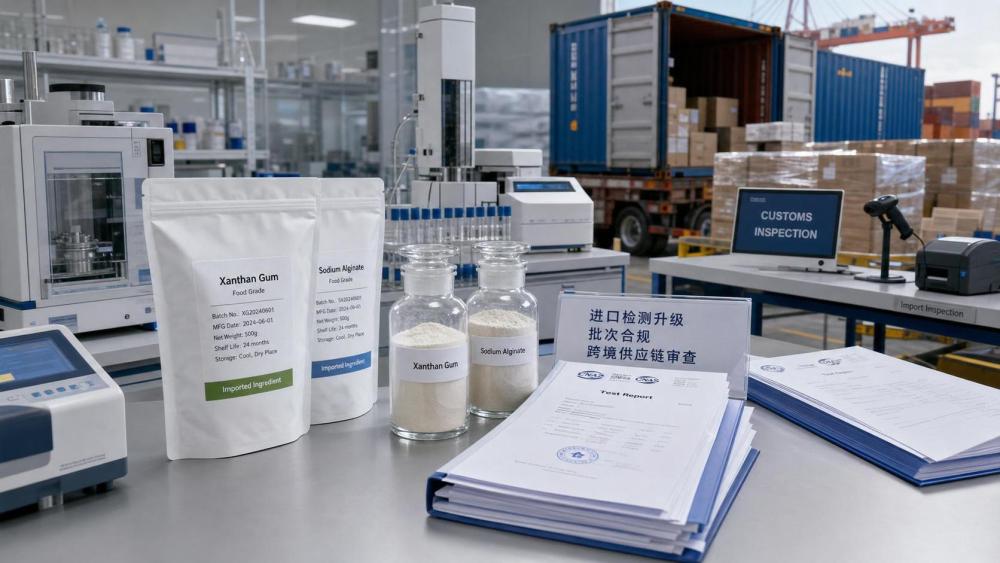
What the New EU Rule Confirms
According to the information provided, the European Commission issued Implementing Regulation (EU) 2026/1127 on June 29, 2026. From September 1, 2026, all imported Xanthan and Alginate hydrocolloids will be subject to mandatory dual-method testing for nano-scale metal oxide impurities below 100 nm.
The required detection methods are transmission electron microscopy (TEM) and single-particle ICP-MS. The same information states that the new rule is expected to increase testing costs for Chinese exporters by an average of $1,200 per batch and extend customs clearance by 2 to 3 working days.
Where the Pressure Is Likely to Appear First
Export transactions face a tighter pre-shipment threshold
From an industry perspective, direct trading companies are likely to feel the impact first because the new rule changes the compliance threshold for goods entering the EU. The main effect is likely to appear in batch release preparation, test document readiness, and shipment scheduling. What deserves closer attention is whether existing export routines are still aligned with the new inspection requirement once the September 1 enforcement date arrives.
Procurement and manufacturing teams may see timing risks
For raw material buyers and processing manufacturers, the issue is not only the added test cost but also the possible delay in delivery cycles. A customs extension of 2 to 3 working days can affect planning for purchase orders, inventory timing, and customer commitments where Xanthan and Alginate hydrocolloids are part of time-sensitive supply arrangements. Observably, the operational effect may be felt most clearly where batches are scheduled tightly around shipment windows.
Logistics and clearance services will need closer coordination
Supply chain service providers, especially those handling customs documentation and shipment sequencing, may need to pay closer attention to the new inspection path. Analysis shows that an additional testing step can shift the timing of document submission, customs communication, and delivery forecasting, even when the regulation itself is directed at imported product compliance.
What Companies Should Watch Before September
Separate the legal requirement from internal assumptions
What deserves closer attention is the exact practical meaning of mandatory dual-method testing under the new rule. Companies should distinguish between the confirmed legal requirement in the regulation summary and any internal assumptions about how quickly testing, documentation, or customs handling will adapt in practice.
Review batch planning and customer delivery commitments
Because the provided information points to an average additional cost of $1,200 per batch and a 2 to 3 working day customs delay for Chinese exporters, affected businesses should pay close attention to batch economics, shipment frequency, and delivery promises tied to EU-bound orders. This is especially relevant where contracts or routine orders depend on narrow lead-time margins.
Prepare for closer document and supplier coordination
Analysis shows that the regulation is likely to increase the importance of test records, batch traceability, and communication between exporters, suppliers, and EU-side customers. Companies involved in these products should focus on whether their current document flow and supplier coordination are sufficient for a stricter import inspection process.
Keep watching for follow-up official clarification
Observably, the rule sets a clear enforcement date, but businesses should continue to watch for any further official wording, implementation detail, or procedural clarification that could affect how the requirement is applied in day-to-day import checks.
Why This Looks Like More Than a Routine Inspection Update
Analysis shows that this development is not just a minor administrative change. The combination of a new nano-scale impurity target, two required analytical methods, higher batch-level testing cost, and longer customs clearance suggests a more compliance-intensive import environment for these hydrocolloids in the EU market.
At the same time, it is more appropriate to understand this as a confirmed regulatory change with further operational implications still worth watching, rather than as a fully settled market outcome. The rule itself is confirmed in the provided information; how evenly the burden will be distributed across exporters, buyers, and service providers still needs observation in practice.
How the Industry May Need to Read This Signal
In practical terms, this update points to a near-term compliance shift with possible longer-term implications for shipment planning, testing workflows, and customer communication around EU-bound Xanthan and Alginate hydrocolloids. The current signal should be read neither as a temporary inconvenience nor as a basis for broad market conclusions, but as a specific regulatory change that requires operational attention ahead of the September 1 start date.
Basis of This Article
This article is based on the user-provided news title, event date, and event summary concerning the June 29, 2026 publication of Implementing Regulation (EU) 2026/1127 and its September 1, 2026 enforcement timeline for imported Xanthan and Alginate hydrocolloids.
For this type of development, relevant source categories typically include official regulatory notices, company disclosures, industry association updates, authoritative media reports, and standard-setting or technical documentation. A specific official source link was not provided in the input, so that point still requires ongoing verification. Follow-up attention should remain on any additional official clarification related to testing procedures, enforcement practice, and import implementation details.
Related News
- How cassava costs shape Thailand xanthan gum market pricesSep 29, 2026Food Rheology Expert
- Can Thailand's xanthan gum market support stable export supply?Sep 28, 2026Food Rheology Expert
- How food hydrocolloids prevent ice crystals in frozen dessertsSep 14, 2026Food Rheology Expert
- Which food texture modifiers for sauces prevent thinning after reheating?Sep 13, 2026Food Rheology Expert
Related News
- 00
0000-00
How to assess color stability from a natural food colors manufacturer - 00
0000-00
When does amino acid surfactant powder improve cleanser mildness? - 00
0000-00
How to verify a cosmetic nanotechnology supplier's safety documentation - 00
0000-00
How rheological thickeners for shampoo affect suspension stability - 00
0000-00
How to assess recombinant collagen ingredients for cream stability
Food Rheology Expert
Weekly Insights
Stay ahead with our curated technology reports delivered every Monday.