





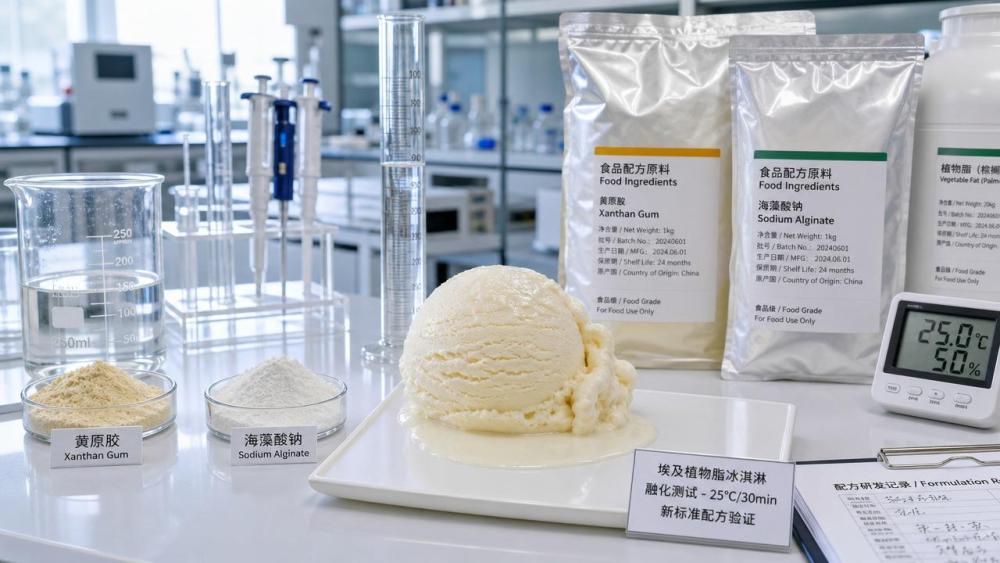
On May 11, 2026, Egypt’s standards body, EOS, released a draft standard for ice cream containing vegetable fat, a move that matters not only for product formulation but also for procurement, trade, and compliance planning. The draft formally permits natural water-soluble hydrocolloids such as gum arabic, xanthan gum, and sodium alginate in the stabilizing system for plant-based ice cream, while also introducing minimum viscosity and melt-resistance indicators, making this a rule change that ingredient suppliers, importers, manufacturers, and quality teams should monitor closely.
What the Draft Standard Clearly Introduces
According to the information provided, EOS issued the ES 2476:2026 Draft on May 11, 2026 for ice cream containing vegetable fat. The draft, for the first time, explicitly allows natural water-soluble colloids including gum arabic, xanthan gum, and sodium alginate to be used as the stabilizing system in plant-based ice cream. It also sets minimum indicators for viscosity and melt resistance. The draft is expected to take effect in Q3 2026, and the summary indicates that it is likely to increase import procurement of Xanthan/Alginate Hydrocolloids in the North African market.
Where the Rule Change May Be Felt First
Formulation and production teams face a clearer ingredient boundary
From an industry perspective, manufacturers of plant-based or vegetable-fat ice cream may be among the first to respond because the draft changes the practical compliance boundary around stabilizer systems. The direct impact is likely to appear in formulation review, specification matching, and internal quality documentation, especially where viscosity and melt-resistance targets need to be reflected in product development and batch release criteria.
Importers and raw material buyers may need to adjust sourcing priorities
Analysis shows that importers and procurement teams dealing in hydrocolloids may need to track demand shifts more closely. Because the draft explicitly recognizes xanthan gum and sodium alginate within the permitted stabilizing framework, purchasing plans, supplier alignment, and delivery scheduling may come under closer review. What deserves closer attention is whether technical documents, product specifications, and shipment paperwork can clearly support intended end use in line with the draft standard once it moves toward implementation.
Suppliers and traders may see stronger scrutiny on technical consistency
For ingredient traders and upstream suppliers, the issue is not only whether a material is saleable, but whether its technical positioning matches the product category now being defined more clearly. The likely pressure point is the handoff between sales claims, specification sheets, and downstream application requirements. Observably, where buyers begin referencing viscosity and anti-melt performance more directly, supplier communication and supporting documents may become more important in commercial discussions.
Testing and compliance-related service providers may need to watch execution language
Testing bodies and compliance service providers may also be affected if buyers or manufacturers begin asking for evidence tied more closely to the newly stated viscosity and melt-resistance indicators. At this stage, the provided information does not set out detailed test methods or enforcement practice, so the main task for service providers is to monitor how the draft is later reflected in technical review, inspection expectations, or commercial documentation.
Practical Issues Companies Should Watch Now
Check whether technical files are ready for a standards-based review
Analysis shows that companies involved in export, import, or formulation should review specification sheets, ingredient descriptions, and product technical files for consistency with the draft’s permitted hydrocolloid framework. This is particularly relevant where product dossiers or customer-facing technical documents refer to stabilizer systems in broad terms.
Follow the final wording and implementation timing closely
Because the measure is described as a draft expected to take effect in Q3 2026, businesses should avoid treating every operational implication as final. What deserves closer attention is the final wording of the standard, the effective date, and whether any implementation guidance or market-facing interpretation emerges during the transition from draft to enforcement.
Revisit procurement and lead-time assumptions for key hydrocolloids
Observably, if the draft does translate into stronger buying interest for Xanthan/Alginate Hydrocolloids in North Africa, procurement teams may need to reassess ordering cadence, supplier readiness, and delivery timing. This should be understood as a planning consideration rather than a confirmed market outcome, but it is directly relevant to businesses exposed to cross-border supply.
Prepare for more detailed buyer and tender document requests
From an industry perspective, a clearer standard often leads to more precise language in commercial exchanges. Companies should therefore watch for changes in customer specifications, tender wording, quality declarations, or product acceptance requirements tied to stabilizer selection and performance indicators, even if those downstream documents are not yet available in the information provided.
Why This Looks More Like an Execution Signal Than a Finished Rule
Analysis shows that this development is best understood as a meaningful regulatory and standards signal rather than a fully settled compliance endpoint. The significance lies in two linked changes: the explicit acceptance of named natural hydrocolloids in a plant-based ice cream stabilizing system, and the addition of minimum performance indicators. Together, these points suggest a more defined technical and commercial framework, but the market still needs to see how final wording, buyer requirements, and implementation practice develop after the draft stage.
How to Read the Development at This Stage
At this point, it is more appropriate to understand the draft as an important directional change with practical implications for formulation, sourcing, and trade preparation. It does not yet justify broad conclusions about final enforcement outcomes, but it does give companies a concrete reason to review materials, documents, and supply assumptions connected to plant-based ice cream and hydrocolloid inputs. The most balanced reading is that the rule change has moved beyond general policy discussion and into a stage where commercial and compliance teams should begin tracking execution closely.
Basis of This Article and What Still Needs Verification
This article is based on the user-provided news title, event date, and event summary. For developments of this kind, relevant source categories commonly include official notices, publications by standards organizations, regulatory releases, trade authority information, industry association materials, customs or market supervision updates, and reporting by authoritative media. No specific official source link was provided in the input, so the exact official document path still requires further verification. Observably, the areas that still need continued monitoring include the final text of the standard, implementation wording, compliance interpretation, procurement document changes, and market feedback from companies involved in supply and execution.
Related News
- How to assess a bio-based thickener manufacturer's batch consistencyOct 16, 2026Food Rheology Expert
- Verifying halal status of hydrocolloid ingredients in the Middle EastOct 15, 2026Food Rheology Expert
- How Do You Test Hydrocolloid Viscosity After Changing a Thickener?Oct 17, 2026Food Rheology Expert
- Which Natural Hydrocolloid Works Best in Acidic Cosmetic Formulas?Oct 16, 2026Food Rheology Expert
Related News
- 00
0000-00
Can biomimetic peptides in cosmetics reduce the look of wrinkles? - 00
0000-00
How to assess a bio-based thickener manufacturer's batch consistency - 00
0000-00
Verifying halal status of hydrocolloid ingredients in the Middle East - 00
0000-00
How to interpret active matter on a surfactant specification sheet - 00
0000-00
How Do You Test Hydrocolloid Viscosity After Changing a Thickener?
Food Rheology Expert
Weekly Insights
Stay ahead with our curated technology reports delivered every Monday.