





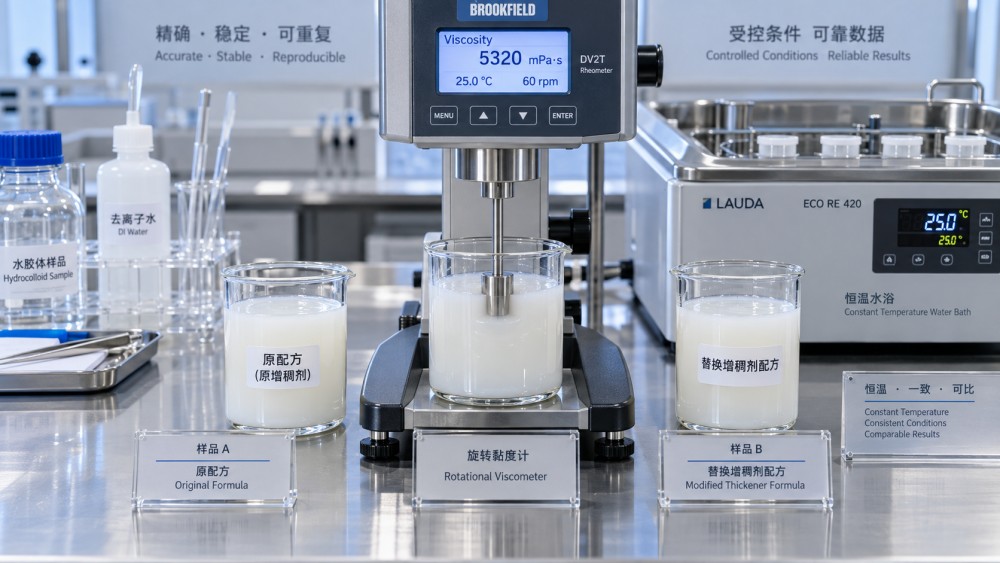
To test hydrocolloid viscosity after changing a thickener, compare the original and replacement formulations under controlled preparation and measurement conditions. Keep temperature, pH, sample age, and shear history consistent, then measure flow at conditions relevant to storage, processing, and use. A replacement can match one viscosity reading while behaving differently during pumping, pouring, or spreading.
The practical question is whether the new thickener delivers the required performance throughout the product’s life. That requires a repeatable viscosity method, a fair comparison, and a few application checks beyond the instrument reading.
Define what the replacement needs to match
Before preparing samples, identify what the original thickener does. In a dressing, it may support suspended particles while allowing easy pouring. In a cream, it may provide body in the container and spread smoothly under rubbing. A beverage may need enough structure to slow settling without becoming noticeably gummy.
Translate those functions into acceptance criteria. Use the original product’s specification and normal batch variation where available. Avoid choosing an arbitrary percentage difference: a small change can matter near a filling limit, while a larger difference may be acceptable if dispensing and sensory performance remain suitable.
Equal weight replacement is a useful starting point for a direct substitution, but it does not establish functional equivalence. Different hydrocolloids, grades, and commercial blends can require different concentrations or preparation conditions.
Prepare a comparison that separates ingredient effects from processing effects
Make a fresh reference batch with the original thickener alongside the replacement batch. An older retained sample can provide context, but comparing it alone against a freshly made product introduces differences in aging and storage history.
For an initial substitution test, keep the base formula and manufacturing sequence constant. If the replacement needs a different hydration process, run a separate trial using that process. These trials answer different questions: whether the material fits the existing process, and whether an adjusted process can deliver the required product.
Control concentration and the surrounding formula
Weigh ingredients rather than relying on volume measures. Record the thickener’s grade, lot, and supplied form, especially when comparing a pure gum with a blend containing carriers or other functional ingredients. Keep water quality, dissolved salts, sugar, proteins, surfactants, and other relevant ingredients consistent.
Measure finished-product pH. Electrolytes and acidity can affect polymer hydration, molecular interactions, and gel formation. A viscosity difference caused by a changed salt level or pH should not be attributed solely to the replacement thickener.
Make hydration an explicit part of the method
Record addition order, dispersion method, mixing time, temperature history, and the time allowed for hydration. Powder clumps can leave dry material inside a hydrated outer layer, producing inconsistent readings even when the weighed concentration is correct.
Use a dispersion approach suitable for the ingredient and formula, such as preblending with a compatible dry ingredient or wetting in an appropriate liquid phase. Some hydrocolloids require heating; others develop viscosity during cooling or depend on particular ions. Applying the same unsuitable preparation method to both materials does not create a fair functional comparison.
Check whether viscosity continues to develop with time. If it does, establish a defined measurement age that represents the intended production checkpoint or finished product. Immediate post-mixing readings and fully developed readings should be treated as separate results.
Standardize handling before measurement
Shear history includes mixing, pumping, shaking, and even vigorous transfer into a sample cup. These actions can temporarily alter structure or, in some systems, cause lasting changes. Use a defined loading procedure and rest period, and avoid testing one sample directly after mixing while the other has rested.
Minimize trapped air without changing the sample’s composition or structure. Bubbles can interfere with contact and torque readings. Keep samples covered where evaporation could concentrate them, and allow the sample itself to reach the test temperature before measuring.
Choose equipment that can answer the question
A rotational viscometer is often sufficient for routine comparisons when the method specifies spindle, speed, vessel, temperature, and reading time. It provides an apparent viscosity: the viscosity measured under those conditions. For a shear-thinning product, that value changes with the imposed flow.
A rheometer is more useful when you need a flow curve at defined shear rates, controlled recovery measurements, or information about gel-like structure. It can reveal differences that a single-speed quality-control test misses.
Use measuring geometry appropriate to the sample. Particles must fit comfortably within the measurement gap. Structured materials may slip against smooth surfaces, creating an artificially low result; a vane or textured geometry may help in suitable systems. Temperature control also matters because both liquid viscosity and hydrocolloid structure can change with temperature.
For a spindle viscometer, keep readings within the instrument’s valid torque range. Ideally, compare both samples with the same suitable setup. If one falls outside the usable range, select an appropriate alternative and document it. Readings from different spindle-and-speed combinations are not automatically equivalent for non-Newtonian materials.
Rotational speed is not universally interchangeable with shear rate. With many routine spindle arrangements, you cannot convert rpm into a meaningful shear rate without the required geometry information. Report the actual measurement conditions instead of treating rpm as a universal flow condition.
Measure a flow profile, then check recovery
Begin with the existing quality-control measurement, if one is established. This preserves continuity with historical results. Then extend the comparison to cover the behaviors that the replacement could change.
- Load consistently. Use the specified sample volume or fill level, position the measuring element correctly, and avoid bubbles.
- Equilibrate. Bring the sample to the chosen temperature and apply the defined rest period.
- Measure across relevant flow conditions. With a rheometer, use a controlled shear-rate sequence. With a routine viscometer, use a documented series of suitable speeds as an operational comparison.
- Use a defined reading rule. Specify how long each condition lasts and when the reading is taken. If viscosity keeps drifting, preserve the time-dependent information rather than selecting a convenient value.
- Check recovery where it matters. Measure under gentle conditions, apply a stronger shear interval, then return to the initial condition and track how structure recovers.
- Repeat with independent preparations. Repeated readings from one cup assess measurement consistency; separately prepared batches also reveal preparation variability.
Plot apparent viscosity against shear rate when the equipment provides valid shear-rate values. For spindle-speed testing, label the horizontal axis as rotational speed and retain the spindle details. Curves are easier to interpret than isolated numbers, particularly when they cross.
Shear thinning means viscosity decreases as shear rate increases. Time-dependent structural breakdown and rebuilding involve an additional effect: viscosity changes with the duration and history of shearing. A decrease during a speed increase alone does not establish thixotropy. An upward and downward sweep can reveal history dependence, but the result also depends on sweep timing and test conditions.
If the product behaves like a soft gel, viscosity may not describe it adequately. Oscillatory measurements can help compare elastic and viscous behavior, provided the method avoids disrupting the structure. Use these measurements when gel strength, shape retention, or spreading behavior drives the decision.
Interpret differences in terms of product performance
Consider a hypothetical sauce in which the replacement matches the reference at the routine test speed but measures lower under gentle flow. It may pour acceptably while offering less support for suspended ingredients. A storage observation is needed to determine whether that difference produces settling.
The reverse can also occur. A replacement may provide similar body at rest but remain more viscous during faster flow, increasing pumping resistance or changing dispensing. Raising or lowering concentration to match a single reading may improve one behavior while moving another further from the target.
Texture deserves a separate comparison. Two formulations can have similar apparent viscosity but differ in stringiness, slipperiness, gumminess, or spreadability. Examine the product in its intended application rather than assuming the instrument predicts every sensory attribute.
For products relying on a yield stress to support particles, low-shear viscosity alone is insufficient evidence of suspension performance. Yield behavior depends on the measurement method, and particle properties also matter. Combine suitable rheological measurements with direct settling checks.
Test after processing and during storage
Repeat the comparison after the treatment the product will actually experience, such as heating, cooling, homogenization, pumping, or filling. Keep the elapsed time between treatment and measurement consistent. A material that performs well before processing may respond differently afterward.
Measure at relevant temperatures rather than assuming a room-temperature result represents refrigerated use or warm filling. For systems that form structure during cooling, control the cooling history as well as the final temperature.
During storage, use realistic conditions and defined sampling points. Record viscosity alongside visible separation, sediment, water release, and texture changes. Stress tests such as temperature cycling are useful when they address a likely exposure, but they do not automatically predict normal shelf life.
For emulsions, matched viscosity does not establish matched emulsion stability. Changes in droplet interactions or the surrounding polymer network may affect separation. Likewise, a viscosity test cannot establish microbiological stability after a formulation change.
Resolve unexpected results before adjusting the dose
When results are inconsistent, check preparation and measurement first. A reading that rises over time may indicate continuing hydration or structural development. Erratic values can result from lumps, air, particles, or unsuitable geometry. An unusually low value may reflect wall slip or insufficient instrument torque.
If the measurements are repeatable but the flow profiles differ, treat that as a functional difference. Adjusting concentration may be appropriate, but retest the relevant profile and application checks after each change. A concentration adjustment rarely guarantees identical behavior across all flow conditions.
Document the accepted method with the formula version, ingredient identification, preparation sequence, hydration age, temperature, pH, instrument setup, reading timing, and results. Include the dispensing, sensory, or stability observations that justified acceptance. This gives subsequent batches a reproducible target.
Accept the replacement when it meets the product’s defined requirements across preparation, processing, use, and storage. Start with a fresh reference batch, establish a repeatable measurement method, and use the differences in the results to decide whether the next change should be concentration, hydration conditions, or the thickener itself.
Related News
- How to choose food hydrocolloids for gluten-free breadNov 03, 2026Food Rheology Expert
- How to choose food-grade hydrocolloid ingredients for stable saucesOct 30, 2026Food Rheology Expert
- How to assess a bio-based thickener manufacturer's batch consistencyOct 16, 2026Food Rheology Expert
- Verifying halal status of hydrocolloid ingredients in the Middle EastOct 15, 2026Food Rheology Expert
Related News
- 00
0000-00
Wissen Research: Global Cosmetics Market to Reach $497.2 Billion by 2031 - 00
0000-00
Can biomimetic peptides improve skin firmness? - 00
0000-00
China Records 543 New Cosmetic Ingredients, Including 167 in 2026 - 00
0000-00
How to check a fragrance raw material specification for IFRA compliance - 00
0000-00
Australia and New Zealand Weigh Wider Steviol Glycoside Use in Griddle Products
Food Rheology Expert
Weekly Insights
Stay ahead with our curated technology reports delivered every Monday.