





Ice Crystal Control Starts in the Unfrozen Phase
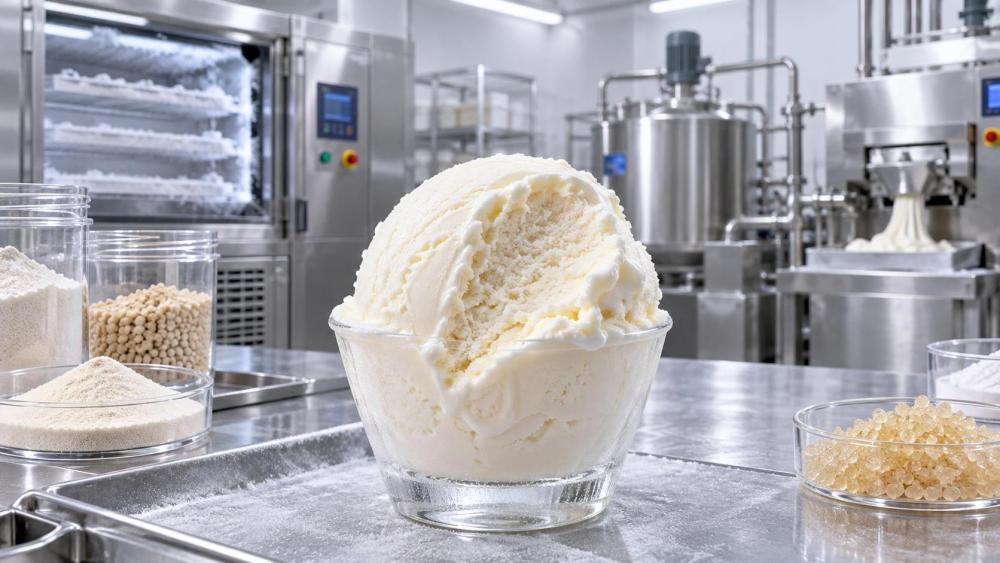
Frozen desserts become icy when small ice crystals grow into larger ones during storage, temperature cycling, or slow hardening. The familiar defect is not simply “too much water.” It is a loss of control over where water sits, how freely it moves, and how quickly the frozen structure can recover after thermal stress.
Food hydrocolloids help by modifying the unfrozen serum phase around ice crystals. At low use levels, they bind or immobilize part of the available water, raise viscosity, and slow the diffusion of water molecules from smaller crystals toward larger ones. This process, known as ice recrystallization, is the main reason a product that initially feels smooth can later become coarse or gritty.
For technical evaluators, hydrocolloids should be assessed as part of the full frozen-dessert system: sweetener profile, total solids, fat and protein structure, overrun, freezing rate, distribution temperatures, and expected shelf life. A stabilizer can reduce crystal growth, but it cannot fully compensate for poor hardening, repeated freezer abuse, or an imbalanced solids system.
Why Large Ice Crystals Form After Freezing
Freshly frozen ice cream, sorbet, and similar products contain a large population of relatively small ice crystals. The structure changes when the product experiences heat transfer during warehousing, transport, retail display, or household storage. Even modest temperature fluctuations can cause partial melting. When the temperature falls again, the released water tends to refreeze onto existing larger crystals rather than creating a new population of fine crystals.
This gives larger crystals a structural advantage. Smaller crystals gradually disappear, while larger ones continue to grow. The result is a colder, rougher bite, weaker flavor release, and less stable body during melting. In water-rich formulations such as fruit sorbets, ice pops, and low-fat frozen desserts, the effect can become visible sooner because there is less fat or protein structure available to mask textural defects.
Hydrocolloids do not generally stop ice from forming. Their value lies in limiting crystal growth after freezing and helping the matrix tolerate temperature variation. They reduce molecular mobility in the unfrozen phase, so water has less opportunity to migrate and join larger crystals.
How Different Hydrocolloids Contribute
“Stabilizer” is a useful formulation category, but it can conceal important differences. Each hydrocolloid contributes through a different balance of hydration behavior, viscosity development, interaction with proteins, and tolerance to processing conditions.
Guar Gum and Locust Bean Gum
Guar gum hydrates readily and builds viscosity efficiently. It is often useful where a formulation needs improved water control and body without a heavy gel-like texture. Its performance can be sensitive to dosage and dispersion quality; excessive use may create a pasty or overly elastic mouthfeel, especially in reduced-fat products.
Locust bean gum is widely valued in frozen desserts because of its texture and its ability to work in blends. It usually requires sufficient heat for complete hydration. When processed correctly, it can support creaminess and reduce the perception of ice crystal growth without producing the sharply thickened character associated with some high-viscosity gums.
Carboxymethyl Cellulose and Microcrystalline Cellulose
Carboxymethyl cellulose, often called CMC, can help manage serum-phase viscosity and improve resistance to heat shock. It is commonly considered when cost, processing consistency, and dry-mix handling matter. Its sensory profile must be checked in the final formula because a technically stable product can still feel less clean or less creamy if the polymer level is too high.
Microcrystalline cellulose systems are used differently. Rather than relying only on dissolved viscosity, they can create a particle network that contributes body and suspension. They are often relevant in lower-fat formats, where the formula needs help replacing some of the lubricity and structural contribution normally supplied by fat.
Carrageenan, Pectin, and Sodium Alginate
Carrageenan is usually a minor but important component in dairy-based frozen desserts. Its interaction with milk proteins can help prevent whey separation and support a more uniform mix structure. It is rarely selected solely for ice recrystallization control; its role makes more sense when dairy protein stabilization is also needed.
Pectin and alginate may be more attractive in fruit-forward, acidified, or plant-based systems, depending on the surrounding formulation and required process. Their suitability depends heavily on pH, soluble solids, calcium availability, and heating conditions. A hydrocolloid that works well in a neutral dairy mix may behave very differently in an acidic fruit base.
Xanthan Gum and Blended Systems
Xanthan gum develops viscosity at low levels and remains effective across a broad range of conditions. Used alone, however, it can produce a texture that some frozen-dessert developers find too ropy or slow to melt. It is therefore often used in carefully designed blends, where one gum provides water management while another improves body, creaminess, or protein stability.
Blending is frequently more reliable than asking one material to solve every problem. A well-matched combination can deliver lower total gum use, better process tolerance, and a more natural melt profile than a single high-dose hydrocolloid.
Viscosity Helps, but More Viscosity Is Not Automatically Better
A common formulation mistake is to treat viscosity as a direct measure of freeze-thaw protection. Higher serum-phase viscosity can reduce water mobility, but an overly viscous mix may create other defects: poor pumping, incomplete homogenization, weak flavor release, gummy body, slow melt, or a dense product that does not aerate as intended.
The target is a stable microstructure with an acceptable eating profile. Technical evaluation should therefore distinguish between mix viscosity before freezing and texture after hardening, storage, and controlled temperature cycling. A gum system that looks strong in a bench viscosity measurement may perform poorly after aging, freezing, or extended storage if it hydrates unevenly or interacts unfavorably with proteins and solids.
Meltdown is particularly informative. A frozen dessert should melt in a controlled manner, retaining a smooth, cohesive structure rather than releasing watery serum or collapsing into a rubbery mass. Hydrocolloids influence this behavior by stabilizing the unfrozen matrix, but fat network formation, emulsifier choice, overrun, and protein content also shape the result.
Processing Determines Whether the Stabilizer Can Work
Hydrocolloids need to be fully and uniformly hydrated before they can control water effectively. Poor dispersion can leave undissolved particles or localized high-viscosity zones. These defects may not be obvious immediately after mixing, yet they can lead to uneven texture and inconsistent performance across production batches.
- Dry blending: Pre-blending hydrocolloids with sugar or other dry ingredients helps reduce clumping during addition.
- Hydration temperature and time: Some gums require heat and adequate hold time, while others hydrate more readily under lower-temperature conditions.
- Order of addition: Protein, mineral, acid, and hydrocolloid addition order can affect viscosity development and stability.
- Homogenization and aging: These stages influence fat dispersion, protein hydration, and the final serum structure in which the hydrocolloid operates.
- Freezing and hardening rate: Rapid freezing creates a finer initial crystal population. Stabilizers protect that structure but do not replace effective freezing capacity.
In practical terms, a formulation should be judged under the production conditions it will actually face. A pilot process with rapid freezing and stable storage can make nearly any system look successful. The more revealing evaluation includes realistic heat-shock conditions and a final sensory review after storage.
Formula Interactions Often Explain Unexpected Results
Sweeteners lower the freezing point and alter the amount of unfrozen water. Fat contributes lubrication and can reduce the sensory impact of small crystal changes. Milk solids and proteins influence water distribution and interact with certain gums. Alcohol, fruit acids, salts, fibers, and high-intensity sweetener systems can all shift the behavior of a stabilizer blend.
This is why a hydrocolloid cannot be selected from an ingredient specification alone. A gum system optimized for full-fat dairy ice cream may not transfer directly to a low-sugar oat-based frozen dessert. In the latter, reduced soluble solids may increase perceived iciness, plant proteins may change viscosity development, and the clean-label requirement may limit the available stabilizer options.
Clean-label positioning also deserves a more precise discussion than simply replacing one ingredient with another. A familiar consumer-facing name does not guarantee equivalent technical performance. Reformulation may require adjustments to sugar solids, protein level, freezing conditions, or the stabilizer blend itself to maintain resistance to recrystallization.
A Practical Evaluation Sequence
For a technical team comparing food hydrocolloids, the first question is not which gum has the highest viscosity. It is which combination can hold the intended texture through the product’s actual processing and distribution profile.
The most defensible choice is usually the lowest effective stabilizer system that preserves fine ice crystals and a clean melt without introducing gumminess, off-texture, or avoidable process complexity. Frozen-dessert quality is established during freezing, but it is protected during every temperature change that follows. Hydrocolloids earn their place by making that protection more reliable.
Related News
- How to assess a bio-based thickener manufacturer's batch consistencyOct 16, 2026Food Rheology Expert
- Verifying halal status of hydrocolloid ingredients in the Middle EastOct 15, 2026Food Rheology Expert
- How Do You Test Hydrocolloid Viscosity After Changing a Thickener?Oct 17, 2026Food Rheology Expert
- Which Natural Hydrocolloid Works Best in Acidic Cosmetic Formulas?Oct 16, 2026Food Rheology Expert
Related News
- 00
0000-00
Can biomimetic peptides in cosmetics reduce the look of wrinkles? - 00
0000-00
How to assess a bio-based thickener manufacturer's batch consistency - 00
0000-00
Verifying halal status of hydrocolloid ingredients in the Middle East - 00
0000-00
How to interpret active matter on a surfactant specification sheet - 00
0000-00
How Do You Test Hydrocolloid Viscosity After Changing a Thickener?
Food Rheology Expert
Weekly Insights
Stay ahead with our curated technology reports delivered every Monday.