





Choosing rheology modifiers for pharmaceutical applications is rarely a simple viscosity decision. The right system must protect stability, support processing, shape dose delivery, and remain acceptable under regulatory review. In practice, that means evaluating polymer behavior, excipient compatibility, sensory performance, and manufacturing resilience together. For organizations tracking cross-sector ingredient science, including the broader thickener expertise highlighted by FFAI, this topic sits at the intersection of formulation control, safety, and product value.
Why rheology matters beyond thickening
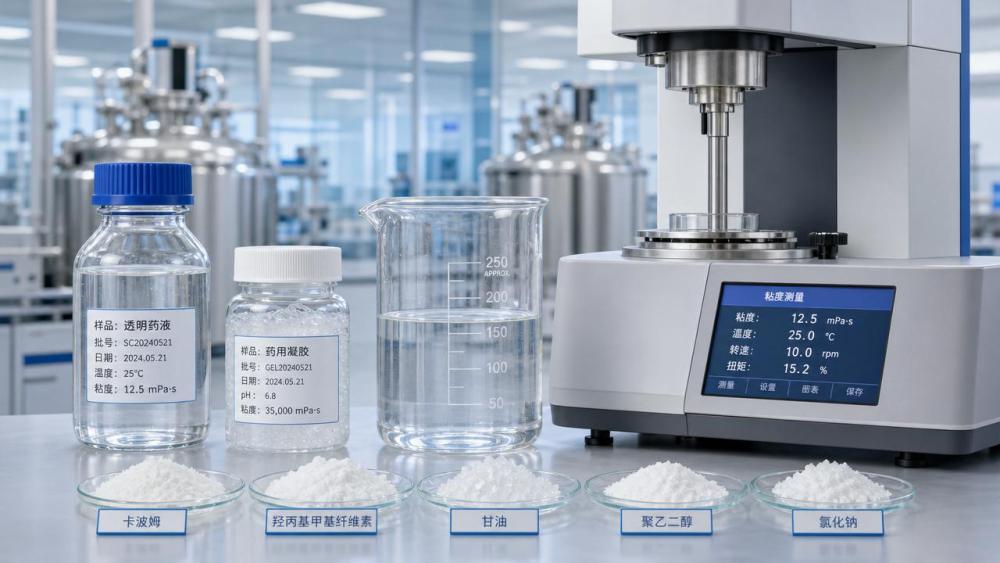
Rheology defines how a formulation moves, deforms, recovers, and stays uniform over time. In pharmaceutical systems, that behavior directly affects suspension stability, syringeability, spreadability, pourability, and dose consistency.
This is why rheology modifiers for pharmaceutical applications are selected for function, not for thickness alone. A gel, cream, suspension, ophthalmic liquid, or oral syrup can fail even when its initial viscosity looks acceptable.
A well-chosen modifier can reduce sedimentation, improve residence time, stabilize insoluble actives, and help users handle the product correctly. A poor choice can create stringiness, phase separation, poor redispersibility, or unexpected bioavailability shifts.
The selection question starts with the dosage form
The most effective way to compare rheology modifiers for pharmaceutical applications is to begin with the product architecture. Different dosage forms ask for very different flow profiles.
Common formulation targets
The key point is that “best” depends on the required flow curve, not on a generic polymer ranking. That is where many early evaluations become misleading.
Polymer chemistry changes the decision
Rheology modifiers for pharmaceutical applications often fall into familiar classes: cellulose derivatives, carbomers, natural gums, starch-based materials, alginates, xanthan gum, and synthetic associative systems.
Each class brings a different mechanism. Some swell in water. Some build viscosity through charge repulsion. Others form weak networks or interact with surfactants and cosolvents.
That mechanism matters because it predicts sensitivity. Carbomers may perform strongly but depend on neutralization and ionic environment. Cellulose ethers can offer robust processing but vary in hydration rate and thermal gelation behavior.
Natural hydrocolloids remain highly relevant. FFAI’s broader focus on thickener intelligence is useful here because lessons from food and personal care rheology often sharpen pharmaceutical screening logic, especially around shear response and mouthfeel-like sensory acceptance.
Still, pharmaceutical use requires a tighter filter. Purity profile, pharmacopeial status, bioburden control, and batch reproducibility carry more weight than they might in adjacent FMCG categories.
What should be tested early
Early screening should move past a single Brookfield number. A practical review combines rheological data, formulation compatibility, and processing behavior.
Key evaluation points
- Flow profile across relevant shear rates, including low-shear stability and high-shear handling.
- Yield stress, when suspension integrity or anti-drip behavior is important.
- Thixotropy and recovery after pumping, filling, rubbing, or injection.
- pH tolerance, electrolyte tolerance, and cosolvent compatibility.
- Interaction with preservatives, surfactants, active ingredients, and packaging surfaces.
- Stability under heat, freeze-thaw exposure, and long-term storage.
Testing should also reflect the manufacturing route. Hydration order, mixing energy, deaeration, and hold time can materially change apparent performance.
A polymer that looks ideal in lab beakers may become difficult during scale-up if dispersion is slow, fisheyes form easily, or viscosity builds too late for efficient processing.
Industry attention is shifting toward robustness and compliance
Current interest in rheology modifiers for pharmaceutical applications is shaped by more than formulation performance. Teams now pay closer attention to regulatory defensibility, supply reliability, and cleaner compositional profiles.
That trend mirrors the wider ingredient landscape observed by FFAI, where safety, purity, and function increasingly need to coexist. In pharmaceuticals, the standard is even stricter.
Several issues now receive more scrutiny:
- Excipient traceability and supplier quality systems.
- Residual solvents, microbial limits, and impurity control.
- Global acceptability across USP, EP, JP, and related standards.
- Performance consistency during reformulation or technology transfer.
- Fit with preservative reduction, patient comfort, or cleaner-label expectations in health products.
This means the conversation has moved from “Which thickener works?” to “Which excipient system stays reliable across markets, plants, and lifecycle changes?”
Practical selection logic for real projects
A useful evaluation path starts by linking product claims and handling needs to measurable rheological targets. That avoids overselecting high-viscosity materials that later create dosing or sensory problems.
A grounded comparison framework
- Define the critical quality attributes first, including delivery, stability, and user handling.
- Screen at realistic pH, salt level, solvent content, and active loading.
- Measure viscosity at more than one shear condition.
- Check recovery after stress, not only initial appearance.
- Review documentation depth, pharmacopeial fit, and long-term supply capacity.
- Estimate total cost through process efficiency, rejection risk, and reformulation burden.
This last point is often underestimated. A cheaper polymer can become expensive if hydration time is long, processing windows are narrow, or batch variability forces repeated adjustment.
By contrast, a slightly higher-cost option may reduce waste, stabilize release behavior, and simplify scale-up validation.
Where formulation teams often misjudge risk
One common mistake is selecting rheology modifiers for pharmaceutical applications only from historic platform familiarity. Legacy choices can hide new incompatibilities when actives, solvents, or preservatives change.
Another mistake is treating sensory attributes as secondary. In oral liquids and topical products, flow and feel influence adherence, dosing confidence, and perceived quality.
Scale-up risk is also frequently under-modeled. Pump shear, filling speed, and storage temperature may reshape the network structure that looked stable in a small trial.
For that reason, comparative work should include bench data, pilot observations, and supplier intelligence. Cross-industry ingredient knowledge, such as the type curated by FFAI, can help identify behavior patterns earlier, but pharmaceutical confirmation must remain application-specific.
A sensible next step for evaluation
A strong decision on rheology modifiers for pharmaceutical applications comes from narrowing the field with evidence, not preference. Start with the target flow behavior, then map polymer mechanism, compatibility limits, process demands, and regulatory fit.
When several options remain, compare them under realistic stress conditions and with full documentation review. That approach usually reveals which modifier supports a durable formulation rather than a short-lived laboratory success.
For deeper work, the most useful next move is to build a decision matrix covering dosage form, rheology profile, excipient interactions, scale-up behavior, and compliance evidence. It creates a clearer basis for screening, supplier discussion, and formulation refinement.
Related News
- How cassava costs shape Thailand xanthan gum market pricesSep 29, 2026Food Rheology Expert
- Can Thailand's xanthan gum market support stable export supply?Sep 28, 2026Food Rheology Expert
- How food hydrocolloids prevent ice crystals in frozen dessertsSep 14, 2026Food Rheology Expert
- Which food texture modifiers for sauces prevent thinning after reheating?Sep 13, 2026Food Rheology Expert
Related News
- 00
0000-00
How to assess a food antioxidants distributor’s traceability practices - 00
0000-00
How minimum order quantities shape private label ingredient sourcing costs - 00
0000-00
What drives personal care ingredient price volatility in sourcing - 00
0000-00
What drives micelles price differences in cosmetic formulations? - 00
0000-00
How to assess color stability from a natural food colors manufacturer
Food Rheology Expert
Weekly Insights
Stay ahead with our curated technology reports delivered every Monday.