





Choosing Xanthan Gum Solutions for Stable Viscosity in Food Formulations
Stable viscosity sounds simple on paper, but anyone who has worked on sauces, dairy drinks, fillings, or plant-based systems knows it rarely stays simple for long. A formulation may look perfect in the lab and then thin out after heat treatment, show fish eyes during hydration, lose suspension after a few weeks, or become unpleasantly sticky in the mouth. That is why selecting xanthan gum solutions is less about picking “a thickener” and more about matching rheology to the real stresses of the product and process.
In food systems, xanthan gum is valued because it can build viscosity at low use levels, tolerate a fairly wide pH range, and maintain structure under shear better than many alternatives. But technical evaluation should not stop at those headline advantages. The meaningful questions are narrower: What kind of flow curve do you need? Is the product filled hot or cold? Does it contain salts, sugar, proteins, acids, alcohol, or pulp? Is “clean label” a marketing preference or a non-negotiable brief? Those details decide whether a xanthan gum solution will behave as expected in production and on shelf.
Start with the product behavior you actually need
A common mistake in evaluation is to begin with supplier grade lists instead of product behavior. Viscosity is only one output. The bigger target is usually a combination of pourability, suspension, cling, mouthfeel, and stability over time.
For example, a salad dressing often needs high low-shear viscosity to keep spices suspended, but it should still pour cleanly from the bottle. A beverage with fruit particulates needs suspension without creating a heavy, syrupy drink. A bakery filling may need body during deposition, then stability through thermal processing. These are different rheological jobs, even if all of them use xanthan.
Xanthan gum is particularly useful when you want pseudoplastic flow: thick at rest, thinner under shear. That is why it shows up so often in pumped, mixed, filled, and dispensed products. If the target texture is creamy and short rather than elastic and slick, xanthan alone may not be enough. In practice, many formulators assess xanthan gum solutions as part of a hydrocolloid system rather than as a single-ingredient decision.
Grade selection is really about process compatibility
When suppliers offer different grades, the differences often relate to particle size, hydration behavior, microbiological specifications, transparency, or intended application handling. The question is not which grade is “best,” but which one fits your line.
If your plant uses high-speed powder induction, a standard grade may hydrate well enough. If your process is more limited and fish eyes are a recurring problem, dispersibility becomes much more important. In dry blends, particle size matching with sugar, salt, or starch can influence distribution before hydration. In liquid premixes, poor dispersion can create lumps that never fully recover, even with later shear.
This is where technical evaluation becomes more valuable than brochure reading. A xanthan grade that looks equivalent on a certificate may behave differently in a real tank depending on powder wetting, addition order, and available shear. Teams focused on rheological thickeners, such as those tracked by FFAI in broader formulation intelligence work, usually pay close attention to this gap between specification-sheet similarity and plant-floor behavior. It matters more than many first-pass evaluations admit.
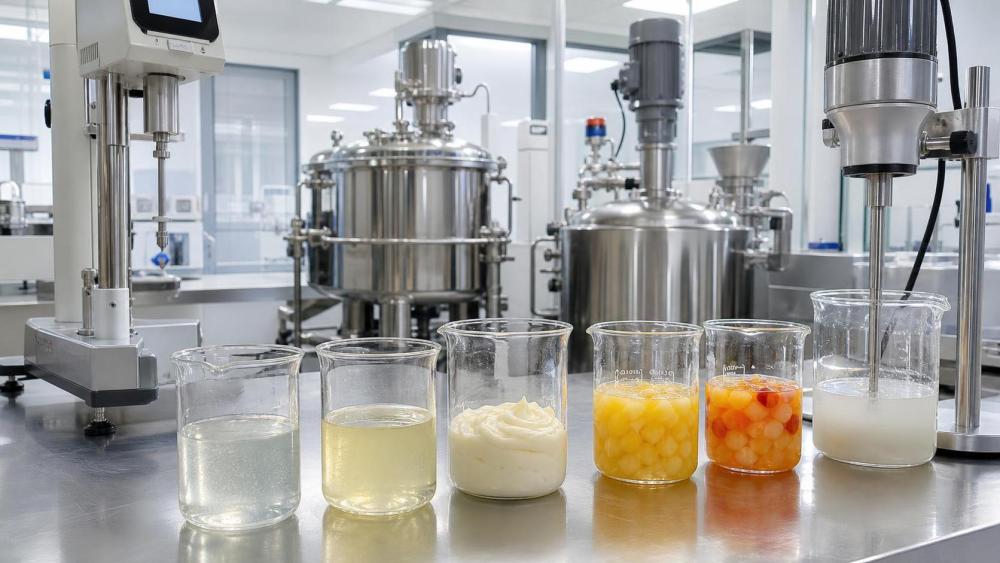
The four stress points that usually decide success
For stable viscosity, most food projects come back to four variables: pH, temperature, shear, and system composition.
pH
Xanthan is often selected because it performs reliably in acidic foods where some other hydrocolloids become less predictable. Still, “acid stable” should not be read as “problem free.” Low pH can interact with other ingredients, especially proteins, minerals, and preservatives, changing the final texture indirectly. In an acidified sauce, the xanthan itself may hold up, while the overall emulsion or suspension does not. Evaluators should test finished-system viscosity, not just a gum solution in water.
Temperature
Heat stability is another reason xanthan is widely used, but processing temperature still affects hydration rate, ingredient interactions, and long-term consistency. In hot-fill products, the immediate post-cook viscosity may differ from the set viscosity after cooling. In frozen or chilled systems, xanthan can help limit phase separation, yet the texture may become more ropy than desired if the rest of the formulation is not balanced. Temperature cycling during distribution should also be part of the assessment if the product is exported or faces variable storage conditions.
Shear
Xanthan generally handles shear better than many starch-based thickening approaches, which is why it is attractive in pumped foods. Even so, line conditions matter. A formula that survives bench-top mixing may change after homogenization, recirculation, or high-shear inline blending. If your product will be dosed, pumped over long distances, or passed repeatedly through narrow valves, the evaluation protocol should reflect that. Bench viscosity at one spindle speed is rarely enough to make a decision.
System composition
Sugar, salt, alcohol, protein, fat, insoluble particles, and other gums all shape the final result. This is where many “xanthan gum solutions” are won or lost. In a simple water system, xanthan may show one viscosity profile; in a seasoned sauce with electrolytes and oil droplets, it may show another. If locust bean gum, guar, pectin, starch, or cellulose derivatives are present, synergy or interference can shift texture significantly. There is no shortcut here: full formula screening matters.
A practical evaluation framework
For technical assessment, it helps to use a screening sequence that mirrors commercial reality rather than only lab convenience.
That final line often gets left too late. In many markets, xanthan remains acceptable within clean-label strategies, but acceptance depends on category, region, retailer posture, and consumer communication. The same ingredient can be routine in one channel and debated in another. If a product is intended for export, local labeling rules and customer standards should be confirmed early rather than after pilot validation.
Where xanthan works well, and where caution is needed
Xanthan is usually a strong candidate in sauces, dressings, dips, beverage concentrates, bakery fillings, and some dairy or dairy-alternative systems. It is particularly useful when you need suspension, cling, and stability under variable shear. It can also help reduce dependence on starch in some applications where freeze-thaw or acid tolerance is a concern.
But there are trade-offs. At the wrong level, xanthan can create a slimy or overly elastic mouthfeel. In clear beverages, visual haze may be an issue depending on the formulation goal. In delicate flavor systems, excessive body can suppress freshness or alter release perception. Given FFAI’s broader lens on molecular sensory interactions across food and fragrance categories, this is a useful reminder: texture is never isolated from flavor delivery. A rheology fix that damages aroma lift or swallow clean-up is not really a fix.
Another caution point is cost-in-use versus total formula efficiency. Xanthan is often effective at low inclusion, but the cheapest option per kilogram is not automatically the best option per batch if it creates hydration losses, rework, or texture drift. Technical teams usually get better decisions when purchasing, processing, sensory, and regulatory perspectives are all represented early.
Questions worth asking suppliers before pilot scale
A short supplier conversation can save weeks of avoidable trial work. Useful questions include whether the grade is optimized for rapid dispersion, what microbiological and physical specifications are relevant to your category, how the material behaves in acidic or high-solids systems, and whether the supplier has application guidance for your process style. If your formulation includes proteins, minerals, or multiple gums, ask directly about known compatibility issues. Good suppliers will usually discuss where their xanthan gum solutions fit and where they may not.
It is also sensible to ask for realistic handling advice rather than idealized lab instructions. Can the gum be dry blended before addition? Is a pre-slurry recommended? What shear range is typically needed for full hydration? These are mundane questions, but they often separate a smooth plant launch from an expensive troubleshooting exercise.
The better decision is usually the less dramatic one
In food formulation, the best xanthan choice is rarely the one with the most impressive standalone viscosity. It is the one that hydrates predictably, tolerates your actual pH and thermal profile, behaves under line shear, supports the intended sensory profile, and stays stable through shelf life without creating downstream headaches.
If there is one practical rule to keep in mind, it is this: evaluate xanthan gum solutions inside the finished system, under production-like conditions, with enough storage time to reveal drift. That sounds obvious, but many poor decisions come from skipping exactly that step. For technical teams making a selection call, that discipline is usually more valuable than any headline claim on the spec sheet.
Related News
- How cassava costs shape Thailand xanthan gum market pricesSep 29, 2026Food Rheology Expert
- Can Thailand's xanthan gum market support stable export supply?Sep 28, 2026Food Rheology Expert
- How food hydrocolloids prevent ice crystals in frozen dessertsSep 14, 2026Food Rheology Expert
- Which food texture modifiers for sauces prevent thinning after reheating?Sep 13, 2026Food Rheology Expert
Related News
- 00
0000-00
What drives fragrance ingredients price changes in bulk orders? - 00
0000-00
How to assess a food antioxidants distributor’s traceability practices - 00
0000-00
How minimum order quantities shape private label ingredient sourcing costs - 00
0000-00
What drives personal care ingredient price volatility in sourcing - 00
0000-00
What drives micelles price differences in cosmetic formulations?
Food Rheology Expert
Weekly Insights
Stay ahead with our curated technology reports delivered every Monday.