





Choosing food grade hydrocolloid ingredients for stable sauces requires more than matching a target viscosity. A dressing can look ideal at filling and still separate on the shelf; a pourable sauce can become gummy after refrigeration. Formulators need to understand how each ingredient behaves across pH, salt levels, processing temperatures and storage conditions, while balancing mouthfeel, labeling requirements and cost. Xanthan gum, starches, pectin and other hydrocolloids offer different routes to thickening, suspension and emulsion stabilization. The best choice is the one that performs throughout the sauce’s intended life, not just in the first laboratory sample.
Define what “stable” means for the sauce
Before comparing ingredients, identify the failure that matters most. A tomato sauce may need to keep herb particles suspended without becoming pasty. A refrigerated dressing may require resistance to oil separation as well as easy pouring. A hot-filled cooking sauce must retain its intended texture after heating, filling and cooling.
These requirements are related, but they are not interchangeable. Viscosity describes resistance to flow under specified conditions; suspension depends on the structure that holds particles in place when the product is at rest. A sauce can measure as thick and still allow spices to settle. Likewise, a hydrocolloid may slow oil droplet movement without replacing an emulsifier or compensating for inadequate homogenization.
Write a brief performance specification before screening candidates. Include the desired appearance, pour or spoon behavior, particle distribution, oil-phase stability and acceptable changes during storage. Specify whether the product will be refrigerated, shelf-stable, frozen or reheated, and identify the manufacturing steps it must survive.
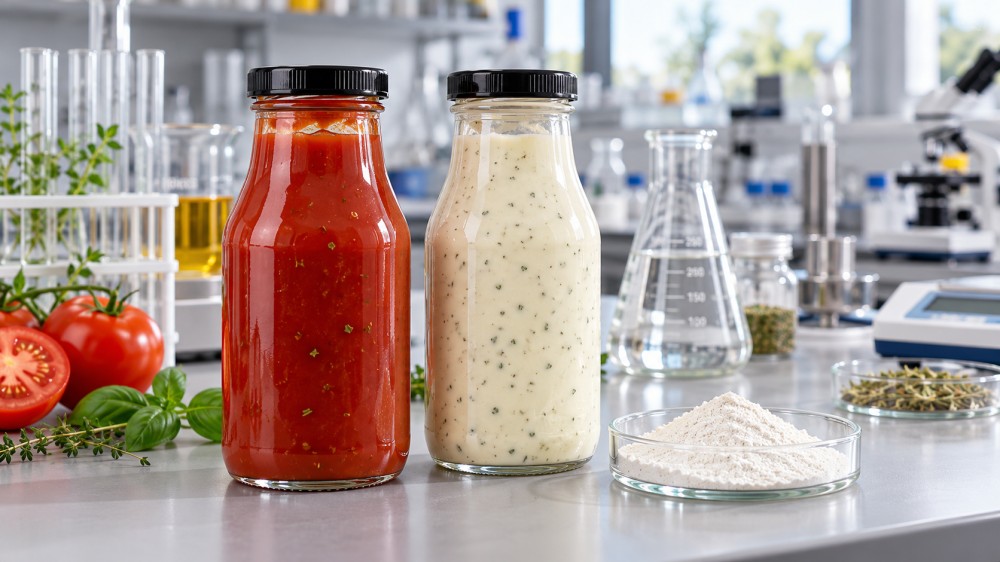
Compare hydrocolloids by function, not reputation
The following comparison is a starting point rather than a ranking. Performance varies with ingredient grade, concentration, formulation and process, so a familiar ingredient name is not enough to predict the result.
Xanthan gum is often a practical candidate when a sauce must hold visible particles yet flow under squeezing or pouring. Its shear-thinning behavior can provide structure at rest and lower apparent viscosity during movement. The trade-off is sensory: too much structure can make a sauce feel slimy or leave an undesirable coating in the mouth.
Starches are useful when the target is a rounded, cooked texture rather than the elastic character associated with some gums. Native and modified starches should not be treated as equivalent. A sauce exposed to prolonged heating, low pH or mechanical shear may need a grade selected specifically for those conditions. Storage behavior also matters: some starch systems can firm, thin or release water over time.
Pectin deserves consideration in acidic sauces, fruit-based condiments and glazes, but “pectin” covers more than one functional category. High-methoxyl and low-methoxyl pectins have different setting requirements. Confirm whether the formulation’s pH, soluble solids and calcium level support the intended texture, especially if a pourable sauce must not set into a gel.
Match the ingredient to the process it will actually encounter
Acidity and salt
Record both the initial and expected final pH, particularly when ingredients are added in stages. A hydrocolloid that performs well in water may behave differently in an acidic sauce containing salt, sugar, proteins or minerals. Some starches are vulnerable to viscosity loss during acid heating, while certain gums can be affected by ionic conditions or interactions with other ingredients.
Do not assume that a supplier’s broad pH range guarantees performance in every formula. Ask for application data that resembles the intended sauce, then test the ingredient in the complete formulation. For calcium-sensitive systems, variations in water hardness and ingredient mineral content can also influence texture.
Heat, shear and order of addition
A sauce may experience high shear during mixing, sustained heat during cooking and a second thermal exposure during filling or consumer reheating. Each step can affect the final structure. A starch that gives the right viscosity in a gentle bench cook may thin under plant conditions; an ingredient that requires heat to hydrate may underperform in a cold process.
Addition order is equally important. Dry powders can form lumps when their outer surfaces hydrate before the interior becomes wet. Depending on the ingredient and equipment, premixing with a dry carrier, dispersing in oil, or using controlled high-shear addition may improve dispersion. Follow the supplier’s handling recommendations and verify that the ingredient has hydrated before judging its effectiveness.
Chilling, freezing and shelf life
Storage is where an initially attractive prototype can reveal its weaknesses. Look for water separation, sediment compaction, oiling off, changes in pourability and surface appearance. If the product will be frozen, include freeze–thaw testing; if consumers are expected to reheat it, evaluate texture after the recommended preparation.
Hydrocolloids manage physical structure, not microbial safety. Shelf-life decisions also depend on the complete formulation, processing, packaging and validated food-safety controls. A thicker sauce should never be assumed to be a safer sauce.
When a blend makes more sense than a single ingredient
A single hydrocolloid can be attractive for a shorter ingredient list and simpler purchasing. Yet the texture brief often asks for opposing behaviors: a sauce should suspend spices at rest, pour readily from a bottle and leave a clean finish. A blend can distribute those jobs across ingredients rather than forcing one material to do everything.
For example, a formulator might screen a starch for body alongside a small amount of xanthan for suspension. The goal is not simply a higher viscosity; it is a structure that maintains particle distribution without making the sauce excessively cohesive. Similarly, certain gum combinations can produce synergistic changes in viscosity or texture, but the effect depends on ratio, hydration and formulation conditions.
Keep the experimental question specific. Compare the blend with each component alone at equivalent practical use levels, and assess both instrument readings and sensory behavior. If the blend only increases thickness without improving suspension, flow or mouthfeel, the additional ingredient may not be justified.
A practical screening plan for technical evaluators
Start with a small set of candidates that fit the process and label requirements. Testing every available gum in a simplified water system can generate data without answering the commercial question. Use the actual sauce matrix as early as practical, including its acid, salt, oil, solids and intended processing sequence.
- Establish a control. Document the current formula or a representative baseline, including ingredient lot, water source, mixing conditions and cooking profile.
- Screen a usable concentration range. Follow supplier guidance for initial trials, then adjust around the desired texture. Compare cost at the level required to meet the specification, not only by price per kilogram.
- Measure flow consistently. Record instrument, spindle or geometry, temperature, shear conditions and time after preparation. A single viscosity value is difficult to interpret without the measurement method.
- Observe real-use behavior. Check filling, pouring, spoon pickup, cling, particle distribution and mouthfeel. Evaluate the sauce at relevant serving temperatures.
- Challenge storage stability. Use representative packaging and temperatures, with checks appropriate to the intended shelf life. Include heating, cooling or freeze–thaw cycles where relevant.
- Repeat promising trials at pilot scale. Confirm that mixing energy, heating rate, hold time and filling conditions produce results comparable to the laboratory sample.
Set acceptance criteria before reviewing results. For example, define what degree of visible separation is unacceptable, how easily the sauce should leave its package and which texture changes would trigger reformulation. This makes trade-offs easier to discuss across R&D, quality, operations and procurement.
What to request from a hydrocolloid supplier
Food-grade status is essential, but a general product description is not sufficient for a technical decision. Request a current specification and certificate of analysis for the relevant material, together with information on identity, composition, microbiological limits, contaminants and any processing aids or carriers that may affect the application.
Ask about recommended dispersion and hydration conditions, typical performance in acidic or salted systems, and batch-to-batch variability. For starches and pectins in particular, identify the exact grade rather than relying on a generic ingredient category. If the supplier offers an application sample, confirm that it represents the material intended for commercial supply.
Regulatory and labeling requirements must be assessed for the intended food category and destination market. An ingredient’s permitted use, naming convention and any applicable conditions can differ by jurisdiction. Verify these details with current local requirements and the supplier’s documentation; terms such as “natural” or “clean label” should not be treated as universal regulatory guarantees.
Make the final decision on performance per formulation
The lowest-cost powder is not necessarily the lowest-cost solution. Consider the amount needed to achieve the target, yield losses from poor dispersion, processing time, storage performance and the cost of any additional stabilizers. A more expensive ingredient used efficiently may be economical, while an inexpensive one can become costly if it requires substantial reformulation or causes variability at scale.
For a technical evaluator, the strongest selection is supported by a clear chain of evidence: a defined sauce specification, relevant supplier documentation, controlled formulation trials and confirmation under realistic processing and storage conditions. FFAI’s ingredient intelligence perspective can help frame those comparisons across functionality, compliance and commercial considerations. The final answer, however, belongs to the sauce itself—and to the data gathered as it moves from the bench to the finished pack.
Related News
- How to choose food hydrocolloids for gluten-free breadNov 03, 2026Food Rheology Expert
- How to choose food-grade hydrocolloid ingredients for stable saucesOct 30, 2026Food Rheology Expert
- How to assess a bio-based thickener manufacturer's batch consistencyOct 16, 2026Food Rheology Expert
- Verifying halal status of hydrocolloid ingredients in the Middle EastOct 15, 2026Food Rheology Expert
Related News
- 00
0000-00
Wissen Research: Global Cosmetics Market to Reach $497.2 Billion by 2031 - 00
0000-00
Can biomimetic peptides improve skin firmness? - 00
0000-00
China Records 543 New Cosmetic Ingredients, Including 167 in 2026 - 00
0000-00
How to check a fragrance raw material specification for IFRA compliance - 00
0000-00
Australia and New Zealand Weigh Wider Steviol Glycoside Use in Griddle Products
Food Rheology Expert
Weekly Insights
Stay ahead with our curated technology reports delivered every Monday.