





The best hydrocolloid for gluten-free bread is the one that supplies the missing function in a particular formula and process—not necessarily the one that produces the thickest batter. Hydroxypropyl methylcellulose (HPMC) is a strong candidate when heat-set structure and loaf volume are priorities; xanthan gum is useful for increasing cold-batter viscosity and suspending particles; psyllium can provide cohesive, dough-like handling. Guar gum and other options may be useful, but their performance depends heavily on hydration, dose, and the surrounding ingredients.
Selection cannot be separated from water level, starch composition, mixing, proofing, and baking. A gum that improves gas retention at one hydration level can produce a dense or gummy loaf at another. Comparing food hydrocolloids for bakery applications therefore requires finished-bread testing as well as measurements of batter consistency.
Identify the structural failure before choosing an ingredient
Gluten-free bread has to retain fermentation gas without the continuous, extensible gluten network found in wheat dough. Its structure comes from a combination of hydrated polymers, proteins, starch gelatinization, and the setting of the crumb during baking. Hydrocolloids can contribute to several of these functions, but none is a complete substitute for gluten in every formulation.
The most useful starting point is to identify when the structure fails. A batter that spreads before proofing needs a different correction from a loaf that rises well but collapses in the oven.
- Spreading during depositing or proofing: Assess cold viscosity, particle hydration, and water level. Xanthan, guar, or psyllium may help build the consistency needed to retain shape.
- Low volume despite adequate fermentation: Examine whether the batter is too stiff to expand or too weak to retain gas. Increasing gum is not automatically the solution.
- Collapse during baking or cooling: Evaluate the transition from gas expansion to structural setting, as well as proofing endpoint and bake profile. An HPMC grade designed for thermal gelation may be worth testing.
- Sticky or gummy crumb: Check total water, bake completion, starch blend, cooling, and hydrocolloid concentration before attributing the problem to a single ingredient.
- Rapid firming in storage: Compare moisture distribution and starch behavior over time; a softer loaf on baking day does not necessarily remain softer throughout shelf life.
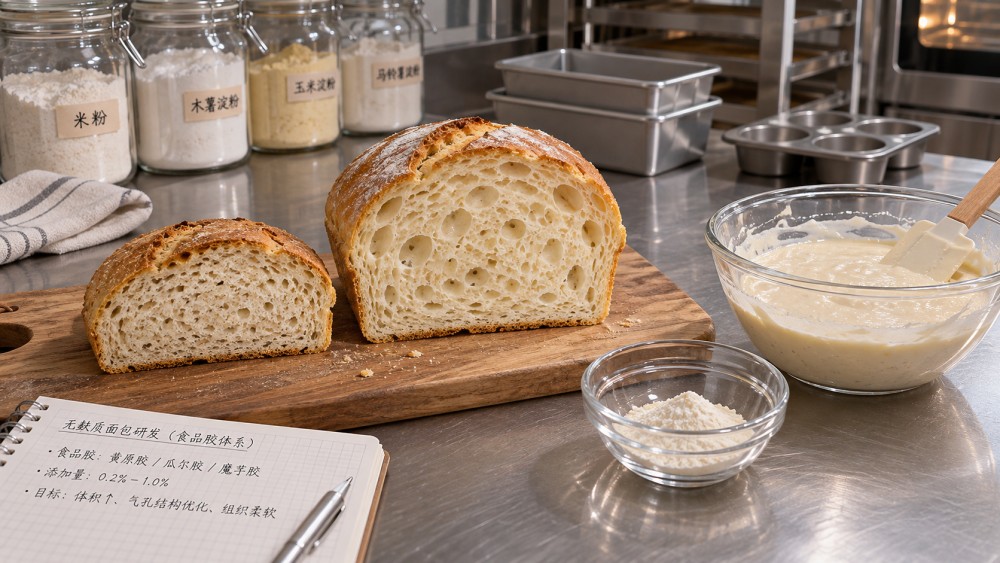
These symptoms can overlap. For example, a sunken loaf may result from overproofing, insufficient baking, excessive water, or weak gas-cell walls. A hydrocolloid trial is most informative after those process variables have been brought under control.
How the main options differ in bread
HPMC: structure during heating
HPMC is a cellulose derivative available in grades with different viscosity and thermal-gelation characteristics. In suitable gluten-free systems, it helps stabilize expanding gas cells and contributes to structure as the batter heats. This makes it a useful reference ingredient for pan breads where loaf volume and resistance to collapse are important.
Grade selection matters. Two materials labeled HPMC can behave differently because substitution characteristics, viscosity, particle size, and hydration behavior affect performance. A grade that gives a desirable batter viscosity is not automatically the best at supporting the loaf in the oven. Follow the supplier’s recommended dispersion and hydration method, then verify it under the intended mixing conditions.
HPMC can also make a formula less attractive where the desired ingredient declaration excludes chemically modified cellulose. That is a positioning constraint rather than a technical measure of bread quality; the applicable labeling rules and the product’s specification should be checked separately.
Xanthan gum: cold viscosity and suspension
Xanthan develops viscosity in water and is useful when a gluten-free batter is too fluid to hold gas or keep particles evenly distributed. Its shear-thinning behavior can help a batter flow during mixing or depositing while retaining more body when at rest. It is therefore a practical candidate for pumpable batters and formulas prone to spreading.
The trade-off is that a highly viscous batter is not necessarily an extensible one. Excessive xanthan or inadequate water can restrict expansion and give a tight, tacky crumb. Conversely, adding water to restore flow may weaken the batter if the rest of the formula cannot hold it. Compare volume, cell structure, and mouthfeel rather than selecting a dose from viscosity alone.
Guar gum: hydration and viscosity, with process sensitivity
Guar gum hydrates in cold water and can increase viscosity and water binding. It may be considered where additional batter body or crumb softness is needed, either alone or in combination with another hydrocolloid.
Its contribution depends on dispersion, hydration time, and the formulation. Poor dispersion can leave hydrated lumps surrounded by under-hydrated powder; delayed hydration can also change batter consistency between mixing and depositing. A guar-containing formula should therefore be assessed across the actual holding time, not just immediately after mixing. If batter thickens substantially while waiting for production equipment, deposit weight and loaf uniformity can suffer.
Psyllium: cohesion and dough-like handling
Psyllium husk or psyllium-derived ingredients form a hydrated gel and can give gluten-free systems greater cohesion. They are particularly relevant when the product needs to be shaped rather than deposited as a batter, as in certain rolls or artisan-style loaves.
Psyllium is not interchangeable with a purified gum on a one-to-one basis. Its water demand and physical contribution are different, and performance varies with particle size, composition, and ingredient grade. Allow sufficient, consistent hydration time before judging dough firmness. At excessive levels or with inadequate baking, a dense or gel-like crumb can result. Color, flavor, and visible particles may also affect product acceptance.
Other hydrocolloids and blends
Locust bean gum, pectin, and other hydrocolloids can be useful in specific systems, but their hydration requirements and interactions with other ingredients must be considered. Some grades require substantial heating for full functionality, making them less useful when early cold-batter viscosity is the main need.
Blends can divide the work: one component contributes cold handling properties while another supports structure during heating. A blend is justified when it improves a defined outcome or widens the processing window—not simply because it contains more ingredients. Evaluate each component or blend against a clear reference formula so that its contribution remains interpretable.
Water is part of the selection, not a fixed background variable
Hydrocolloids compete with starches, proteins, fibers, sugars, and other ingredients for available water. Changing the hydrocolloid while holding water constant is useful for isolating its direct effect, but it does not necessarily show each ingredient at its best. A second comparison at adjusted hydration is needed before rejecting an otherwise promising option.
For example, if psyllium produces a stiff, poorly expanded dough at the control water level, test whether controlled additional water improves handling and loaf volume without leaving the crumb wet. If xanthan produces a sticky batter with a tight crumb, a lower dose may be more informative than adding water alone. Record water as a percentage of total flour and starch so that formulas can be compared consistently.
The flour and starch blend also changes the result. Rice flour, maize starch, potato starch, and protein-rich flours differ in particle characteristics, water absorption, and behavior during heating. Replacing a starch or increasing fiber can alter the effective hydrocolloid requirement even when the gum itself is unchanged. A hydrocolloid selected for one base formula should therefore be requalified after a material change to the flour blend.
Match the ingredient to the production sequence
Laboratory mixing can conceal problems that become significant when powder is added to a larger vessel or batter waits in a hopper. The order of addition, mixing energy, water temperature, and time between mixing and depositing all affect hydration.
Preblending a small quantity of gum with dry flour or another suitable dry ingredient can improve dispersion, but the procedure must be validated for the specific material and equipment. The objective is to prevent powder agglomeration while achieving a reproducible rate of hydration. Hydration protocols should not be transferred automatically between HPMC, xanthan, guar, and psyllium.
Observe whether batter consistency remains usable from the start to the end of the intended holding period. A formula that produces an excellent first loaf but becomes difficult to pump or deposit later may not be robust enough for the line. Conversely, a batter that initially appears loose may develop sufficient structure after a defined rest. Specify that rest as part of the process rather than relying on an informal visual judgment.
Proofing and baking also influence the result. If fermentation proceeds beyond the batter’s ability to retain gas, a stronger hydrocolloid system may appear to help while concealing an uncontrolled proof. Similarly, a hydrocolloid cannot compensate reliably for an underbaked center. Compare candidates at consistent batter temperature, deposit weight, proof endpoint, oven conditions, and cooling time.
Design a comparison that separates ingredient effects from process effects
Begin with a control formula that has a known failure mode. Test a small number of candidates or grades against that control, using a defined range of inclusion levels selected from supplier guidance and preliminary work. Express each addition on the same flour-and-starch basis, and record whether the ingredient replaces another dry component or changes the total formula.
A useful trial has two stages. In the first, keep water and processing conditions constant to see how each candidate changes the reference system. In the second, adjust water within a planned range for the most promising candidates. This avoids declaring a material unsuitable simply because it was tested at a hydration level designed for another ingredient.
Measure more than loaf height. Depending on the product, a practical assessment can include:
- Before baking: batter temperature, consistency at defined times, deposit weight, spreading, and proof rise.
- After baking and cooling: loaf volume, shape retention, crumb-cell distribution, internal tackiness, and sliceability.
- During intended storage: crumb firmness, perceived dryness, gumminess, and package condensation under consistent packaging and temperature conditions.
Use repeat bakes where possible and compare loaves at the same age and cooling condition. A single large loaf or one attractive slice can misrepresent batch variability. Instrumental texture measurements are useful when the sampling method is consistent, but they should be interpreted alongside eating quality: a softer instrument reading does not necessarily mean a less sticky or more acceptable crumb.
Distinguish texture retention from microbial shelf life
Hydrocolloids can affect water distribution and the rate at which bread firms, but they are not a substitute for an established microbial shelf-life strategy. A loaf that remains soft may still spoil, and a formula change that increases moisture or changes packaging conditions can affect microbial risk.
Assess texture and microbiological stability separately under the intended storage and distribution conditions. Water activity, pH, packaging integrity, hygienic controls, and any preservation system require their own validation. Do not infer shelf life from the hydrocolloid’s water-binding capacity alone.
Set ingredient specifications around the function being purchased
Once a candidate works, the specification should identify more than its generic name. Request the exact grade and relevant characteristics such as viscosity test method and conditions, particle-size information, composition, recommended hydration procedure, and applicable microbiological and contaminant specifications. For HPMC, thermal-gelation behavior and grade identity are especially relevant; for psyllium, particle size and husk or powder composition can materially affect water demand.
Confirm food-grade status, permitted use, and labeling requirements in each destination market. For a gluten-free claim, assess the ingredient’s own risk of gluten-containing material and cross-contact throughout handling and supply; the suitability of the finished product depends on the applicable rules and the complete manufacturing system, not the hydrocolloid name alone.
A substitute should be qualified in the bread process even when it carries the same ingredient declaration. Incoming viscosity results measured in a supplier’s standard solution do not necessarily predict behavior in a complex batter. The most dependable selection is the grade that meets finished-loaf requirements across an agreed range of hydration, holding time, and processing conditions—not merely the grade that delivers the strongest result in one laboratory bake.
Related News
- How to choose food hydrocolloids for gluten-free breadNov 03, 2026Food Rheology Expert
- How to choose food-grade hydrocolloid ingredients for stable saucesOct 30, 2026Food Rheology Expert
- How to assess a bio-based thickener manufacturer's batch consistencyOct 16, 2026Food Rheology Expert
- Verifying halal status of hydrocolloid ingredients in the Middle EastOct 15, 2026Food Rheology Expert
Related News
- 00
0000-00
China Records 543 New Cosmetic Ingredients, Including 167 in 2026 - 00
0000-00
How to check a fragrance raw material specification for IFRA compliance - 00
0000-00
Australia and New Zealand Weigh Wider Steviol Glycoside Use in Griddle Products - 00
0000-00
How does pH affect plant-based color ingredients in beverages? - 00
0000-00
China Announces Risk-Based Cosmetic Change Reviews and Shorter Timelines
Food Rheology Expert
Weekly Insights
Stay ahead with our curated technology reports delivered every Monday.