





How to Choose Food Thickeners for Sauces Without Changing Flavor
Choosing food thickeners for sauces is not simply a matter of adding viscosity. A sauce can reach the target thickness and still fail at the point of use: its herbs may taste muted, its acid note may seem sharper, its color may turn dull, or its texture may feel pasty rather than naturally rich. For operators, the practical question is not “Which thickener is strongest?” but “Which system gives the desired flow, cling, stability, and serving behavior while allowing the original flavor profile to remain clear?”
That decision depends on the sauce itself. A hot-filled tomato pasta sauce, a chilled salad dressing, a frozen gravy concentrate, and a glossy Asian-style dipping sauce may all look similar in a beaker, yet they place very different demands on starches, gums, proteins, and processing equipment. Heat exposure, pH, salt, fat, shear, filling conditions, and storage time can each change how a thickener performs—and how consumers perceive flavor.
The most reliable approach is to treat thickener selection as a sensory and process decision at the same time. Viscosity matters, but it is only one part of the finished eating experience.
Start with the sauce behavior you need, not the ingredient name
“Thick” is an incomplete specification. Before comparing ingredients, define what the sauce must do in the actual application. Does it need to coat pasta evenly? Stay suspended around vegetable pieces? Pour smoothly from a bottle after refrigeration? Hold on a fried snack without running off? Recover its body after pumping or shaking? A sauce that pours cleanly may still need high cling, while a spoonable sauce may need a short, creamy texture rather than a long, elastic pull.
This is where rheology becomes more useful than a single viscosity reading. Many food thickeners for sauces are shear-thinning: they become less viscous during mixing, pumping, or pouring, then regain structure at rest. That behavior can be helpful for a squeeze bottle or a sauce line. However, excessive structure may produce a stringy tail, an unnatural gel-like impression, or a surface that traps flavor release. A good target is often not maximum thickness, but controlled flow under the conditions the consumer and production team will encounter.
Write a short performance brief before requesting samples. It should cover the base system, target appearance, serving temperature, thermal treatment, pH range, salt and sugar level, expected shelf life, packaging format, and whether the sauce will be frozen, reheated, pumped, or dispensed. This brief prevents a common error: choosing a thickener that works in a bench sample but loses its intended texture after commercial processing.
Why thickening can change perceived flavor even when the ingredient is neutral
A thickener may have little or no obvious taste on its own, yet still alter flavor perception. The reason is physical. Viscosity changes how quickly aroma compounds move from the sauce to the headspace and how quickly dissolved tastes reach receptors in the mouth. A more structured sauce can slow the release of garlic, chili, citrus, roasted notes, or delicate herbs. In some formulas, fat droplets and hydrocolloids also affect how flavor compounds partition in the system.
Texture changes expectation as well. A light soy-based sauce that becomes overly glossy and elastic may be perceived as sweeter or more artificial, even if the seasoning dose is unchanged. A roux-style gravy thickened too aggressively can feel floury, which makes savory flavors seem flatter. In a bright acidic sauce, a heavy starch body may delay the initial flavor impact and leave a dull finish.
For this reason, sensory evaluation should compare more than flavor intensity. Assess aroma on opening, first taste, salt and acid timing, spice release, aftertaste, coating, and any powdery, slimy, gummy, or gelatinous impression. The best thickener is frequently the one that disappears into the eating experience rather than announcing its presence.
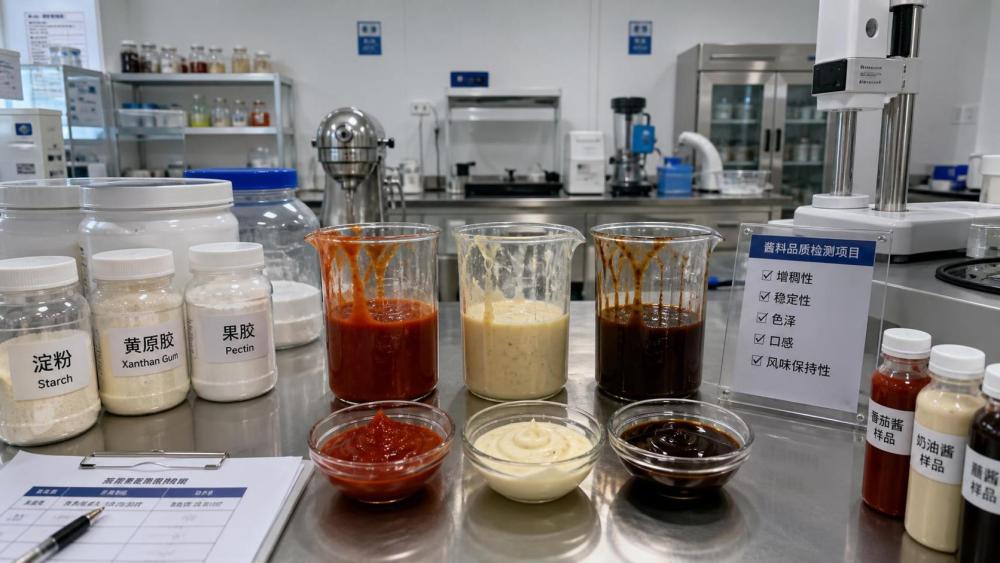
Understand the main thickener families
There is no universal winner among food thickeners for sauces. Each family contributes a different texture and has different limits under heat, acid, freeze-thaw cycles, and mechanical shear.
Starch is often a sensible starting point when the target is a familiar, cooked texture. It can provide body that feels consistent with gravy, cream sauce, or tomato-based applications. Yet not all starches tolerate the same process. Long cooking, high acidity, strong agitation, or repeated freeze-thaw exposure can reduce viscosity or create texture defects. The source and modification level matter, so supplier technical documentation should be read as a formulation guide rather than treated as a generic claim.
Xanthan gum is valued because very small amounts can create substantial viscosity and maintain suspension under a broad range of conditions. It is often useful in acidic sauces, low-fat dressings, and products that need stable flow after storage. Its advantage can become its drawback: an excessive level may suppress clean flavor release and create a lubricious or ropy texture. A lower xanthan level combined with another texturizer is sometimes easier to balance than relying on xanthan alone.
Pectin deserves attention in sauces with fruit, vegetables, acidity, or a label strategy centered on recognizable plant-derived ingredients. But “pectin” is not a single solution. Its behavior is linked to the particular grade and to the composition of the formula. A change in pH, calcium availability, or sugar content may alter the result substantially. It should be tested in the final matrix, not only in water.
Match the thickener to process stress
The processing route often decides whether an otherwise suitable ingredient remains suitable. Consider the full journey of the sauce: dry blending, hydration, high-shear mixing, cooking, homogenization where applicable, hot filling or retorting, cooling, transportation, and consumer use. If the ingredient is added incorrectly, even a technically appropriate grade can form fisheyes, incomplete hydration, or uneven viscosity.
Acid should be examined early. Tomato, vinegar, citrus, fermented ingredients, and certain fruit preparations can make a sauce challenging for some starch systems during prolonged heating. In many operations, the timing of acid addition is as important as the thickener selection itself. Adding an acid component after the thickener has hydrated may produce a different result from exposing the ingredient to acid throughout the cook. This is not a universal rule; it is a process variable that requires controlled trials.
Freeze-thaw stability is another frequent source of late-stage surprises. A sauce that looks smooth after production may release water after freezing and thawing, particularly if its structure is not designed for that cycle. Evaluate the product after realistic storage and reheat conditions, not only on the day it is made. For chilled sauces, refrigeration can also change apparent viscosity, so serving-temperature assessment is essential.
Avoid the single-ingredient mindset
Many sauce systems benefit from a blend rather than a single thickener. A starch may build the broad, familiar body; a small amount of gum may improve suspension and stabilize flow; an emulsification strategy may help control oil separation. The objective is not complexity for its own sake. It is to assign separate tasks to ingredients instead of forcing one ingredient to solve every problem at a high use level.
This approach can protect flavor. If a gum alone is pushed too far to prevent spice sedimentation, the sauce may become too slick. If starch alone is increased to stop water release, the sauce may become dense and opaque. A balanced system can reach the required stability with less sensory intrusion. It also allows the team to adjust body independently from cling or particle suspension.
Be careful, however, with interactions. Salt, proteins, dairy solids, acids, sweeteners, alcohol-containing flavor extracts, and particulates may all influence the final texture. Ingredient compatibility cannot be fully predicted from a datasheet. Bench screening should narrow options, but a pilot-scale run is usually needed before making a commercial decision.
Build a practical evaluation protocol
A useful trial compares candidates at equal sensory targets, not necessarily at equal dosage. One material may require a much lower inclusion rate than another, while a different option may need a higher dose to produce a more natural texture. Prepare a control formula, then test realistic alternatives under the same mixing, cooking, and filling conditions.
During evaluation, record observations that operators can repeat: hydration time, mixing order, visible lump formation, viscosity at the relevant temperature, pumpability, coating, settling, oil separation, reheating behavior, and texture after storage. Include a blind sensory check when possible. The panel does not need to be large to identify clear problems such as muted aromatics, delayed seasoning impact, or an artificial mouth-coating finish.
Ask suppliers for the information that supports the decision: recommended dispersion method, applicable processing conditions, lot-to-lot specifications, microbiological documentation where relevant, allergen and origin statements, and the regulatory status needed for the destination market. Ingredient approval requirements differ by geography and product category, so labeling and compliance should be confirmed against the actual formula and market rather than assumed from a general product description.
A clearer decision path for flavor-sensitive sauces
For a sauce where flavor is the main asset, begin by protecting the sensory brief. Identify which notes are most vulnerable: fresh basil, butter, smoke, pepper heat, umami depth, citrus lift, or fermented complexity. Then define the required physical behavior and process stresses. Only after that should the team shortlist thickener families.
FFAI approaches rheological thickeners as part of a wider molecular-sensory system. In practical terms, that means considering how a change in flow or mouthfeel affects aroma release, color perception, preservation strategy, and the consumer’s expectation of quality. This perspective is particularly valuable when a formulation must meet several demands at once: a cleaner label direction, stable processing, reliable shelf-life performance, and a flavor profile that still tastes deliberate rather than engineered.
The right choice is rarely the thickener with the highest apparent viscosity or the lowest quoted addition level. It is the one that performs through the complete process, stays consistent during storage, fits the intended labeling and market requirements, and leaves the sauce tasting like itself. Before final approval, verify the ingredient system in the finished recipe, at the intended serving temperature, and after the storage conditions the product will actually face.
Related News
- How cassava costs shape Thailand xanthan gum market pricesSep 29, 2026Food Rheology Expert
- Can Thailand's xanthan gum market support stable export supply?Sep 28, 2026Food Rheology Expert
- How food hydrocolloids prevent ice crystals in frozen dessertsSep 14, 2026Food Rheology Expert
- Which food texture modifiers for sauces prevent thinning after reheating?Sep 13, 2026Food Rheology Expert
Related News
- 00
0000-00
What drives fragrance ingredients price changes in bulk orders? - 00
0000-00
How to assess a food antioxidants distributor’s traceability practices - 00
0000-00
How minimum order quantities shape private label ingredient sourcing costs - 00
0000-00
What drives personal care ingredient price volatility in sourcing - 00
0000-00
What drives micelles price differences in cosmetic formulations?
Food Rheology Expert
Weekly Insights
Stay ahead with our curated technology reports delivered every Monday.