





Ingredient application guides for thickeners start with real use conditions
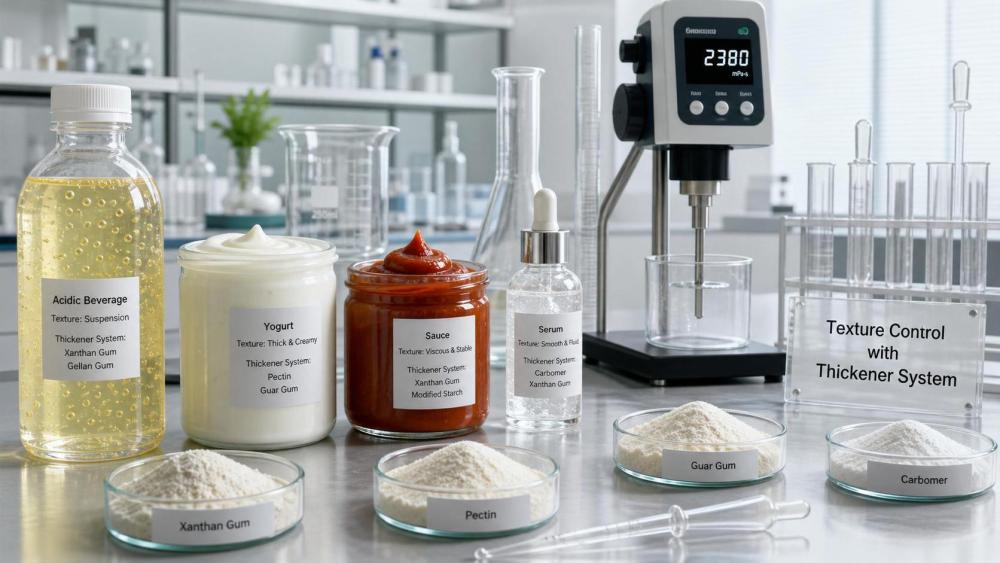
Ingredient application guides for thickeners matter because texture control is never only about viscosity.
In actual development, the right system must also survive heat, shear, pH shifts, storage, fragrance load, or active delivery requirements.
That is why FFAI tracks thickeners alongside preservatives, flavors, cosmetic actives, and surfactants.
A hydrocolloid behaves differently when it supports yogurt body, holds sauce suspension, stabilizes shampoo flow, or improves serum glide.
The more performance-driven the formula becomes, the less useful a one-number viscosity target is.
A useful ingredient application guide for thickeners should compare texture mechanisms, not just list gum names.
It should explain whether the system builds yield stress, improves suspension, masks wateriness, or creates a short, clean break during pouring.
That distinction shapes formulation speed, label positioning, process risk, and long-term sensory consistency.
Different applications ask different questions before any gum is chosen
Most missteps happen when similar-looking products are treated as identical rheology problems.
A beverage thickener may need clarity and acid stability, while a dessert thickener may need spoonable body and freeze-thaw resistance.
Personal care creates another shift.
There, ingredient application guides for thickeners must account for surfactant compatibility, electrolyte tolerance, active suspension, and spread profile on skin or hair.
The same xanthan gum that improves beverage stability can feel draggy in a premium serum if the rest of the system is not balanced.
FFAI often frames the first decision around four variables:
- What texture experience should remain after processing and storage.
- Which stresses the formula will face, including heat, acid, salts, alcohol, and shear.
- How clean-label, naturality, or compliance expectations narrow the ingredient pool.
- Whether the thickener works alone or needs synergy with starches, proteins, emulsifiers, or polymers.
Those questions make ingredient application guides for thickeners far more practical than a simple specification sheet.
Food systems usually split between flow control and indulgent mouthfeel
In beverages, the thickener often has to do very little visually while doing a lot physically.
It may keep pulp suspended, reduce phase separation, or soften an acidic bite without creating opacity.
Here, low-dose xanthan, pectin, or tailored blends are common starting points.
The key judgment is not maximum viscosity.
It is whether the system gives enough low-shear structure while remaining easy to pump and fill.
Dairy-style products and spoonable desserts move in another direction.
They often need a fuller oral coating, controlled syneresis, and a smooth breakdown during eating.
Carrageenan, guar, locust bean gum, starch systems, or mixed hydrocolloid networks become more relevant there.
A common error is copying a stable drink system into a cultured or frozen format.
The texture may survive laboratory viscosity checks yet fail on melt behavior, spoon pickup, or post-acidification stability.
Ingredient application guides for thickeners are most useful when they connect mouthfeel language with measurable rheology targets.
Where food applications usually diverge
Personal care systems shift the discussion from mouthfeel to deposition and glide
In skin care, ingredient application guides for thickeners are often used to avoid a mismatch between efficacy story and sensory reality.
A serum built around peptides or anti-aging actives cannot feel stringy, tacky, or cloudy without affecting premium perception.
That pushes selection toward carbomers, cellulose derivatives, natural gums, or hybrid systems, depending on pH and electrolyte load.
The first screen is usually compatibility.
The second is skin playtime, break, and afterfeel.
Hair care and cleansing products create another pattern.
Surfactants, salts, fragrances, and pearlizing agents can all distort viscosity curves.
A system that looks ideal in water may collapse in a sulfate-free shampoo or become unstable after fragrance addition.
In these cases, ingredient application guides for thickeners should compare salt-thickening, polymer-thickening, and gum-assisted structures side by side.
The practical goal is stable dispensing and a polished in-use feel, not just a higher Brookfield reading.
The same thickener can perform well or poorly depending on process reality
Process tolerance is where many thickener decisions are won or lost.
Some systems hydrate fast but form lumps under poor dispersion.
Others need heat activation, specific pH windows, or careful order of addition.
A technically elegant choice can become inefficient if the plant cannot disperse it consistently.
This is especially relevant across global FMCG operations, where formula transfer between regions is common.
Ingredient application guides for thickeners should therefore include implementation questions:
- Will hydration quality change with local water hardness?
- Does thermal processing weaken or strengthen the network?
- Can the system tolerate flavor oils, preservatives, salts, or active compounds?
- Will storage at cold or high ambient conditions change texture drift?
These checks reflect the kind of cross-functional intelligence FFAI emphasizes, where texture decisions are linked with compliance, processing, and market positioning.
Common misreads appear when teams compare names instead of systems
One frequent mistake is choosing by supplier datasheet viscosity alone.
That number rarely predicts suspension, yield value, or consumer-perceived richness in a finished formula.
Another misread is assuming natural gums always support clean-label goals without tradeoffs.
Some natural systems complicate transparency, flavor release, or elegant skin feel.
Cost can also be misunderstood.
A lower-cost thickener may require higher dosage, longer processing, or extra stabilizers, which changes total formula economics.
Ingredient application guides for thickeners are most credible when they help compare total performance cost, not only raw material price.
It is also worth checking regulation early.
Food applications may need GRAS alignment, while cosmetic exports can run into notification and regional ingredient naming issues.
A practical way to narrow the right texture-control system
A workable selection path usually starts with the finished experience, then moves backward into rheology design.
Describe the target as consumers would feel it, then translate that into flow behavior, stability needs, and process limits.
From there, ingredient application guides for thickeners become easier to use.
- Map the application: beverage, spoonable food, serum, shampoo, or hybrid system.
- Define the stress profile: heat, shear, pH, salt, alcohol, freeze-thaw, or fragrance load.
- Set the sensory target: clean pour, creamy hold, cushion, slip, or rich afterfeel.
- Screen for compliance and label fit before optimization work expands.
- Test single thickeners first, then blends only where synergy solves a real gap.
The value of ingredient application guides for thickeners is not in offering one universal answer.
It is in helping teams build sharper comparison logic across food, beauty, and other texture-sensitive categories.
The next step is straightforward.
List the exact use condition, identify the texture risk most likely to fail, and compare thickener systems against that reality before scaling trials.
Related News
- How cassava costs shape Thailand xanthan gum market pricesSep 29, 2026Food Rheology Expert
- Can Thailand's xanthan gum market support stable export supply?Sep 28, 2026Food Rheology Expert
- How food hydrocolloids prevent ice crystals in frozen dessertsSep 14, 2026Food Rheology Expert
- Which food texture modifiers for sauces prevent thinning after reheating?Sep 13, 2026Food Rheology Expert
Related News
- 00
0000-00
What drives fragrance ingredients price changes in bulk orders? - 00
0000-00
How to assess a food antioxidants distributor’s traceability practices - 00
0000-00
How minimum order quantities shape private label ingredient sourcing costs - 00
0000-00
What drives personal care ingredient price volatility in sourcing - 00
0000-00
What drives micelles price differences in cosmetic formulations?
Food Rheology Expert
Weekly Insights
Stay ahead with our curated technology reports delivered every Monday.