





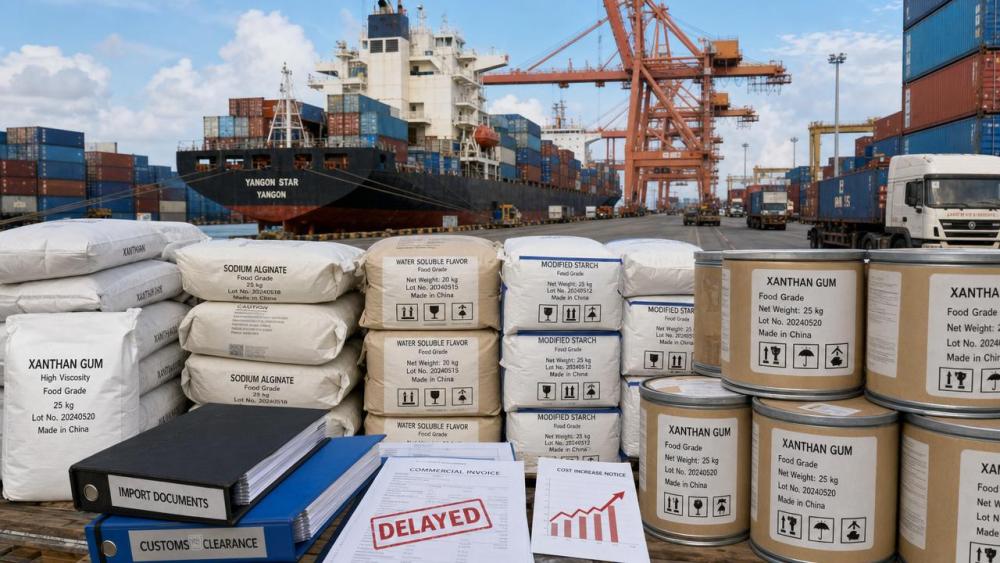
Myanmar’s import cost structure for food-related intermediates changed on June 1, 2026, after the Ministry of Finance announced additional import duties on 237 product lines in late May. The measure covers categories including Xanthan gum, Alginate, Water-soluble Flavors, and Modified Starches, while longer customs clearance at Yangon Port—now extended to 14 working days—adds a second layer of pressure. For Chinese exporters, Myanmar importers, and procurement teams across food ingredient supply chains, the immediate issue is not only higher landed cost but also how CIF terms and duty-sharing arrangements will be handled in active business.
What has been confirmed so far
According to the information provided, Myanmar’s Ministry of Finance announced in late May 2026 an additional import tax of 3% to 12% on 237 food-related intermediate products. The listed scope includes Xanthan gum, Alginate, Water-soluble Flavors, and Modified Starches. The new rule took effect on June 1, 2026.
The same information also indicates that customs clearance at Yangon Port has been extended to 14 working days. Against this backdrop, Chinese exporters are required to discuss adjustments to CIF terms and mechanisms for sharing tariff costs with Myanmar importers.
Where the pressure is likely to appear first
Trade transactions face immediate repricing pressure
From an industry perspective, direct trading companies are likely to feel the impact first because the policy affects imported food-related intermediates at the customs and settlement stage. The most immediate pressure point is landed cost calculation, especially where quotations, shipment plans, or customer confirmations were made before June 1. What deserves closer attention is whether existing offers, confirmations, or shipment arrangements can still absorb the added duty burden under current commercial terms.
Procurement teams will need to reassess cost and timing together
For ingredient buyers and import-side procurement teams, the issue is not limited to tariff rates alone. The longer 14-working-day clearance cycle at Yangon Port may affect ordering rhythm, inventory arrival expectations, and coordination with downstream production or distribution. Analysis shows that businesses relying on Xanthan gum, Alginate, Water-soluble Flavors, or Modified Starches may need to review both price assumptions and delivery timing in parallel.
Supply chain service providers may face more coordination work
Logistics and supply chain service providers may also encounter higher operational complexity. Observably, once import duties change and clearance takes longer, the burden of document coordination, timeline management, and shipment communication can increase. The key concern is not a confirmed disruption, but a greater need for tighter alignment among exporter, importer, and customs-related execution steps.
Practical issues companies should watch now
Check how the new duty burden is reflected in active contracts
Businesses involved in current or near-term shipments should focus on whether existing CIF-based transactions clearly define tariff responsibility. The provided information specifically points to the need for Chinese exporters and Myanmar importers to negotiate CIF term adjustments and duty-sharing mechanisms, making this a practical priority rather than a theoretical one.
Separate policy text from operational execution
Analysis shows that companies should pay attention to the difference between a rule taking effect and its day-to-day implementation in trade operations. Even where the tariff scope is clear, businesses still need to confirm how affected product categories are treated in actual customs processing and billing, especially for shipments crossing the June 1 implementation point.
Review item exposure in covered categories
What deserves closer attention is product-level exposure. Companies handling Xanthan gum, Alginate, Water-soluble Flavors, and Modified Starches should identify which orders, quotations, or procurement plans are directly tied to the covered categories. This is particularly relevant for teams managing multiple food ingredient lines where some items may be affected and others may not.
Prepare for longer delivery communication cycles
With Yangon Port clearance extended to 14 working days, communication with customers and suppliers becomes a more immediate operational issue. Businesses may need to recheck shipping schedules, document readiness, and expected arrival windows so that cost changes do not combine with timing misunderstandings in downstream execution.
Why this should be read as more than a simple tariff update
As an observation, this development is best understood as an operational cost-and-timing signal rather than only a tax adjustment notice. The confirmed facts show two pressures arriving at once: added import duty on a broad list of food-related intermediates and a longer customs clearance cycle at Yangon Port. Together, these factors make trade execution more sensitive to contract terms, shipment timing, and allocation of cost responsibility.
It is more appropriate to understand this as a short-term business adjustment with implications that still require observation. The tariff measure is already in effect, so the immediate impact is real at the transaction level. However, the broader industry consequences—such as whether buyers alter sourcing behavior or whether exporters materially change quotation strategies—cannot be treated as established facts based on the current information alone.
What the market should take from this stage
At this point, the most reasonable reading is that Myanmar’s latest import duty increase creates direct pressure on the cost base of selected food-related intermediates, while slower clearance raises execution risk for ongoing shipments. For companies exposed to Xanthan gum, Alginate, Water-soluble Flavors, and Modified Starches, the priority is not broad market speculation but disciplined review of pricing terms, shipment timing, and customer coordination. Current developments are clear enough to require action in live business, but broader structural conclusions should still be made cautiously.
Basis of this article and what still needs verification
This article is based on the user-provided news title, event date, and event summary. The confirmed information used here includes the late-May 2026 announcement by Myanmar’s Ministry of Finance, the 3% to 12% additional import duty on 237 food-related intermediate items, the inclusion of Xanthan gum, Alginate, Water-soluble Flavors, and Modified Starches, the June 1 effective date, the extension of Yangon Port customs clearance to 14 working days, and the need for Chinese exporters and Myanmar importers to negotiate CIF adjustments and tariff-sharing arrangements.
For this type of industry update, relevant source categories typically include official government notices, company disclosures, industry association information, authoritative media reporting, and customs or trade-related documentation. A specific official source link was not provided in the input, so continued verification is still necessary. Follow-up attention should focus on any further official clarification, implementation wording, and how the stated tariff changes are applied in actual transaction and customs practice.
Related News
- How cassava costs shape Thailand xanthan gum market pricesSep 29, 2026Food Rheology Expert
- Can Thailand's xanthan gum market support stable export supply?Sep 28, 2026Food Rheology Expert
- How food hydrocolloids prevent ice crystals in frozen dessertsSep 14, 2026Food Rheology Expert
- Which food texture modifiers for sauces prevent thinning after reheating?Sep 13, 2026Food Rheology Expert
Related News
- 00
0000-00
What drives fragrance ingredients price changes in bulk orders? - 00
0000-00
How to assess a food antioxidants distributor’s traceability practices - 00
0000-00
How minimum order quantities shape private label ingredient sourcing costs - 00
0000-00
What drives personal care ingredient price volatility in sourcing - 00
0000-00
What drives micelles price differences in cosmetic formulations?
Food Rheology Expert
Weekly Insights
Stay ahead with our curated technology reports delivered every Monday.