





Rheology Modifiers Bulk Supplier: How to Compare Cost, MOQ, and Consistency
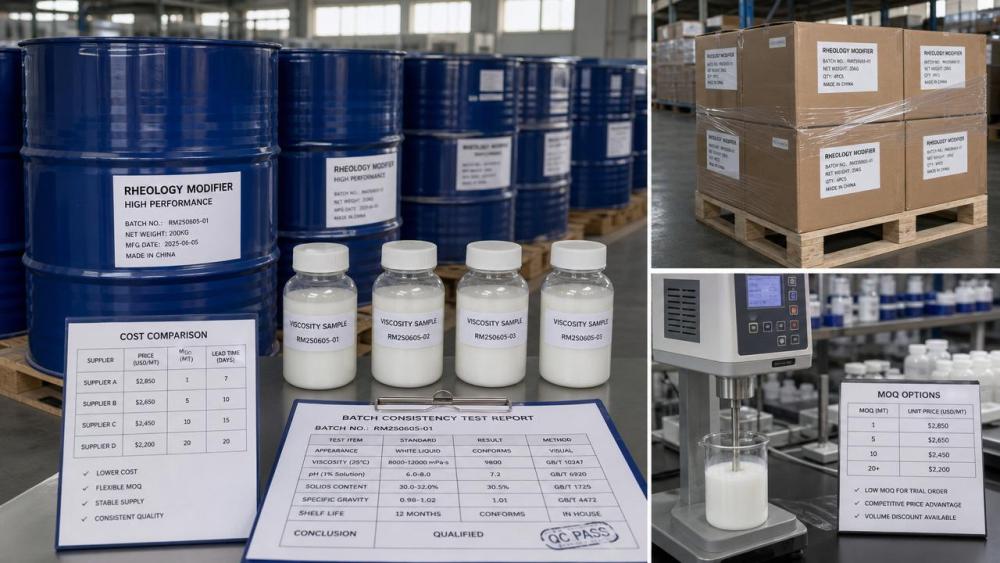
Choosing a rheology modifiers bulk supplier is rarely just a price exercise.
A low quote may look attractive first.
But procurement results depend on the full landed picture.
That includes MOQ, consistency, lead time, and technical support.
For many formulations, rheology modifiers control texture, suspension, spreadability, and process stability.
A mismatch at supplier level quickly becomes a plant-level problem.
This is why comparing a rheology modifiers bulk supplier needs a structured method.
The best decisions balance cost control with formulation reliability.
In practical sourcing, that balance protects margins and avoids hidden operating losses.
Why supplier comparison matters more than unit price
A cheaper drum does not always mean a cheaper formula.
If the dosage rises, real cost per finished batch may increase.
If viscosity drifts, rejection and rework costs appear fast.
That is the hidden risk when selecting a rheology modifiers bulk supplier only by quotation.
Recent market changes make this even more important.
Raw material volatility, freight swings, and compliance pressure all affect supplier performance.
A dependable rheology modifiers bulk supplier helps reduce those variables.
A weak supplier passes them downstream to your operations.
What usually drives total procurement cost
- Unit price per kilogram or per metric ton.
- Minimum order quantity and inventory carrying pressure.
- Required dosage to reach target viscosity or flow profile.
- Freight, customs, packaging, and warehousing costs.
- Batch approval delays and quality control workload.
- Technical failure costs during scale-up or reformulation.
When these factors are measured together, supplier rankings often change.
How to compare cost without missing hidden losses
Start with the delivered cost, not the factory-gate price.
Then compare performance at application level.
A rheology modifiers bulk supplier should be evaluated by cost-in-use.
This means asking how much material is needed in the real formulation.
Two products may share a similar specification sheet.
Yet one may require a higher addition level under your process conditions.
Use a simple landed cost checklist
- Confirm quoted basis, such as FOB, CIF, or delivered.
- Convert all offers into one common cost unit.
- Estimate usage level in the finished product.
- Add testing, validation, and safety stock costs.
- Factor in lead time risk and emergency purchase scenarios.
This process makes supplier comparison more realistic and less reactive.
It also creates stronger internal alignment between procurement and formulation teams.
Ask these cost questions early
- Does the rheology modifiers bulk supplier offer volume breaks?
- Is pricing stable for three, six, or twelve months?
- Can packaging size reduce waste or handling cost?
- Are samples and pilot quantities priced fairly?
- What surcharge applies for urgent shipments?
Small answers here often reveal large cost patterns later.
How MOQ shapes flexibility, cash flow, and risk
MOQ is one of the most underrated sourcing variables.
A competitive price can lose value if the minimum order is too high.
This is especially true during new product rollout or demand uncertainty.
The right rheology modifiers bulk supplier supports realistic buying patterns.
That may mean flexible batch sizes, split deliveries, or regional stock points.
Low MOQ is not always better
Very low MOQ can bring a higher unit price.
It may also signal limited production commitment.
The goal is not the lowest MOQ alone.
The goal is the best MOQ for forecast accuracy, storage capacity, and working capital.
What to review when comparing MOQ terms
In real sourcing, MOQ should be reviewed together with replenishment speed.
Why consistency is the real test of a rheology modifiers bulk supplier
Consistency is where many supplier comparisons become clear.
A stable rheology modifiers bulk supplier protects process repeatability.
That affects mixing time, pumpability, filling speed, and end-user feel.
Even minor variation can change product behavior noticeably.
This is especially true in sauces, dairy systems, personal care, and detergent applications.
Check more than the COA
A certificate of analysis is necessary, but not sufficient.
You also need to know how tightly the supplier controls process variation.
Ask for typical values, not only specification limits.
That gives a better view of normal production behavior.
Key consistency indicators to compare
- Viscosity range under defined test conditions.
- Particle size or hydration behavior.
- pH stability and electrolyte tolerance.
- Shear response and recovery profile.
- Lot-to-lot color, odor, and appearance stability.
- Retention of performance after shipping and storage.
A capable rheology modifiers bulk supplier can discuss these points clearly.
If answers stay vague, the sourcing risk is usually higher.
Questions that reveal supplier strength quickly
Good supplier evaluation does not require hundreds of questions.
A short, focused list often reveals more.
When assessing a rheology modifiers bulk supplier, concentrate on operational proof.
- How many production sites support this grade?
- What is the average lead time by region?
- Which applications are already validated commercially?
- Can the supplier share retention samples or trend data?
- How are non-conformances investigated and closed?
- Is there technical support during plant trials?
- What compliance documents are available immediately?
Clear, prompt answers usually indicate a more mature supply organization.
A practical scorecard for supplier selection
A scorecard helps convert subjective impressions into a comparable decision.
This is useful when several suppliers appear similar at first glance.
For a rheology modifiers bulk supplier, weighting should reflect actual business priorities.
The exact weights can change by application.
Still, this framework keeps comparison disciplined and practical.
Common buying mistakes and how to avoid them
Some procurement issues repeat across categories and regions.
The same patterns appear often with a rheology modifiers bulk supplier.
- Choosing by lowest quote before confirming dosage efficiency.
- Ignoring MOQ impact on warehouse space and cash flow.
- Approving samples without checking commercial lot consistency.
- Skipping contingency planning for dual sourcing.
- Overlooking transport conditions and moisture sensitivity.
- Delaying technical review until after commercial negotiation.
Avoiding these mistakes usually saves more than negotiating another small discount.
Final decision: choose the supplier that lowers total risk
The best rheology modifiers bulk supplier is not simply the cheapest option.
It is the supplier that delivers repeatable performance at a sustainable total cost.
That means acceptable MOQ, predictable quality, reliable delivery, and responsive support.
In actual business, this choice reduces reformulation pressure and protects production schedules.
It also creates better long-term leverage in price discussions.
Use a scorecard, test real batches, and compare cost-in-use carefully.
That approach makes supplier selection more confident and far less reactive.
When the next quotation arrives, review it through this wider lens.
That is how a smart procurement decision turns into a stronger supply chain outcome.
Related News
- Verifying halal status of hydrocolloid ingredients in the Middle EastOct 15, 2026Food Rheology Expert
- How cassava costs shape Thailand xanthan gum market pricesSep 29, 2026Food Rheology Expert
- Can Thailand's xanthan gum market support stable export supply?Sep 28, 2026Food Rheology Expert
- How food hydrocolloids prevent ice crystals in frozen dessertsSep 14, 2026Food Rheology Expert
Related News
- 00
0000-00
Verifying halal status of hydrocolloid ingredients in the Middle East - 00
0000-00
How to interpret active matter on a surfactant specification sheet - 00
0000-00
What Quality Checks Should You Run on Fragrance Ingredient Suppliers? - 00
0000-00
How to assess a flavor chemistry manufacturer's batch consistency - 00
0000-00
What drives fragrance ingredients price changes in bulk orders?
Food Rheology Expert
Weekly Insights
Stay ahead with our curated technology reports delivered every Monday.