





Rheology mistakes usually start before the first pilot run
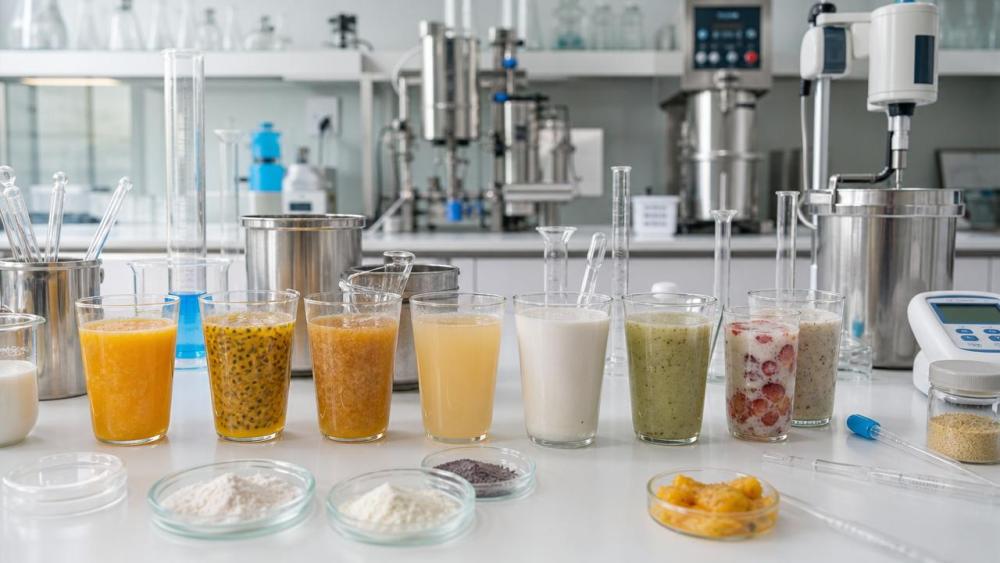
Choosing rheology modifiers for beverage industry formulas looks simple on paper.
In practice, it often decides whether a drink feels premium or unstable.
A small mismatch can trigger sedimentation, ring formation, poor pour, or heat-process failure.
The issue is not only texture.
It also affects clean label claims, flavor release, shelf life confidence, and batch reproducibility.
That is why rheology modifiers for beverage industry projects deserve broader judgment than viscosity alone.
Within the wider FMCG landscape, FFAI often frames thickeners as sensory control tools, not simple add-ons.
That perspective matters because beverage texture sits between chemistry, regulation, and consumer expectation.
Actual selection changes with the beverage scene
Different drinks fail for different reasons, even when they use similar hydrocolloids.
A high-acid fruit drink does not stress a modifier like a protein shake does.
A juice with pulp needs suspension control.
A botanical beverage may care more about haze management and flavor lift.
An indulgent dairy-style drink usually lives or dies by mouth-coating and flow recovery.
This is where common mistakes begin.
Teams often transfer a successful gum system from one format into another.
The composition looks close, but the stress profile is not.
pH, sugar load, alcohol level, calcium, homogenization, and thermal treatment all shift the result.
For rheology modifiers for beverage industry use, context is the real specification.
Where requirement differences become obvious
In fruit and acid systems, pH stability matters more than headline viscosity
Many fruit beverages are judged by brightness, flow, and clean taste.
That creates a trap.
A modifier can look ideal in neutral water, then lose structure after acidification.
The resulting drink may separate during storage or show uneven pulp distribution.
A second mistake is overbuilding body to solve suspension.
That often dulls top-note flavor and leaves a sticky finish.
For rheology modifiers for beverage industry formulations in this segment, the better approach is layered testing.
Check hydration behavior first.
Then verify acid tolerance, shear recovery, and storage drift after flavor addition.
FFAI frequently highlights how sensory performance and preservation strategy interact.
That is useful here because antioxidants, pigments, and hydrocolloids can influence each other over time.
Protein drinks create a different kind of failure
Protein beverages rarely fail because they are too thin alone.
More often, they fail because the texture becomes heavy, sandy, or unstable after processing.
The common mistake is treating hydrocolloid selection as an isolated viscosity adjustment.
In reality, protein source, mineral content, UHT exposure, and final pH reshape the network.
A gum that supports suspension in a plant protein drink may destabilize a dairy-protein system.
Another overlooked point is flavor release.
If the matrix holds aroma too tightly, the beverage can taste flatter than the formula suggests.
When selecting rheology modifiers for beverage industry applications here, it helps to test three moments.
- Immediately after homogenization, to assess process tolerance.
- After thermal treatment, to identify hidden thickening or collapse.
- Late in shelf life, to catch sediment compaction and flavor masking.
Suspension beverages need structure, not just thickness
Drinks with pulp, fiber, seeds, or added micronutrients are often judged too narrowly.
The assumption is that higher viscosity equals better suspension.
That is only partly true.
If the system lacks the right yield behavior, particles still settle.
If it becomes too thick, pouring becomes uneven and drinking comfort drops.
This is where rheology modifiers for beverage industry design should focus on flow profile.
Ask how the drink behaves after shaking, during pouring, and after resting on shelf.
A well-selected system recovers enough structure to hold particles again.
It does not create a gummy or elastic swallow.
The most costly mistake here is approving based on fresh batch appearance only.
Storage, transport vibration, and cold-chain interruption often reveal the real weakness.
Practical checks before locking a modifier system
- Confirm whether the target is suspension, creamy mouthfeel, or both.
- Measure behavior after pH adjustment, pasteurization, or UHT, not before.
- Review label declaration impact alongside functionality.
- Check compatibility with flavors, sweeteners, minerals, and preservatives.
- Test aging under real packaging and transport conditions.
Clean label projects change the decision logic again
Some beverage launches are driven as much by declaration language as by texture.
In these cases, the mistake is choosing rheology modifiers for beverage industry performance first, then discovering label friction later.
A technically strong system may complicate regional acceptance or brand positioning.
FFAI’s regulatory and formulation perspective is useful because clean label success is rarely just a sourcing issue.
It sits at the intersection of sensory expectation, compliance route, and market language.
The better judgment method is comparative.
Review what is gained in consumer-friendly labeling and what is lost in process tolerance or shelf-life margin.
That trade-off should be explicit before scale-up.
The most common misjudgments are rarely visible in supplier data sheets
One recurring error is trusting single-point viscosity data.
Beverages are dynamic systems, so one number says very little.
Another is ignoring hydration order.
The same modifier can perform very differently depending on dispersion sequence.
A third mistake is chasing lower ingredient cost while missing total implementation cost.
Rework, rejects, and shorter shelf stability quickly erase nominal savings.
It is also risky to assume one regional compliance path covers every export destination.
For rheology modifiers for beverage industry portfolios with cross-border ambitions, technical fit and regulatory fit must move together.
A better next step is to build a scene-based selection standard
The strongest beverage programs do not start from a favorite gum.
They start from the real operating scene.
Map the drink type, process conditions, package format, label goal, and target shelf life.
Then compare rheology modifiers for beverage industry candidates against those conditions, not against ideal lab water.
A practical review should include flow behavior, flavor impact, compatibility, compliance risk, and aging performance.
That kind of structured comparison is more valuable than chasing the highest viscosity or the shortest ingredient statement alone.
In beverage development, the right modifier is usually the one that survives the full scene, not the one that wins a quick bench test.
The next useful move is to define those scene conditions clearly, rank the non-negotiable parameters, and validate under real process stress.
Related News
- How cassava costs shape Thailand xanthan gum market pricesSep 29, 2026Food Rheology Expert
- Can Thailand's xanthan gum market support stable export supply?Sep 28, 2026Food Rheology Expert
- How food hydrocolloids prevent ice crystals in frozen dessertsSep 14, 2026Food Rheology Expert
- Which food texture modifiers for sauces prevent thinning after reheating?Sep 13, 2026Food Rheology Expert
Related News
- 00
0000-00
When does amino acid surfactant powder improve cleanser mildness? - 00
0000-00
How to verify a cosmetic nanotechnology supplier's safety documentation - 00
0000-00
How rheological thickeners for shampoo affect suspension stability - 00
0000-00
How to assess recombinant collagen ingredients for cream stability - 00
0000-00
How to evaluate anti-aging cosmetic compounds for wrinkle care
Food Rheology Expert
Weekly Insights
Stay ahead with our curated technology reports delivered every Monday.