





Thailand’s Food and Drug Administration (TFDA) put a new packaging-related compliance requirement into effect on June 6, 2026, requiring food additives and functional ingredients sold in sealed containers to pass specific migration limit (SML) testing and be supported by third-party test reports. For suppliers, exporters, buyers, contract manufacturers, and testing-related service providers handling products such as probiotic freeze-dried powders, antioxidant peptide preparations, and other compound-form ingredients, the change deserves attention because it shifts part of market access and delivery readiness toward packaging-material compliance rather than product composition alone.
What the new TFDA requirement clearly covers
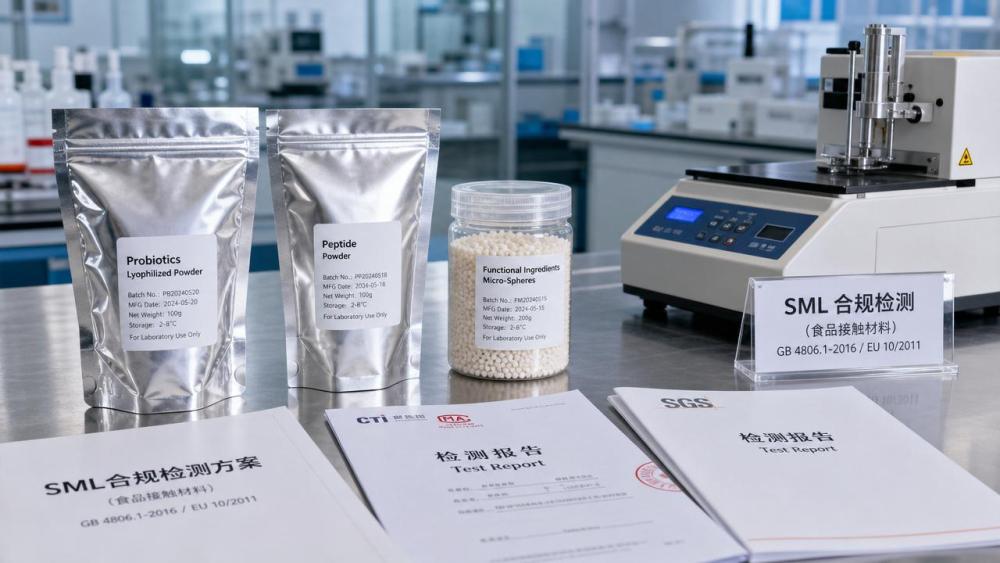
According to the provided event summary, the TFDA rule took effect on June 6, 2026. It applies to food additives and functional ingredients packaged in sealed containers including aluminum foil bags, aluminized film packaging, and plastic jars.
The requirement is that covered products must pass food-contact-material specific migration testing (SML) and submit a third-party testing report. The scope described in the input expressly includes anti-aging peptides, natural antioxidants, probiotic freeze-dried powders, compound-form products using Xanthan or Alginate thickener carriers, and high-purity hyaluronic acid microspheres.
Where the compliance impact is likely to appear first
Packaging-linked exporters and traders
From an industry perspective, exporters and trading companies are likely to feel the impact early because shipment readiness may now depend not only on product specifications but also on whether the sealed packaging format is supported by an SML test record and a third-party report. What deserves closer attention is whether commercial documents, product files, and shipment preparation materials are aligned with the packaging actually used for delivery.
Procurement teams buying functional ingredients
For procurement-side companies, the main issue is supplier qualification at the packaging-and-document level. Buyers sourcing probiotic powders, antioxidant ingredients, peptide preparations, or compound-form additives may need to verify in advance whether the supplied material comes in a covered sealed container and whether the required migration testing evidence is available before order confirmation or delivery scheduling.
Manufacturers working with composite forms
Processors and manufacturers using carrier-based or microsphere-form ingredients may also need to pay closer attention. Analysis shows that the rule’s inclusion of Xanthan/Alginate carrier systems and high-purity hyaluronic acid microspheres points to scrutiny extending beyond simple bulk powders toward more complex packaged formats, which may affect specification review, incoming material acceptance, and technical document management.
Testing and compliance support participants
Testing service providers and compliance support firms may see greater demand for migration-related document review and report matching. Observably, the practical issue is not only testing itself, but whether the report can clearly support the packaging configuration and product category presented in trade or regulatory submissions.
What companies should review now
Check whether the package format triggers the requirement
Companies should first review whether their products fall within the described sealed-container formats, especially where aluminum foil bags, aluminized films, or plastic jars are used for food additives or functional ingredients.
Match reports with actual delivered goods
Analysis shows that firms should pay close attention to the consistency between packaging materials, test reports, and shipped product forms. If the commercial pack, sample pack, or final delivery pack differs, the supporting compliance file may need closer review.
Prepare third-party documentation early in the transaction cycle
Because the input specifies submission of a third-party testing report, companies may need to place more emphasis on document readiness during quotation, sourcing, contracting, and delivery planning. This is especially relevant where buyers ask for technical files before approving procurement or import arrangements.
Keep watching for implementation language and market practice
The provided information confirms the effective requirement, but it does not provide further implementation detail. It is therefore advisable to keep tracking how the rule is described in official communications, how supporting documents are requested in practice, and whether purchasing or tender documents begin to reflect the new testing expectation more explicitly.
Why this looks like an execution signal, not just a headline
Observably, this development is more appropriate to understand as a rule now tied to market execution because an effective date and a concrete documentation requirement are both present in the provided information. At the same time, analysis should remain cautious: the input does not state how strictly different product types will be reviewed in practice, how documentation will be checked in specific transactions, or whether additional interpretive guidance will follow.
From an industry perspective, the key significance is that packaging compliance for sealed food-ingredient formats is becoming a more visible operational issue. That may affect not only regulatory review, but also supplier screening, order acceptance, delivery timing, and dispute prevention if documentation is incomplete or mismatched.
How the market should read this stage
At this stage, the development is best read as an already effective compliance change with direct relevance for packaged food additives and functional ingredients entering or circulating in the affected market context. It should not yet be overstated as a fully settled execution framework, because further practical interpretation, document expectations, and industry feedback may still evolve.
A rational takeaway is that companies involved in probiotic powders, antioxidant preparations, peptide ingredients, thickener-carrier systems, and similar sealed-container products should focus on packaging-related test evidence and third-party documentation readiness as a current compliance checkpoint.
Basis of this article and what still needs verification
This article is generated from the user-provided news title, event date, and event summary. For developments of this kind, relevant source types usually include official regulatory notices, releases from supervisory authorities, customs or trade-administration information, industry association updates, standard-setting documents, and reporting by authoritative trade media.
No specific official source link was provided in the input, so the exact official link remains to be verified on an ongoing basis. It is also still necessary to continue monitoring any later detail on implementation wording, certification or testing interpretation, changes in tender or procurement documents, market feedback, and how companies are applying the requirement in practice.
Related News
- Verifying halal status of hydrocolloid ingredients in the Middle EastOct 15, 2026Food Rheology Expert
- How cassava costs shape Thailand xanthan gum market pricesSep 29, 2026Food Rheology Expert
- Can Thailand's xanthan gum market support stable export supply?Sep 28, 2026Food Rheology Expert
- How food hydrocolloids prevent ice crystals in frozen dessertsSep 14, 2026Food Rheology Expert
Related News
- 00
0000-00
Verifying halal status of hydrocolloid ingredients in the Middle East - 00
0000-00
How to interpret active matter on a surfactant specification sheet - 00
0000-00
What Quality Checks Should You Run on Fragrance Ingredient Suppliers? - 00
0000-00
How to assess a flavor chemistry manufacturer's batch consistency - 00
0000-00
What drives fragrance ingredients price changes in bulk orders?
Food Rheology Expert
Weekly Insights
Stay ahead with our curated technology reports delivered every Monday.