





A hydrocolloid’s ingredient name does not establish its halal status. Gelatin requires verification of animal origin and, where applicable, slaughter compliance; fermentation-derived gums require scrutiny of production inputs; and plant or seaweed extracts still need review of processing aids, additives, and contamination controls. A halal certificate is useful only when it covers the material actually supplied, the relevant manufacturing site, and a certification body accepted for the intended destination.
For hydrocolloid ingredients entering Middle East markets, two separate questions must be resolved: whether the product meets the applicable halal requirements, and whether its evidence is accepted by the destination authority or customer. A technically credible certificate can still be unsuitable for an import route. Conversely, an ingredient without obvious animal content is not automatically supported well enough for use in a halal-certified finished product.
Establish the destination requirement before approving the supplier
The Middle East is not a single halal certification jurisdiction. Requirements differ between countries, product categories, import procedures, and customer certification schemes. A requirement applying to meat or animal-derived ingredients should not be assumed to apply identically to every plant-derived thickener. Equally, the absence of a mandatory certificate for a particular import category does not remove a finished-product manufacturer’s obligation to satisfy its own halal certification scheme.
Regional standards provide reference points, but they do not create automatic acceptance across borders. GSO 2055-1 addresses general requirements for halal food, while OIC/SMIIC 1 provides another general halal food framework. The applicable edition, national adoption, certification scheme, and destination-specific rules must be established rather than inferred from a standard number printed on a certificate.
For Saudi Arabia, the Saudi Food and Drug Authority and the Saudi Halal Center are relevant official sources for applicable requirements and certification-body recognition. For the United Arab Emirates, the Ministry of Industry and Advanced Technology’s halal conformity framework is a relevant starting point, alongside applicable import and food-control requirements. Other destinations require their own checks; acceptance in one Gulf market does not demonstrate acceptance throughout the region.
Before requesting a quotation, define the destination country, intended use, exact ingredient grade, and whether the material will enter a halal-certified finished product. Ask the importer or finished-product certification body which evidence is required. Keep regulatory acceptance and customer acceptance as separate approval criteria: either can prevent use of an otherwise acceptable ingredient.
The raw-material source determines where scrutiny should concentrate
Hydrocolloids do not present a uniform halal risk. The useful distinction is not simply “natural” versus “synthetic,” but which inputs and production stages could introduce prohibited materials or break traceability.
Gelatin: “bovine” is not a complete answer
Porcine gelatin is not acceptable for halal use. For bovine gelatin, species identification resolves only part of the question. Where the applicable scheme requires halal slaughter, the animal-material supply chain must satisfy that requirement, and certification must cover the resulting gelatin production. A bovine-origin declaration without corresponding halal evidence leaves a material gap.
Fish gelatin avoids the land-animal slaughter question, but its manufacturing inputs and handling still require assessment. Neither “fish-derived” nor “food-grade” replaces a review of the supplied product’s scope. Arguments based on chemical transformation should not be used to override the destination’s accepted certification scheme; interpretations are not uniform.
Fermentation-derived gums: review the inputs, not just the organism
Xanthan gum and gellan gum are produced through microbial fermentation. Their microbial origin does not by itself resolve the halal status of the fermentation medium. Carbon sources, nitrogen nutrients, antifoams, enzymes, and other auxiliaries can introduce questions about animal origin or other restricted inputs.
A sugar-based fermentation process is therefore insufficient evidence on its own. Nutrient mixtures may contain components whose sources are not apparent from their commercial names. Recovery and purification stages also matter. Where alcohols or other solvents are used, acceptance depends on the applicable scheme’s rules concerning origin, use, and residual presence; a blanket assumption that every alcohol-assisted process is prohibited is not a sound verification method.
Detailed formulations may be commercially confidential. That does not justify accepting an unsupported assurance. The supplier can provide confidential information directly to the certification body, while supplying written confirmation that the relevant inputs and process stages fall within the certified scope.
Plant and seaweed origin reduces some risks, not all
Guar gum, locust bean gum, pectin, agar, carrageenan, and alginates do not inherently raise the same animal-source concerns as gelatin. Their assessment can consequently be less extensive when a clear composition and process history are available. However, a plant-origin declaration describes the principal polymer, not necessarily everything in the commercial ingredient.
Standardizing sugars or salts, carriers, emulsifiers, preservatives, and processing aids can affect the assessment. A compounded stabilizer containing carrageenan is not equivalent to unblended carrageenan. The full supplied formulation must be reviewed, including ingredients that do not appear in the product’s abbreviated trade name.
Read the certificate as a scope document
A halal logo on a specification sheet or a certificate attached to an email is not enough. The certificate must connect a recognized issuer to an identifiable legal entity, manufacturing location, and product. Where products are listed in an annex, the annex is part of the evidence and must be retained with the certificate.
The central checks are:
- Issuer acceptance: Confirm that the certification body is accepted under the destination’s applicable framework and for the relevant product category. Accreditation or recognition elsewhere does not establish universal acceptance.
- Authenticity and status: Check the certificate number through the issuer’s official verification service or contact the issuer using independently obtained details. A valid-looking document may have been suspended, withdrawn, or altered.
- Product identity: Match the commercial name, grade, and product code to the specification and purchase order. A certificate for one grade should not be extended to another without documented coverage.
- Site coverage: Match the physical manufacturing address, not merely the supplier’s headquarters. Identify any blending, repacking, or outsourced operations that require inclusion.
- Dates and conditions: Check validity dates, exclusions, annexes, and any conditions affecting the order. Establish what evidence is required at production, shipment, and receipt rather than assuming one date settles every requirement.
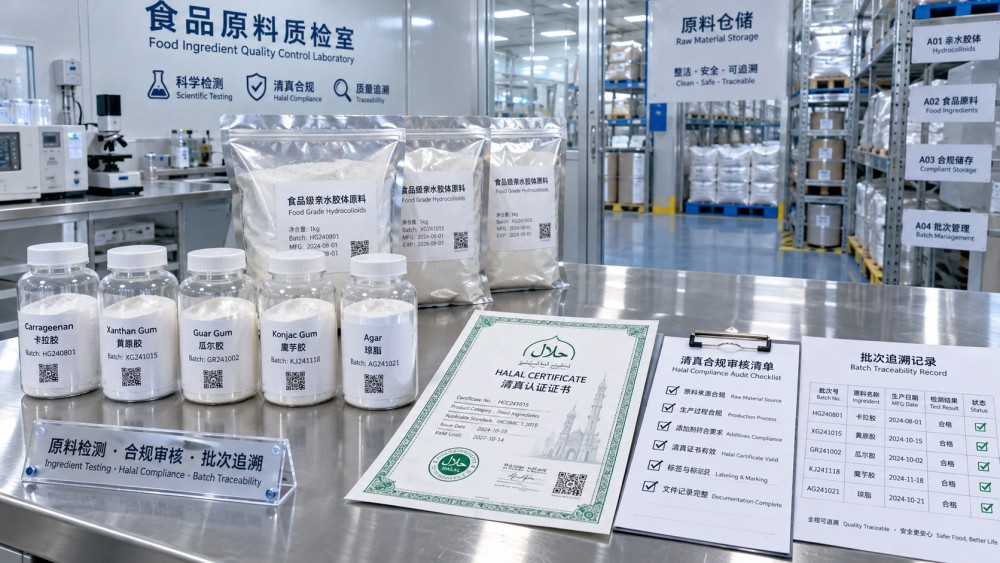
A distributor’s certificate deserves particular attention. Certification of trading or warehousing activities does not necessarily certify the manufacturing process. The approval file should link the trader’s supplied SKU to the original manufacturer’s certified product, while also covering any subsequent blending, repacking, or handling relevant to halal integrity.
A certificate stating “food additives” without an accessible product list may be too broad to establish coverage of a specific hydrocolloid. Likewise, a factory-level statement should not be treated as proof that every output is certified. If the scope is unclear, obtain written clarification from the issuer rather than relying solely on the sales representative’s interpretation.
Build traceability around the material actually delivered
Certificate approval establishes an eligible source; it does not prove that every delivery came from that source. The documentation chain should connect the approved product and site to the purchase order, batch number, packing label, delivery documents, and certificate of analysis. The certificate of analysis confirms specified batch characteristics, but does not independently establish halal status unless it carries appropriate supporting information.
Repacking can weaken this chain. A warehouse may replace the original lot number with its own code, split a batch, or combine materials into a blend. Such operations need records that preserve the connection to the original certified material. If the supplier cannot reconstruct that link, the problem is traceability, even where the underlying gum presents a low source-related risk.
Shared equipment also requires a process-specific assessment. Relevant questions concern exposure to prohibited materials, physical segregation, cleaning procedures, storage, and transport. Shared production is not automatically disqualifying, but controls must satisfy the applicable certification scheme. A generic food-safety cleaning statement does not establish that halal-specific requirements have been addressed.
Testing has a supporting role, not a universal one. Species testing can help investigate suspected animal-source substitution or contamination where the method is suitable for the matrix. A negative result, however, cannot establish compliant slaughter, acceptable fermentation nutrients, or adequate process controls. Extensive processing may also limit detectability. Laboratory evidence should answer a defined question rather than substitute for supply-chain verification.
Make approval conditional on controlled changes
An approved ingredient can lose its documented status without changing its viscosity specification. A manufacturer might change a nutrient supplier, introduce a different antifoam, move production, or outsource blending while maintaining the same commercial product code. Functional equivalence does not guarantee halal equivalence.
Supply agreements should require notification of changes affecting source, composition, processing aids, production site, subcontractors, or certification status. When a change falls outside the established scope, approval should be reassessed before affected material is released for the intended application. Alternative manufacturing sites and backup suppliers should receive their own review rather than inherit approval from the primary source.
For recurring orders, retain a controlled approval record containing the exact SKU, manufacturer and site, certificate and annex, verification date, destination acceptance basis, and any unresolved conditions. Check renewal before expiry and obtain updated evidence where the issuer changes scope or status. A renewed certificate still needs review: product listings and site coverage can change.
The practical release decision should distinguish a documented approval from an incomplete assessment. An exact product-and-site match, accepted issuer, suitable process evidence, and intact batch traceability support approval. A missing annex, unexplained repacking step, or certificate from an unaccepted body requires resolution before release for the specified halal use. Describing the material as “probably halal” does not close any of those gaps.
The strongest verification file answers two concrete questions: whether this exact hydrocolloid was produced under acceptable halal controls, and whether this shipment can be traced to that approved production. Ingredient names, logos, and general declarations are starting points. Destination acceptance, certificate scope, and shipment-level traceability are what make the sourcing decision defensible.
Related News
- How to choose food hydrocolloids for gluten-free breadNov 03, 2026Food Rheology Expert
- How to choose food-grade hydrocolloid ingredients for stable saucesOct 30, 2026Food Rheology Expert
- How to assess a bio-based thickener manufacturer's batch consistencyOct 16, 2026Food Rheology Expert
- Verifying halal status of hydrocolloid ingredients in the Middle EastOct 15, 2026Food Rheology Expert
Related News
- 00
0000-00
Wissen Research: Global Cosmetics Market to Reach $497.2 Billion by 2031 - 00
0000-00
Can biomimetic peptides improve skin firmness? - 00
0000-00
China Records 543 New Cosmetic Ingredients, Including 167 in 2026 - 00
0000-00
How to check a fragrance raw material specification for IFRA compliance - 00
0000-00
Australia and New Zealand Weigh Wider Steviol Glycoside Use in Griddle Products
Food Rheology Expert
Weekly Insights
Stay ahead with our curated technology reports delivered every Monday.