





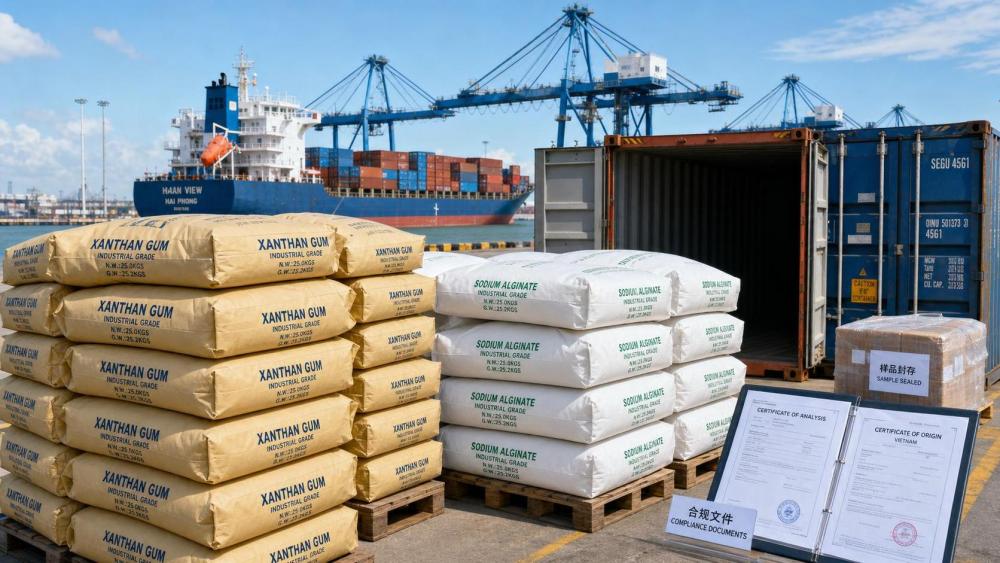
Vietnam will enforce a stricter import control step for xanthan gum and sodium alginate from 15 July 2026, as the General Department of Vietnam Customs (GDVC) requires mandatory pre-shipment inspection before these goods are loaded for shipment. For exporters, import-facing trading companies, procurement teams, and certification-related service providers, the change is worth close attention because it moves compliance checks further forward in the delivery process and links shipment release readiness more directly to a Certificate of Conformance (CoC) issued by an ISO/IEC 17065-accredited body.
What the 15 July requirement confirms
According to the information provided, GDVC has announced mandatory pre-shipment inspection (PSI) for all xanthan gum and sodium alginate imports, with enforcement starting on 15 July 2026. The same information states that a Certificate of Conformance (CoC) issued by an ISO/IEC 17065-accredited body, including examples such as SGS, BV, and Intertek, is required before vessel loading. The announced change is also described as affecting lead times and the allocation of related costs for exporters.
Where the rule change is likely to be felt first
Shipment planning moves closer to certification timing
From an industry perspective, exporters and direct trading companies are likely to feel the immediate effect because the compliance requirement now sits before vessel loading rather than later in the logistics chain. That means shipment scheduling, document readiness, and booking coordination may need to align more tightly with inspection and CoC issuance.
Procurement teams may need to reassess delivery assumptions
For buyers and procurement-facing businesses handling xanthan gum or sodium alginate imports into Vietnam, the practical issue is not only whether product is available, but whether it can be shipped with the required CoC in time. Analysis shows that purchase planning, contract timing, and expected arrival windows may need closer review where supply commitments were previously based mainly on production and freight arrangements.
Certification and inspection service providers gain a more operational role
For accredited conformity assessment bodies and related service organizations, the rule change gives certification a more operational function in trade execution. What deserves closer attention is that the CoC is no longer just a supporting compliance document in this context; it becomes a pre-loading condition tied directly to shipment readiness for the covered hydrocolloids.
Cost allocation may become a live commercial issue
Observably, the summary already points to cost allocation as an area of impact for exporters. That suggests companies involved in cross-border transactions may need to review who bears inspection-related fees, document handling burdens, and delay risks when a shipment cannot proceed until the required conformity evidence is in place.
What companies should review now
Check whether current document workflows are sufficient
Analysis shows that companies dealing in the affected products should review whether their existing export and import documentation process can support a pre-loading CoC requirement. The key point is not to assume that standard commercial and shipping documents alone will be enough once PSI becomes mandatory.
Confirm the accreditation basis behind the CoC
Because the provided information specifically refers to ISO/IEC 17065-accredited bodies, firms should pay close attention to the qualification basis of whichever body they plan to use. Where supplier approval or buyer qualification systems already exist, this requirement may need to be reflected in vendor screening and transaction preparation.
Revisit lead-time commitments in sales and procurement
What deserves closer attention is the timing effect created by a mandatory inspection step before loading. Companies may need to recheck internal lead-time assumptions, customer promises, and procurement windows so that certification timing is treated as part of the delivery schedule rather than as a parallel administrative task.
Keep watching for execution details and wording changes
The information provided confirms the new requirement and enforcement date, but it does not include fuller operational detail. It is therefore more appropriate to understand current actions as preparation and monitoring rather than as a response to a fully detailed implementation manual. Businesses should continue to watch for official wording, execution interpretations, and any transaction-specific document expectations that may emerge around enforcement.
How this change is best understood at this stage
Observably, this is more than a general policy signal because an enforcement date has been identified and the required compliance instrument has been specified. At the same time, analysis shows it should still be treated as a rule change whose day-to-day execution may depend on how inspection practice, document review, and trade documentation expectations are applied in actual transactions. For the market, the immediate message is that conformity control for the covered hydrocolloids is moving earlier in the shipment cycle.
A practical reading for the market
In practical terms, this development is best read as an implemented compliance requirement with operational consequences for shipment preparation, procurement timing, and commercial cost discussions. It does not by itself establish every downstream outcome, but it clearly signals that exporters and import-related businesses handling xanthan gum and sodium alginate should place pre-shipment conformity arrangements higher on their execution checklist ahead of 15 July 2026.
Basis of this article and what still needs verification
This article is based on the user-provided news title, event date, and event summary concerning Vietnam's tighter pre-shipment inspection requirement for xanthan gum and sodium alginate imports. For developments of this kind, relevant source types would usually include official notices, customs or trade authority releases, regulatory announcements, industry association updates, standard-related documents, and reporting from established professional media. A specific official source link was not provided in the input, so the exact official text and subsequent implementing details still require ongoing verification. Areas that remain worth monitoring include detailed enforcement wording, certification application in practice, document expectations in trade execution, procurement and tender document adjustments, and market feedback from affected companies.
Related News
- Verifying halal status of hydrocolloid ingredients in the Middle EastOct 15, 2026Food Rheology Expert
- How cassava costs shape Thailand xanthan gum market pricesSep 29, 2026Food Rheology Expert
- Can Thailand's xanthan gum market support stable export supply?Sep 28, 2026Food Rheology Expert
- How food hydrocolloids prevent ice crystals in frozen dessertsSep 14, 2026Food Rheology Expert
Related News
- 00
0000-00
Verifying halal status of hydrocolloid ingredients in the Middle East - 00
0000-00
How to interpret active matter on a surfactant specification sheet - 00
0000-00
What Quality Checks Should You Run on Fragrance Ingredient Suppliers? - 00
0000-00
How to assess a flavor chemistry manufacturer's batch consistency - 00
0000-00
What drives fragrance ingredients price changes in bulk orders?
Food Rheology Expert
Weekly Insights
Stay ahead with our curated technology reports delivered every Monday.