





On May 31, 2026, the European benchmark spot price for WPC80 moved up to €26,450 per ton, putting protein cost pressure back at the center of formulation and procurement decisions. For sports nutrition, meal replacement, and infant formula businesses, the key issue is not only the price spike itself, but also the faster shift toward xanthan and alginate hydrocolloids as overseas formulators look for workable stability alternatives under supply chain stress.
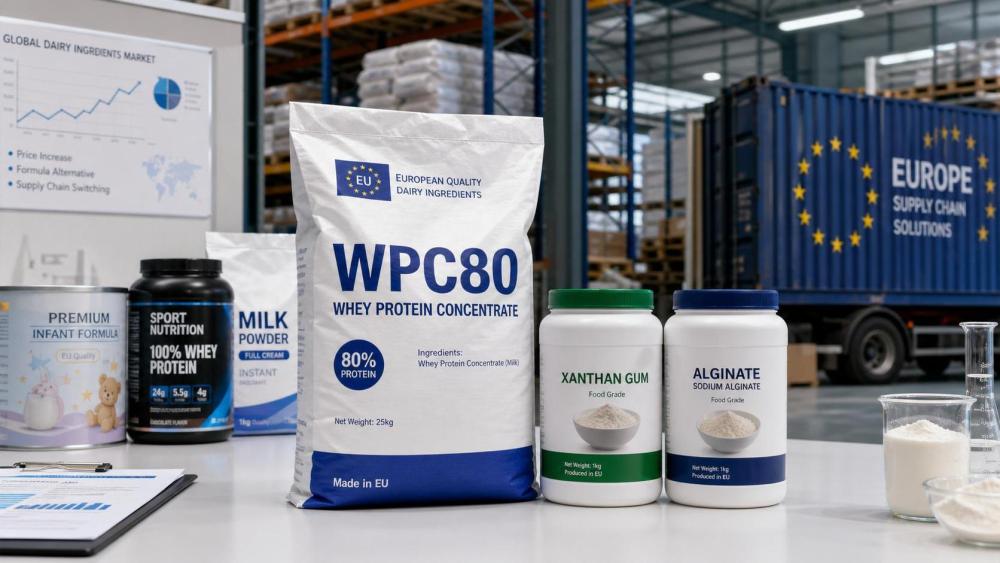
What the market has confirmed so far
As of the end of May 2026, the European benchmark spot price for whey protein concentrate 80% (WPC80) reached €26,450 per ton. Compared with June 2025, that level represents an increase of nearly 90%.
The reported drivers behind the higher raw material cost are disruption to Red Sea shipping, reduced milk supply in New Zealand, and continued protein demand linked to GLP-1 medications.
At the same time, xanthan and alginate hydrocolloids have been highlighted as stable substitute options. Inquiries for these materials in sports nutrition, meal replacement, and infant formula rose 63% week on week, and they have become a key option for overseas formulators making urgent supply chain switches.
Where the pressure is likely to show up first
Procurement teams face a dual challenge of cost and continuity
From an industry perspective, buyers of protein-based formulations may be affected first because the WPC80 move directly changes raw material budgets while also forcing faster sourcing decisions. The main pressure points are supplier allocation, quote validity, replacement material screening, and delivery timing.
What deserves closer attention is whether procurement activity shifts from price optimization to supply assurance, especially in applications where reformulation windows are short.
Formulators and manufacturers must reassess recipe stability
For processors and finished-product manufacturers, the impact is likely to appear in formulation work rather than in pricing alone. Where WPC80 costs rise sharply, xanthan and alginate are drawing more attention as stabilizing alternatives, particularly in sports nutrition, meal replacement, and infant formula.
Analysis shows that the practical issue is not simply replacing one ingredient with another, but managing texture, stability, and product consistency while supply chains are being adjusted.
Supply chain service providers may see urgency rise
For logistics and supply chain service participants, the event matters because Red Sea shipping disruption is already part of the confirmed cost backdrop. This means lead times, routing reliability, and coordination between ingredient suppliers and overseas customers may receive greater scrutiny.
Observably, service performance becomes more visible when customers are making emergency sourcing changes rather than routine replenishment decisions.
What companies should watch now
Track whether price pressure continues to reshape ingredient priorities
Companies should closely watch whether WPC80 remains at elevated levels and whether alternative hydrocolloid inquiries continue to stay active in the named application sectors. The current signal is that substitution interest is linked directly to cost and supply pressure rather than to a broad, confirmed structural replacement.
Separate emergency substitution from long-term qualification
Businesses should distinguish between immediate sourcing action and longer qualification work. Xanthan and alginate may be receiving urgent attention, but actual commercial use still depends on internal review, formulation fit, and customer acceptance in each end-use category.
Review supplier documentation and fulfillment timing
Given that overseas formulators are switching supply chains quickly, supplier qualification materials, product documentation, and fulfillment timelines become more important in day-to-day execution. For teams in active negotiations, customer communication around availability and delivery expectations may matter as much as quoted price.
Focus on the most exposed categories first
The sectors specifically referenced in the market update are sports nutrition, meal replacement, and infant formula. Companies with exposure to these categories may need to prioritize scenario planning there first, rather than applying the same response across all product lines.
Why this matters beyond a single price point
Analysis shows that this development should be read as more than a one-day commodity headline. The combination of freight disruption, reduced milk supply, and demand-side protein support points to a multi-factor cost environment rather than a single isolated trigger.
At the same time, it is more appropriate to understand the surge in xanthan and alginate inquiries as a live market reaction, not yet as proof of a completed long-term substitution cycle. The current significance lies in how quickly formulators are testing alternatives when protein economics tighten.
For the industry, continued observation is necessary because the next phase depends on whether elevated WPC80 pricing persists and whether substitute demand turns from inquiry volume into stable purchasing behavior.
How this update is best understood for now
At this stage, the most balanced reading is that the market is showing both acute cost stress and an immediate search for formulation flexibility. The confirmed facts point to a sharp WPC80 price rise and a rapid increase in xanthan and alginate inquiries in selected application areas.
What deserves closer attention is whether this remains a short-term response to disrupted supply conditions or develops into a longer-running change in ingredient purchasing patterns. For now, it is more appropriate to treat the event as a strong industry signal that still requires follow-up verification.
Basis of this article
This article is generated from the user-provided news title, event date, and event summary. The confirmed basis includes the reported WPC80 price level, the stated year-on-year comparison, the cited drivers of raw material cost pressure, and the reported increase in xanthan and alginate inquiry activity.
For this type of market update, source categories typically worth checking include official statements, company disclosures, industry association information, authoritative media reporting, and standard-setting or trade documentation where applicable.
No specific official source link was provided in the input, so the exact source trail still needs ongoing verification. Follow-up attention should focus on subsequent market disclosures around WPC80 pricing, shipping conditions, milk supply developments, and whether substitute inquiries translate into sustained procurement activity.
Related News
- How cassava costs shape Thailand xanthan gum market pricesSep 29, 2026Food Rheology Expert
- Can Thailand's xanthan gum market support stable export supply?Sep 28, 2026Food Rheology Expert
- How food hydrocolloids prevent ice crystals in frozen dessertsSep 14, 2026Food Rheology Expert
- Which food texture modifiers for sauces prevent thinning after reheating?Sep 13, 2026Food Rheology Expert
Related News
- 00
0000-00
How to interpret active matter on a surfactant specification sheet - 00
0000-00
What Quality Checks Should You Run on Fragrance Ingredient Suppliers? - 00
0000-00
How to assess a flavor chemistry manufacturer's batch consistency - 00
0000-00
What drives fragrance ingredients price changes in bulk orders? - 00
0000-00
How to assess a food antioxidants distributor’s traceability practices
Food Rheology Expert
Weekly Insights
Stay ahead with our curated technology reports delivered every Monday.