





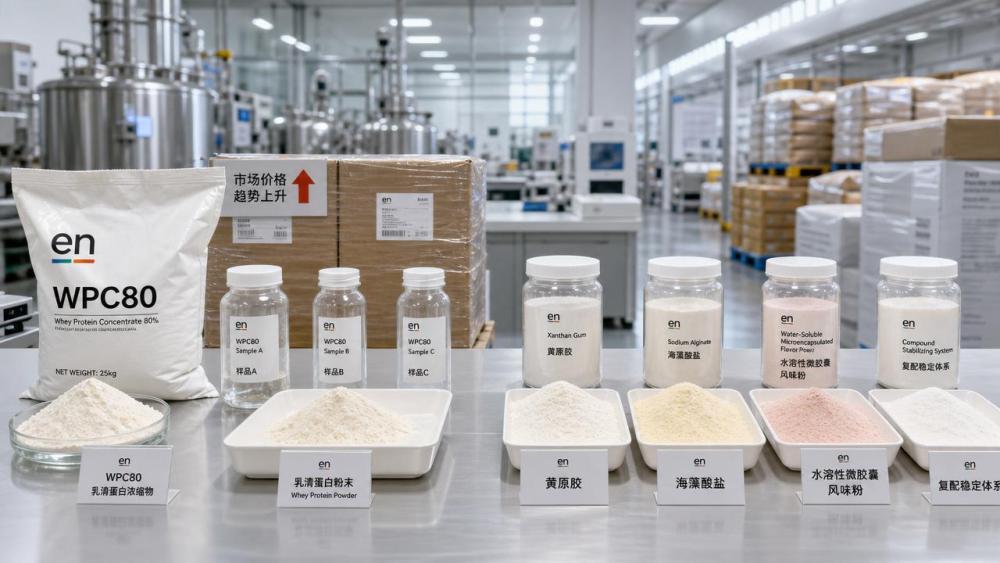
On June 12, 2026, the domestic industrial-grade price of WPC80 in China moved above RMB 190,000 per ton, nearly doubling year on year as global whey supply remained tight. For ingredient buyers, food manufacturers, formulation teams, and overseas sourcing managers, the key issue is not only the price jump itself, but also the speed at which substitution is shifting toward xanthan/alginate hydroxypropyl-modified thickening systems, water-soluble encapsulated flavor solutions, and compound stabilization technologies built around natural antioxidant peptides.
What the market has already confirmed
The confirmed event is straightforward. Against a backdrop of constrained global whey availability, China’s domestic quotation for industrial-grade WPC80 exceeded RMB 190,000 per ton in June 2026. The reported level was close to twice that of the same period a year earlier.
The same market move is also linked with a visible downstream response. Higher whey protein costs are accelerating interest in alternative solution paths, including xanthan/alginate hydroxypropyl-modified thickening systems, water-soluble flavor microencapsulation, and compound stabilization technologies using natural antioxidant peptides.
For overseas food manufacturers, the available information also indicates that China’s production flexibility and response speed in natural hydrocolloids, microencapsulated flavors, and blended preservative systems are becoming an important substitute option.
Where the pressure is likely to be felt first
Procurement teams face immediate cost and formulation pressure
From an industry perspective, buyers of whey-related ingredients are likely to feel the impact first because the price surge directly affects raw material budgeting and formula economics. What deserves closer attention is whether procurement decisions now shift from single-ingredient replacement toward broader system selection involving texture, flavor delivery, and stability.
Manufacturers must reassess processing and product consistency
For processing manufacturers, the issue is not limited to ingredient substitution on paper. Analysis shows that a move from WPC80 toward modified thickening systems or encapsulated flavor solutions can affect multiple production links, including formulation balance, processing compatibility, and finished-product consistency. The practical impact is therefore concentrated in R&D validation, production adjustment, and delivery reliability.
Overseas sourcing managers may widen their supplier map
For overseas food manufacturers and sourcing teams, the development draws attention to China’s role as an alternative supply base in natural hydrocolloids, microencapsulated flavors, and compound preservative systems. Observably, the relevant business focus is likely to center on supply responsiveness, specification matching, and the ability to move quickly when whey-based costs become difficult to absorb.
Supply chain service providers need closer coordination on lead times
Supply chain and service partners may also need to monitor changes in order structure. If downstream users shift from whey protein purchases to functional replacement systems, the operational focus can move toward specification confirmation, fulfillment timing, and communication across procurement, production, and export-facing teams.
What companies should monitor now
Track substitution demand by solution type
What deserves closer attention is which alternative path customers are actually prioritizing: hydroxypropyl-modified xanthan/alginate systems, water-soluble flavor microencapsulation, or natural antioxidant peptide-based compound stabilization. These are not interchangeable in the same way, so inquiry patterns matter as much as price movement.
Verify supplier capability beyond product availability
For companies evaluating Chinese supply options, the practical issue is not only whether material is available, but whether the supplier can support specification consistency, documentation, and delivery rhythm. Analysis shows that rapid response capacity becomes more important when customers are managing urgent reformulation or substitution timelines.
Prepare customer communication around formula transition
Manufacturers and traders should also pay attention to how substitution is explained to customers. Where whey protein costs are forcing a change, communication may need to cover the functional logic of the replacement route, especially when the solution involves texture systems, flavor encapsulation, or compound stabilization rather than a direct one-to-one swap.
Watch the gap between demand interest and actual conversion
Observably, rising interest in alternatives does not automatically mean immediate large-scale conversion. Companies should distinguish between initial inquiry activity and actual purchasing or implementation, particularly in projects that require technical review, sample validation, or cross-border coordination.
Why this looks bigger than a single price spike
Analysis shows that this development should not be read only as a short-term raw material fluctuation. It also points to a broader market response in which cost pressure is pushing customers toward integrated functional alternatives rather than simply cheaper protein inputs. That said, it is still too early to frame this as a settled structural shift across all food applications based only on the information provided.
It is more appropriate to understand this as a strong industry signal with immediate commercial consequences and a possible longer-term effect on formulation choices, especially where buyers are already evaluating natural hydrocolloids, water-soluble flavor systems, and blended preservation solutions.
How this news is best understood for now
At this stage, the most balanced reading is that the WPC80 price surge highlights both supply vulnerability in whey-related inputs and the commercial relevance of substitute ingredient systems. The confirmed facts point to cost escalation and faster downstream interest in alternatives; the broader outcome, however, still depends on how much of that interest turns into repeat orders, validated formulations, and stable procurement behavior.
For industry participants, this is best treated as a live market signal rather than a closed conclusion. The immediate priority is to watch how substitution demand develops across thickening, flavor delivery, and compound stabilization applications.
Basis of this article
This article is based on the user-provided news title, event date, and event summary. No specific official source link was provided in the input, so the exact original official reference still requires ongoing verification.
For this type of industry update, source categories commonly relevant for follow-up checking include official announcements, company statements, industry association information, authoritative media coverage, and standard-setting documents. The main areas that still merit continued observation are subsequent market statements, downstream purchasing behavior, and whether substitute demand develops into sustained order conversion.
Related News
- How cassava costs shape Thailand xanthan gum market pricesSep 29, 2026Food Rheology Expert
- Can Thailand's xanthan gum market support stable export supply?Sep 28, 2026Food Rheology Expert
- How food hydrocolloids prevent ice crystals in frozen dessertsSep 14, 2026Food Rheology Expert
- Which food texture modifiers for sauces prevent thinning after reheating?Sep 13, 2026Food Rheology Expert
Related News
- 00
0000-00
What drives fragrance ingredients price changes in bulk orders? - 00
0000-00
How to assess a food antioxidants distributor’s traceability practices - 00
0000-00
How minimum order quantities shape private label ingredient sourcing costs - 00
0000-00
What drives personal care ingredient price volatility in sourcing - 00
0000-00
What drives micelles price differences in cosmetic formulations?
Food Rheology Expert
Weekly Insights
Stay ahead with our curated technology reports delivered every Monday.