





Xanthan gum is usually the best first candidate for acidic cosmetic formulas when reliable thickening and suspension matter more than perfect transparency or an exceptionally light skin feel. In an exfoliating serum or low-pH emulsion, a thickener that performs well in water can lose structure after acids, neutralizers, salts, and preservatives are added. The result may be a watery serum, settling particles, or an emulsion that separates during storage.
The answer changes when the product brief prioritizes clarity, reduced stringiness, or compatibility with charged ingredients. Sclerotium gum is worth screening alongside xanthan for sensory reasons, while other natural hydrocolloids have narrower processing or compatibility windows. Rather than selecting on pH tolerance alone, compare candidates in the complete acid system, at the intended storage conditions and dispensing format.
Start with the acid system, not just the pH number
A glycolic acid serum and a citric-acid-adjusted moisturizer can have the same measured pH but place different demands on a hydrocolloid. Total acid concentration, degree of neutralization, dissolved salts, solvents, and water availability all influence polymer hydration and rheology.
Partial neutralization introduces counterions and increases the ionic load. Botanical extracts, mineral ingredients, and active blends may introduce additional electrolytes that are not obvious from the marketing description. A viscosity change after adding an active therefore does not automatically mean the gum cannot tolerate acidity.
Before screening thickeners, record these formulation conditions:
- Target pH and acceptable drift: Measure the finished formula after equilibration, not only immediately after acid addition.
- Acid identity and concentration: Include the acid supplied through premixes, not just the separately added acid.
- Neutralizing agents and electrolytes: Account for salts introduced by buffers, extracts, and active solutions.
- Solvent environment: Alcohol and high polyol levels can change hydration and texture.
- Required structure: A pourable serum, suspended-particle gel, and pumpable emulsion do not need the same flow behavior.
Clarity also needs a defined acceptance criterion. “Clear enough in a thin laboratory vial” is different from transparent in a full retail bottle. Judge appearance in a representative optical path and distinguish trapped air from genuine polymer haze.
Which hydrocolloids deserve a place in the screening panel?
This comparison is a starting point, not a guarantee for every commercial grade. Molecular characteristics, purification, particle size, and blends can alter hydration, appearance, and viscosity. Obtain the supplier’s application guidance for the exact material under consideration.
Xanthan: the most useful reference formulation
Xanthan develops strong shear-thinning behavior: the product resists movement at rest but flows more easily during pumping or spreading. That makes it useful when an acidic serum must remain pourable while limiting particle settling. It can also support the continuous phase of an emulsion, although it does not replace an appropriate emulsifier system.
Its broad acid tolerance is an advantage over polymers whose thickening depends heavily on neutralization. However, “acid tolerant” does not mean indefinitely stable under any combination of low pH, elevated temperature, and storage time. Test the complete formula rather than relying on a broad pH range stated for an aqueous gum solution.
The main compromise is sensory. Raising xanthan concentration may improve low-shear structure while increasing drag, tack, or filament formation between the fingers. Transparent grades can improve appearance, but the finished formula may still be hazy because of other ingredients or interactions.
Sclerotium: a meaningful sensory alternative
Sclerotium gum is a nonionic polysaccharide that can provide a different texture from xanthan. It is a useful candidate when the xanthan reference meets stability requirements but feels too stringy or heavy. Its nonionic character may also help avoid some charge-driven interactions, although compatibility still requires testing.
Do not assume that replacing xanthan with sclerotium at the same percentage will preserve viscosity, suspension, or dispensing behavior. Compare each at a concentration appropriate to its performance. Hydration conditions and supplier grade can strongly influence the outcome.
A xanthan–sclerotium blend can be screened where neither gum alone delivers the desired balance. Treat improved sensory feel or structure as a hypothesis to verify, not an automatic synergy.
Why the remaining gums are not default choices
Native guar and locust bean gum can be useful formulation tools, but strongly acidic storage conditions may promote chain degradation, especially when combined with heat. Locust bean gum also commonly needs elevated-temperature hydration, which can complicate processing around sensitive actives.
Alginate, pectin, and carrageenan introduce additional dependencies on ion content, polymer type, and processing. Calcium-triggered structure, acid-induced changes, or excessive rigidity may be desirable in a specialized gel but troublesome in a facial serum. Their natural origin alone is not a sufficient reason to select them.
Build a comparison that answers the product brief
A useful screen separates processing failure from genuine ingredient incompatibility. Begin with a simple base, then add the components that make the intended formula difficult. Comparing several incomplete prototypes without controlled conditions can produce a misleading winner.
- Prepare hydrated polymer references. Use the supplier’s recommended dispersion and hydration procedure. Establish appearance and flow before adding the acid system.
- Add the intended acid and neutralizer. Keep acid identity, concentration, final pH, and addition order consistent across candidates.
- Introduce the remaining formulation loads. Include solvents, active blends, preservatives, and electrolytes at their intended levels. Check after each major addition.
- Allow equilibration before judging. Record pH and rheology after a defined rest period. Immediate readings may reflect incomplete hydration, temperature differences, or trapped air.
- Compare equivalent performance. Adjust concentrations where necessary to reach a useful application texture, rather than requiring every gum to work at the same dosage.
- Test the dispensing package. Evaluate pump force, droplet control, stringing, and recovery after dispensing. A satisfactory beaker texture may still perform poorly in use.
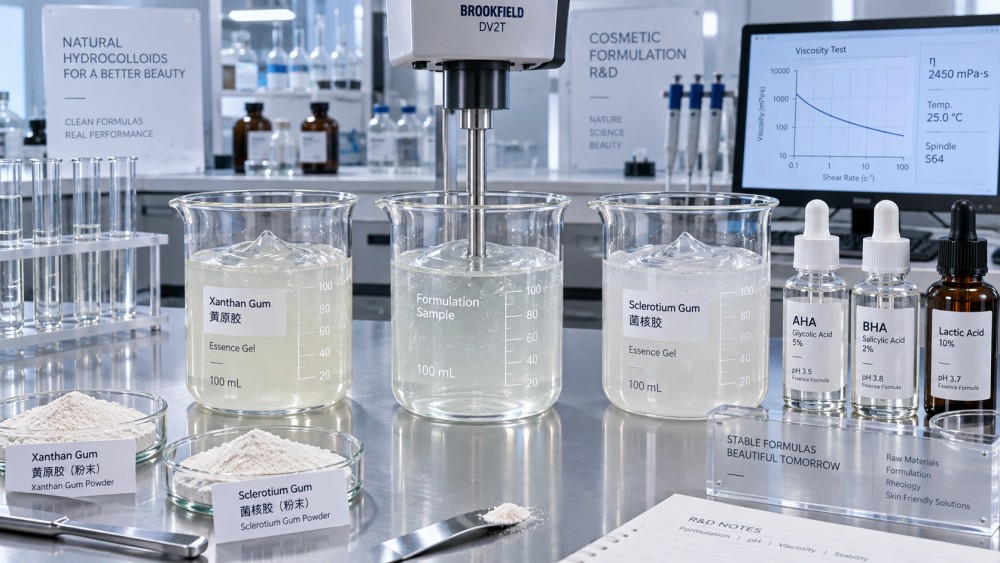
Keep a fixed measurement method. For a rotational viscosity test, document instrument geometry or spindle, speed, temperature, sample preparation, and reading time. Since these materials are shear-thinning, a viscosity value without measurement conditions is not a dependable comparison.
For particle suspension, assess low-shear structure and actual settling rather than viscosity alone. For emulsions, monitor droplet behavior and separation as well as bulk thickness. A thicker water phase may slow instability without correcting an unsuitable emulsifier system.
Hydrate first, then challenge the polymer
When the process allows, disperse and hydrate the gum in a suitable aqueous phase before exposing it to the full acid, electrolyte, or solvent load. Premixing powder into a compatible humectant can help prevent clumps, provided enough water remains available for hydration and the supplier supports that method.
Adding dry gum directly into an already acidic, concentrated active solution can create partially hydrated particles with wet outer surfaces and dry centers. These lumps may be mistaken for insolubility or acid incompatibility. More mixing does not always repair them efficiently.
Add acids gradually with adequate mixing to reduce locally concentrated acidic zones. Where heating is necessary for hydration, consider whether the acid should be introduced after cooling. Avoid unnecessary hot holding of acidified polymer solutions, since acidity and temperature together can accelerate degradation.
Processing must also fit the other ingredients. Follow relevant temperature and shear restrictions for actives, emulsifiers, and preservatives rather than optimizing the gum in isolation. Recheck final pH after the complete batch has equilibrated.
Read the failure pattern before changing the gum
Viscosity falls immediately after an addition
First check dilution, temperature, and measurement conditions. Then repeat the addition in a small controlled sample. An immediate change after neutralizer addition points toward ionic effects; a change after a cationic ingredient may indicate polymer interaction or complex formation. Xanthan is anionic, so compatibility with cationic materials deserves particular attention.
Separate cloudiness, precipitation, and thinning in the observations. They may arise from different mechanisms and need different corrections.
The formula looks acceptable initially but thins in storage
Investigate pH drift, thermal exposure, acid-driven chain degradation, and microbiological deterioration. Track pH and rheology together. A stable pH does not rule out polymer degradation, while a changing pH can also affect active solubility and preservation.
Evaluate samples under storage conditions relevant to the intended product, alongside appropriate accelerated conditions. High-temperature screening can reveal weaknesses, but it does not by itself establish shelf life. Use the observed failure to design follow-up testing rather than converting it directly into a shelf-life prediction.
Increasing gum solves settling but ruins the skin feel
This indicates a mismatch between the required resting structure and acceptable application texture. Screen a different grade, a second hydrocolloid, or a blend before continuing to increase concentration. Also examine particle size, density, and wetting: suspension problems may not be solved efficiently by polymer concentration alone.
In emulsions, inspect the emulsifier and droplet structure. Using extra gum to conceal separation can produce an unpleasant texture while leaving the underlying instability unresolved.
Set the acceptance boundary before selecting the winner
The strongest candidate should meet predefined limits for appearance, pH drift, flow, dispensing, and storage stability. Include skin feel after dry-down, because tack may become more evident as water evaporates. Where layering matters, assess pilling with representative complementary products rather than judging the serum only on bare skin.
Natural origin does not establish preservation, skin tolerance, or compliance. Hydrocolloid-containing formulas still need a suitable preservation system and microbiological validation. Acidic pH may help preservation, but it is not a substitute for testing. Exfoliating formulas also require safety assessment of the acid system and intended use; successful thickening says nothing about irritation potential.
For natural-positioning claims, verify the exact ingredient’s sourcing and processing against the chosen claim standard. Native gums, chemically modified derivatives, and commercial blends should not automatically be treated as interchangeable.
Choose xanthan when it meets the sensory brief and survives complete-formula testing. Move to sclerotium or a tested blend when the xanthan reference is stable but fails on feel, appearance, or compatibility. When every candidate loses viscosity, revisit hydration, neutralization, solvent load, and storage conditions before assuming that another natural gum will solve the problem.
Related News
- How to choose food hydrocolloids for gluten-free breadNov 03, 2026Food Rheology Expert
- How to choose food-grade hydrocolloid ingredients for stable saucesOct 30, 2026Food Rheology Expert
- How to assess a bio-based thickener manufacturer's batch consistencyOct 16, 2026Food Rheology Expert
- Verifying halal status of hydrocolloid ingredients in the Middle EastOct 15, 2026Food Rheology Expert
Related News
- 00
0000-00
Wissen Research: Global Cosmetics Market to Reach $497.2 Billion by 2031 - 00
0000-00
Can biomimetic peptides improve skin firmness? - 00
0000-00
China Records 543 New Cosmetic Ingredients, Including 167 in 2026 - 00
0000-00
How to check a fragrance raw material specification for IFRA compliance - 00
0000-00
Australia and New Zealand Weigh Wider Steviol Glycoside Use in Griddle Products
Food Rheology Expert
Weekly Insights
Stay ahead with our curated technology reports delivered every Monday.