





Xanthan gum can lose apparent viscosity after electrolyte addition because dissolved ions change how its charged polymer chains interact with water and with one another. However, an unexpected drop can also come from incomplete hydration, dilution, a change in pH, or the way viscosity is measured. In a multicomponent formula, the electrolyte may affect another thickener or a surfactant structure that was providing much of the original body.
Xanthan generally tolerates salts well, so thinning does not automatically mean the gum has degraded or that it is unsuitable for the product. The useful first distinction is whether the electrolyte changed a fully hydrated xanthan solution, prevented the gum from developing its viscosity, or disturbed the wider formulation. Each requires a different correction.
How electrolytes can change xanthan’s viscosity
Xanthan is an anionic polysaccharide: its side chains contain groups that carry negative charges under many formulation conditions. Those charges influence chain conformation and interactions in solution. When an electrolyte dissolves, its ions screen electrostatic interactions, changing the environment around the polymer.
In some conditions, screening reduces the contribution of electrostatic repulsion to the polymer’s effective dimensions and flow resistance. A viscosity decrease is therefore possible without breaking the polymer backbone. The response depends on gum concentration, initial salt content, temperature, and the shear rate used for measurement.
That explanation has an important limit. Xanthan has a relatively stiff, ordered structure, and salt can help stabilize that structure. Its response cannot be predicted using the simple rule that adding salt makes every charged thickener collapse. Depending on the starting conditions, electrolyte addition may reduce viscosity, produce little change, or help preserve viscosity during heating.
A formulation made with low-electrolyte water may show a different response from one already containing buffers, preservatives, mineral salts, or ionic surfactants. Once the ionic environment has changed substantially, each further addition need not produce the same effect. A single comparison between “no salt” and “with salt” provides only a limited picture.
Salt identity matters alongside concentration
Sodium chloride, calcium chloride, and magnesium sulfate are not interchangeable challenges. Their ions have different charges and specific interactions, while equal percentages by weight do not provide equal molar concentrations or ionic strengths. Ionic strength reflects both ion concentration and charge, making it a more useful starting point than the total weight of “salts” in a formula.
Multivalent ions deserve particular attention because they can interact more strongly with charged ingredients. Even so, calcium or magnesium does not automatically destroy xanthan viscosity. A loss of body may involve a companion polymer, insoluble material, or changes in the dispersion. Haze, flocs, sediment, or separation provide evidence that the problem extends beyond a uniform change in solution viscosity.
Also consider how the salt enters the batch. Pouring in a concentrated electrolyte solution creates a temporary local environment much stronger than the final bulk concentration. If circulation is poor, this can produce uneven hydration or trigger interactions between ingredients before the addition is fully distributed.
Check hydration and measurement before declaring incompatibility
One of the most useful checks is whether xanthan developed its viscosity before encountering the electrolyte. Powder can appear dispersed while still containing incompletely hydrated particles. Their wetted outer surfaces can conceal dry material inside, especially when powder is added too quickly or mixing does not distribute it effectively.
Substantial electrolyte loading can make hydration more difficult or slower in some systems. If xanthan is added directly to a concentrated salt solution, the low viscosity may reflect limited hydration rather than a loss of viscosity from an already developed solution. This distinction changes the next step: improving dispersion and addition order may solve a problem that increasing the gum dose does not.
Prepare one sample by hydrating xanthan in the available low-electrolyte water phase before adding salt. Prepare another with salt present before gum addition. Keep final composition, temperature, and assessment time equivalent. If the first sample develops substantially more viscosity, the process sequence is a strong suspect.
Hydration time should be established for the selected grade and process. A universal mixing time is unreliable because particle characteristics, water composition, gum concentration, temperature, and equipment all affect viscosity development. Follow the viscosity until it reaches a reasonably stable level under controlled conditions.
Account for dilution and shear history
Adding an electrolyte solution also adds liquid. Unless the formulation was calculated on a final-weight basis, xanthan concentration falls during the addition. Because viscosity does not necessarily vary linearly with polymer concentration, a modest dilution can produce a noticeable change. An equal-liquid control helps separate this effect from the effect of the dissolved salt.
Xanthan solutions are shear-thinning, so “viscosity” is incomplete information without measurement conditions. A sample tested at a higher spindle speed or shear rate can appear much thinner even when its composition is unchanged. Temperature, geometry, sample loading, bubbles, and the time between mixing and measurement can further affect the result.
Use the same instrument settings and temperature for every comparison. Give samples a consistent conditioning period, and record whether the reported value was taken immediately or after it stabilized. When processing behavior matters, measure across relevant shear rates rather than relying entirely on one reading.
A lower viscosity during pumping does not necessarily imply poor particle suspension at rest. Conversely, an acceptable reading at one speed does not establish storage stability. The assessment needs to include the behavior that matters to the product: suspension, pouring, dispensing, spreading, or recovery after processing.
Run a small comparison that separates the likely causes
A controlled bench comparison is more informative than repeatedly increasing xanthan in the full formula. Start with a simple xanthan-and-water system, then test the complete formulation. Use the same gum lot and water source, and calculate every sample to the same final gum concentration.
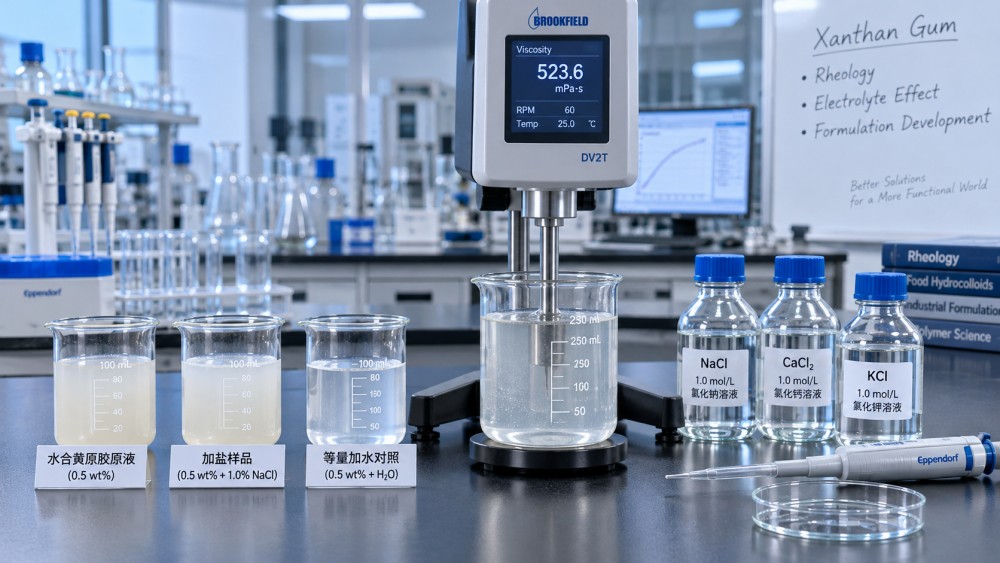
1. Establish a hydrated reference and a dilution control
Prepare a xanthan solution without the suspect electrolyte and allow its viscosity to stabilize. Divide it into portions. Add the electrolyte solution to one portion and an equivalent amount of water to another, using comparable mixing. Retain a reference sample so that any change caused by holding time can also be recognized.
Compare the samples at matched temperatures and shear conditions. If salt and water additions produce similar thinning, dilution may explain much of the result. If the electrolyte sample loses more viscosity, an ionic effect or another property of the electrolyte solution needs investigation.
2. Compare addition order
Make a separate sample with electrolyte present before xanthan addition. Keep its final composition identical to the sample that received salt after hydration. Assess both after sufficient conditioning, rather than comparing one freshly mixed sample with another that has rested much longer.
If prehydration improves the result, revise the manufacturing sequence and confirm that the improvement persists during storage. If both sequences reach similar lower viscosities, addition order alone is unlikely to restore the target. The final composition may require adjustment.
3. Build an electrolyte concentration series
Test several concentrations around the intended operating level while holding xanthan concentration constant. This reveals whether the response is gradual, reaches a plateau, or changes sharply within a narrow range. Include the expected variation in electrolyte content where it is relevant to production.
Change one electrolyte at a time when diagnosing the cause. Substituting a different salt at the same weight percentage changes several variables together and can obscure the explanation. Conductivity can help monitor consistency between comparable batches, but it cannot identify the ions present or establish compatibility by itself.
4. Track pH, appearance, and time
Measure pH before and after addition. An electrolyte-containing ingredient may also introduce acid or alkali, so the trial may otherwise combine ionic-strength and pH effects. Where practical, use a pH-matched control, accounting for the ions introduced during adjustment.
Record appearance alongside viscosity. Uniform thinning, incomplete hydration, flocculation, and phase separation point toward different mechanisms. Recheck samples after equilibration and under relevant storage conditions. An immediate drop that stabilizes requires a different response from a progressive decline accompanied by discoloration, odor changes, or separation.
Find which part of the full formula is losing structure
If the simple xanthan solution tolerates the electrolyte but the complete product thins, examine the other ingredients. A formula may obtain its body from several structures simultaneously, including polymer networks, surfactant micelles, dispersed droplets, and suspended solids. Their contributions can change independently.
In cleansing products, electrolyte addition can alter micellar structure and produce a viscosity maximum followed by thinning as salt concentration rises. Xanthan may still be contributing viscosity while the surfactant system loses its original structure. A salt-response curve for the surfactant base, with and without xanthan, helps distinguish these effects.
In cosmetic gels, some companion thickeners depend strongly on charge repulsion or neutralization to develop viscosity. Electrolytes may reduce their contribution more substantially than xanthan’s. Test the polymers separately in a simplified base before attributing the entire loss to the gum.
In foods, proteins, other hydrocolloids, acids, and mineral ingredients can affect compatibility and suspension. A mineral addition may change protein aggregation or another gum’s behavior. In emulsions, changing droplet interactions can alter apparent viscosity even when the aqueous xanthan phase remains functional.
Interactions with cationic ingredients also merit a specific check because xanthan is anionic. Depending on composition, complexes or visible flocculation can form. This is a different mechanism from ordinary screening by a simple dissolved salt, and adding more xanthan may intensify the interaction.
Reserve polymer degradation for evidence that supports it
An immediate viscosity drop after ordinary salt addition is insufficient evidence of chain breakdown. A progressive, persistent loss raises a different set of questions: thermal history, strongly acidic or alkaline conditions, oxidizing ingredients, contamination, and damaging combinations of temperature and pH.
Viscosity testing alone cannot prove molecular degradation. Comparing retained samples and controlled ingredient combinations can narrow the cause; a definitive investigation may require analytical support. Simply diluting a suspect sample is not a clean reversibility test, because dilution changes both polymer concentration and the ionic environment.
Choose the correction that matches the diagnosis
When hydration is responsible, improve powder distribution and give xanthan access to an appropriate water phase before adding concentrated electrolytes. A suitable predispersion method may help prevent agglomerates, but the carrier must fit the formulation. Avoid relying on excessive mixing after salts are already present to compensate for poor initial dispersion.
When fully hydrated xanthan shows a reproducible response to the final electrolyte level, establish a workable formulation range. Evaluate whether electrolyte concentration can change, whether a different xanthan grade performs better under the required conditions, or whether a compatible thickener blend provides the needed behavior. Salt substitution requires checking its original function as well as its rheological effect.
Increasing xanthan can restore viscosity in some systems, but it may also change pouring, stringiness, mouthfeel, dispensing, and processing resistance. Confirm those properties before accepting a higher dose. If another ingredient supplies the structure that is being lost, adjusting xanthan alone may leave the underlying instability unresolved.
The final acceptance criterion should reflect product performance. A suspension needs evidence that particles remain adequately distributed; a cleanser needs suitable flow and dispensing; a food needs the intended texture under use conditions. Define the permissible viscosity range together with electrolyte composition, pH, temperature, addition sequence, and measurement method. That gives the production team a controllable operating window—and a clearer basis for investigating the next thin batch.
Related News
- How to choose food hydrocolloids for gluten-free breadNov 03, 2026Food Rheology Expert
- How to choose food-grade hydrocolloid ingredients for stable saucesOct 30, 2026Food Rheology Expert
- How to assess a bio-based thickener manufacturer's batch consistencyOct 16, 2026Food Rheology Expert
- Verifying halal status of hydrocolloid ingredients in the Middle EastOct 15, 2026Food Rheology Expert
Related News
- 00
0000-00
China Records 543 New Cosmetic Ingredients, Including 167 in 2026 - 00
0000-00
How to check a fragrance raw material specification for IFRA compliance - 00
0000-00
Australia and New Zealand Weigh Wider Steviol Glycoside Use in Griddle Products - 00
0000-00
How does pH affect plant-based color ingredients in beverages? - 00
0000-00
China Announces Risk-Based Cosmetic Change Reviews and Shorter Timelines
Food Rheology Expert
Weekly Insights
Stay ahead with our curated technology reports delivered every Monday.