





Why are xanthan gum applications discussed far beyond simple thickening?
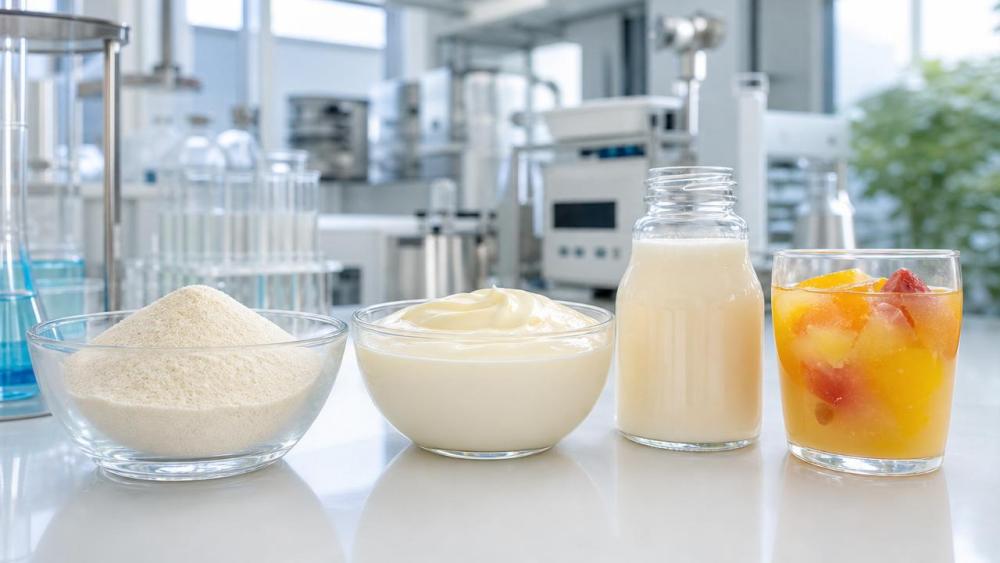
Xanthan gum applications matter because texture is rarely an isolated target. It influences stability, pourability, appearance, and even how premium a formula feels in use.
In practical formulation work, very small dosage shifts can change spoonability, suspension performance, and processing tolerance. That is why this ingredient often sits at the center of both technical and cost discussions.
Across the FMCG landscape, hydrocolloids act like quiet structural tools. FFAI often frames them as part of the hidden architecture behind flavor delivery, shelf stability, and sensory trust.
That broader view is useful. It connects rheology, compliance, and margin protection instead of treating xanthan gum as a commodity powder with one obvious job.
The most common reason teams revisit xanthan gum applications is not failure. It is optimization. They want the same or better texture with cleaner labels, lower dosage, or more resilient performance.
This becomes especially relevant in sauces, dairy systems, beverage suspensions, bakery fillings, and personal care textures where consistency defines repeat purchase behavior.
Where do xanthan gum applications create the most value in real formulations?
The answer depends on the system. Xanthan gum performs differently in high-acid liquids, sugar-rich products, heat-processed foods, and surfactant-heavy consumer care formulas.
In dairy and plant-based drinks, it helps manage mouthfeel and sedimentation. In sauces and dressings, it improves cling, suspension, and visual uniformity without making the product feel pasty.
Bakery fillings often rely on xanthan gum applications for freeze-thaw tolerance and moisture control. Beverage systems use it more selectively, usually when particulates or pulp need support.
Outside food, the same logic appears in shampoo, lotion, and cleansing formulas. Here, rheology is not only about thickness. It shapes flow, deposition, and user perception of mildness.
A useful way to assess value is to look at what problem the gum solves first, then compare whether the same result could be achieved by process adjustment or a different hydrocolloid blend.
This comparison helps separate useful xanthan gum applications from routine overuse. The right answer is often system-specific rather than category-specific.
How do you balance texture targets with dosage efficiency?
Most texture problems are not solved by adding more gum. They are solved by understanding hydration, shear history, solids content, and the final sensory target.
Xanthan gum applications usually work best when dosage is tied to a measurable goal. That could be viscosity at a defined shear rate, suspension time, or stability after heat treatment.
A common mistake is screening only one addition level. Small intervals often reveal a narrow efficiency window where texture improves sharply before mouthfeel becomes heavy or elastic.
Another useful step is pretesting with the full formula matrix. Sugar, salt, proteins, acids, and oils can all shift how xanthan performs once the product moves from bench sample to production.
When FFAI evaluates rheological thickeners, the key question is not only peak viscosity. It is whether the structure survives real processing conditions and still feels right at the moment of use.
- Define one sensory target before adjusting dosage.
- Test at least three close usage levels, not one broad jump.
- Check hydration order and mixing speed before changing grade.
- Confirm texture after thermal, acidic, or freeze-thaw stress.
In many cases, better efficiency comes from smarter process control rather than a higher addition rate.
Is a higher-priced grade always better for xanthan gum applications?
Not necessarily. Price only makes sense when linked to function, consistency, and compliance risk. A premium grade is justified only if it reduces total formulation cost or lowers technical uncertainty.
Sometimes a higher-purity or tighter-spec material improves hydration speed, microbial confidence, or batch-to-batch rheology. In other cases, the difference is commercially visible but technically minor.
The more useful comparison is cost-in-use. If one grade performs at lower dosage, minimizes rejects, or shortens adjustment time on the line, its higher unit price may still be economical.
This is where FFAI’s intelligence perspective becomes relevant. Ingredient value should be judged through formulation behavior, regulatory fit, and end-market positioning, not invoice price alone.
For clean label or export-sensitive products, documentation also matters. GRAS status, allergen handling, origin transparency, and regional specification alignment can all influence sourcing decisions.
A practical cost review usually includes these questions
- Does the grade allow lower dosage without losing texture?
- How stable is viscosity across production batches?
- Will hydration behavior slow down production throughput?
- Are the compliance documents suitable for target markets?
- Could a blend strategy outperform a single-gum approach?
What mistakes make xanthan gum applications look weaker than they really are?
The first issue is poor dispersion. Xanthan can fish-eye or clump if added directly into water without proper agitation or premixing. That leads to false conclusions about weak performance.
The second issue is judging texture too early. Some systems need full hydration time before viscosity stabilizes. Quick bench decisions often underestimate final body and suspension power.
There is also a sensory trap. More viscosity does not automatically mean better quality. Overbuilt structure can mute flavor release, create gummy flow, or leave an artificial afterfeel.
Another common misunderstanding is comparing xanthan with starches or cellulose gums as if they respond identically. Their shear behavior, temperature response, and label perception are different.
In personal care systems, incompatibility with salts or surfactant packages can also distort the result. The gum may be fine, but the formula architecture may be the real issue.
How should sourcing and compliance shape the final decision?
Once the texture target is clear, sourcing becomes a quality control decision as much as a pricing decision. Reliable xanthan gum applications depend on repeatable specifications, not occasional lab success.
That means checking viscosity range, microbial limits, mesh or particle profile, origin documentation, and application support. A technically adequate sample is only the beginning.
For cross-border business, compliance review should start early. Food, personal care, and health-adjacent categories may require different supporting files and regional statement formats.
FFAI’s broader industry lens is useful here because it treats ingredient choice as part of a connected system. Texture, safety, market access, and brand positioning often move together.
A grounded next step is to create a short evaluation sheet before changing suppliers or grades. Keep it technical, commercial, and regulatory at the same time.
- List the required texture outcome and usage range.
- Define acceptable batch variation limits.
- Compare cost-in-use instead of price per kilogram.
- Check regulatory and export documentation upfront.
- Run one pilot under actual process conditions.
When those points are aligned, xanthan gum applications become easier to scale, easier to defend internally, and less vulnerable to hidden formulation cost.
The real goal is not to use more xanthan gum or less. It is to use the right grade, at the right level, in a system that delivers texture confidence and commercial discipline together.
Related News
- How cassava costs shape Thailand xanthan gum market pricesSep 29, 2026Food Rheology Expert
- Can Thailand's xanthan gum market support stable export supply?Sep 28, 2026Food Rheology Expert
- How food hydrocolloids prevent ice crystals in frozen dessertsSep 14, 2026Food Rheology Expert
- Which food texture modifiers for sauces prevent thinning after reheating?Sep 13, 2026Food Rheology Expert
Related News
- 00
0000-00
What drives fragrance ingredients price changes in bulk orders? - 00
0000-00
How to assess a food antioxidants distributor’s traceability practices - 00
0000-00
How minimum order quantities shape private label ingredient sourcing costs - 00
0000-00
What drives personal care ingredient price volatility in sourcing - 00
0000-00
What drives micelles price differences in cosmetic formulations?
Food Rheology Expert
Weekly Insights
Stay ahead with our curated technology reports delivered every Monday.