





Xanthan Gum Applications in Food Formulas: Stability, Dosage, and Cost Tradeoffs
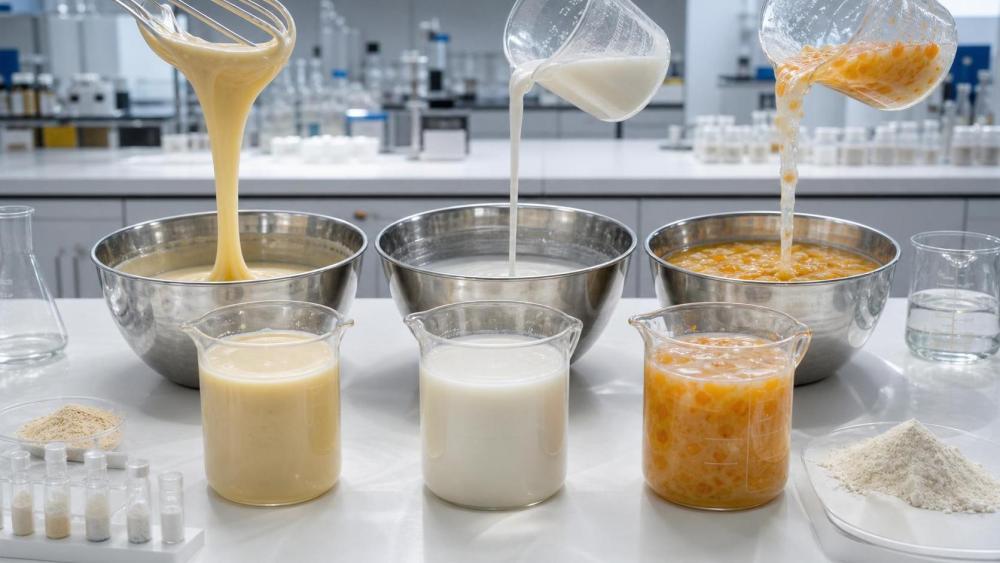
For technical evaluation, xanthan gum applications are rarely just about adding thickness.
A small dosage change can shift flow behavior, suspension stability, mouthfeel, and batch cost at the same time.
That is why formulators keep returning to xanthan gum applications across sauces, beverages, dairy, bakery, and frozen foods.
It performs at low use levels, tolerates process stress, and helps stabilize products that move through complex supply chains.
Still, not every formula benefits from pushing xanthan gum higher.
Overuse can create a ropy texture, suppress flavor release, and raise costs without adding real functional value.
The practical question is not whether xanthan gum works.
The real question is where xanthan gum applications create the best balance between stability, dosage efficiency, and total economics.
This article focuses on that balance with a formulation-first view.
Why Xanthan Gum Applications Stay Relevant
Xanthan gum is valued because one ingredient supports several technical targets at once.
It can build viscosity at low concentration, hold particles in suspension, and improve resistance to phase separation.
It also performs under a wide pH range and remains useful in salt-containing systems.
That combination explains why xanthan gum applications appear in products with very different processing demands.
Another advantage is shear-thinning behavior.
The product can feel thick at rest, yet still pour or pump during filling, mixing, or consumer use.
In actual development work, that often reduces the need for multiple texture modifiers.
- Improves suspension in spice sauces and pulp beverages
- Supports cling and coating in dressings and toppings
- Helps control ice crystal growth perception in frozen systems
- Adds body in reduced-fat or reduced-solids formulas
Even so, successful xanthan gum applications depend on dosage discipline and a clear texture target.
Typical Food Formula Applications and Performance Goals
Different product categories ask different things from xanthan gum.
A beverage formula may need suspension without a heavy drink.
A sauce formula may need yield value, cling, and clean plate coverage.
A gluten-free bakery system may need moisture retention and structure support.
Sauces, Dressings, and Condiments
This is one of the most common xanthan gum applications.
Typical use levels often start around 0.15% to 0.40%, depending on oil phase, solids, and target pourability.
At the lower end, xanthan helps reduce serum separation.
At the higher end, it can deliver heavy cling, which is useful for spoonable dressings or barbecue sauces.
Beverages and Suspended Drinks
In beverage xanthan gum applications, the dosage window is usually narrower.
Many systems operate around 0.02% to 0.10%.
That range may be enough to slow sedimentation of cocoa, fiber, minerals, or fruit particles.
Go too high, and the drink can feel slimy or block flavor brightness.
Dairy and Plant-Based Alternatives
Here, xanthan gum applications often support body, emulsion stability, and consistent mouthfeel.
It is frequently paired with guar gum, locust bean gum, carrageenan, or starches.
Blends can improve creaminess while reducing the risk of an elastic texture.
Bakery and Gluten-Free Systems
In bakery, xanthan gum applications are less about simple thickening.
They are more about water management, batter viscosity, gas retention, and structure support.
That is especially relevant in gluten-free breads, cakes, and premixes.
How Dosage Changes Stability, Texture, and Processability
The most useful way to assess xanthan gum applications is to map dosage against three outputs.
Those outputs are stability, sensory texture, and process behavior.
Performance rarely rises in a straight line.
There is usually a practical sweet spot.
This is where bench screening matters.
A formula that looks stable after one day may still fail after heat exposure, shipping vibration, or cold storage.
Good xanthan gum applications should be checked under realistic abuse conditions, not only room-temperature storage.
Processing Factors That Influence Xanthan Gum Applications
A strong formulation on paper can still underperform if hydration and dispersion are poor.
That is a common reason why xanthan gum applications appear inconsistent from lab to plant scale.
The first practical risk is fisheye formation during addition.
Pre-blending xanthan with sugar, salt, or other dry ingredients often improves dispersion.
Addition under strong agitation also helps, but too much shear can trap air in some systems.
The second factor is hydration timing.
Viscosity may continue rising after initial mixing, so early readings can mislead cost and texture decisions.
The third factor is interaction with other hydrocolloids and solids.
In real formulations, xanthan gum applications are rarely isolated from starches, proteins, fibers, salts, or emulsifiers.
- Check final viscosity after full hydration, not only after five minutes
- Track pH and salt because both can change final flow behavior
- Validate plant mixing order before locking dosage
- Review deaeration needs for dressings and beverage concentrates
Cost Tradeoffs: When More Xanthan Adds Less Value
Cost evaluation should go beyond ingredient price per kilogram.
The better question is cost per unit of functional gain.
In many xanthan gum applications, the first increments deliver large stability benefits.
Later increments may mostly add thickness, not real shelf-life protection.
That is where formula cost starts climbing faster than technical value.
There is also a hidden sensory cost.
If extra xanthan reduces flavor release or creates a sticky finish, the formula may need compensating flavors or texture modifiers.
That can erase any expected simplification benefit.
For this reason, cost reviews of xanthan gum applications should include four checkpoints.
- Minimum effective dose for target stability
- Texture acceptability at commercial serving temperature
- Impact on flavor perception and visual appearance
- Opportunity to replace part of the xanthan with a blend strategy
From a budget view, smart xanthan gum applications are usually optimized, not maximized.
A Practical Evaluation Framework for Formula Teams
A useful screening model keeps the work grounded in measurable outcomes.
That helps compare xanthan gum applications across categories without relying on guesswork or habit.
Start with a narrow dosage ladder.
For most projects, three to five points are enough for first-pass screening.
Then test each sample against a short list of business-relevant measures.
- Initial viscosity and 24-hour viscosity
- Suspension or phase separation after stress storage
- Sensory profile, especially sliminess and flavor release
- Pumpability, fill behavior, and clean label fit
- Formula cost at target batch size
This framework keeps xanthan gum applications tied to commercial realities.
A technically strong sample is not the winner if it slows filling lines or misses the intended eating experience.
In practice, the best option is often the sample just below the maximum stability point.
That choice usually preserves texture quality and leaves more cost flexibility.
Final Takeaway
Xanthan gum applications remain highly effective because they solve several food formula problems with one ingredient.
But their real value comes from disciplined use, not automatic inclusion at high dosage.
The strongest results usually come from matching xanthan gum applications to a clear product target, process reality, and cost boundary.
For formulation teams, the practical path is straightforward.
Define the texture goal, test the minimum effective range, stress the samples properly, and calculate value beyond simple ingredient price.
That approach makes xanthan gum applications easier to compare, easier to defend, and more likely to succeed at commercial scale.
Related News
- How to assess a bio-based thickener manufacturer's batch consistencyOct 16, 2026Food Rheology Expert
- Verifying halal status of hydrocolloid ingredients in the Middle EastOct 15, 2026Food Rheology Expert
- How Do You Test Hydrocolloid Viscosity After Changing a Thickener?Oct 17, 2026Food Rheology Expert
- Which Natural Hydrocolloid Works Best in Acidic Cosmetic Formulas?Oct 16, 2026Food Rheology Expert
Related News
- 00
0000-00
Can biomimetic peptides in cosmetics reduce the look of wrinkles? - 00
0000-00
How to assess a bio-based thickener manufacturer's batch consistency - 00
0000-00
Verifying halal status of hydrocolloid ingredients in the Middle East - 00
0000-00
How to interpret active matter on a surfactant specification sheet - 00
0000-00
How Do You Test Hydrocolloid Viscosity After Changing a Thickener?
Food Rheology Expert
Weekly Insights
Stay ahead with our curated technology reports delivered every Monday.