





Xanthan Gum Supplier Comparison: Lead Time, Specs, and Batch Consistency
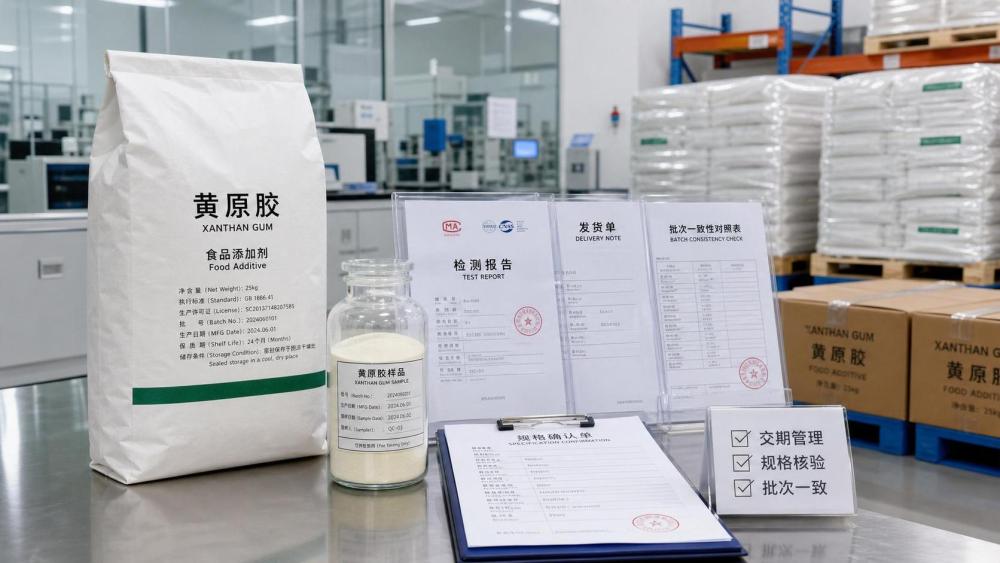
Choosing a xanthan gum supplier is rarely just about price. For quality and safety teams, the bigger question is operational control.
A delayed shipment can stop production. A vague specification can trigger audit findings. An unstable batch can force reformulation without warning.
That is why a practical xanthan gum supplier comparison should focus on reliability signals, not just quoted cost per kilogram.
In real purchasing cycles, three factors usually decide supplier fit: lead time, specification quality, and batch-to-batch consistency.
These factors shape production stability, complaint risk, and document readiness across food, personal care, and industrial applications.
This article breaks down how to compare each xanthan gum supplier with a decision framework that is practical, auditable, and easy to defend internally.
Why Lead Time Matters More Than the Quoted Delivery Window
Most suppliers can promise a lead time. Fewer can prove that their lead time holds under pressure.
That difference matters when freight routes tighten, raw material input shifts, or production slots are fully booked.
A strong xanthan gum supplier should provide more than a sales estimate. They should show historical on-time delivery performance.
Ask for average lead time, peak-season lead time, and emergency replenishment options. The gap between normal and stressed conditions is revealing.
It also helps to check whether the supplier holds safety stock, works with multiple shipping ports, or depends on one production line.
From a risk perspective, single-point dependency is often more dangerous than a slightly longer nominal lead time.
Questions that expose real delivery capability
- What was the on-time shipment rate for the last 12 months?
- How often were partial shipments used to avoid stockouts?
- Is production outsourced or controlled directly by the xanthan gum supplier?
- What is the backup plan during port disruption or plant maintenance?
- Can the supplier support lot reservation for critical accounts?
A supplier with transparent answers usually performs better during disruptions. That transparency also supports internal approval more smoothly.
How to Read Xanthan Gum Specs Without Missing Hidden Risk
Specification sheets often look complete at first glance. In practice, many leave room for interpretation where quality issues begin.
A useful xanthan gum supplier comparison checks both what is listed and what is missing.
Core items usually include viscosity, pH, mesh size, loss on drying, ash, and microbial limits. That is only the starting point.
You also need to confirm test methods, sampling rules, acceptance ranges, and version control for updated specifications.
This becomes more important when the same xanthan gum is used across sauces, beverages, dairy systems, or cosmetic emulsions.
A spec that works for one application may still be too broad for another. Functional fit and document fit are not always the same thing.
Key specification checkpoints
- Viscosity range and test conditions, including solution concentration and temperature.
- Microbiological criteria, especially yeast, mold, and total plate count.
- Heavy metal declarations and allergen status where relevant.
- Compliance references such as FCC, EU food standards, or customer-specific requirements.
- Certificate of Analysis alignment with the approved master specification.
A capable xanthan gum supplier should explain why each limit exists. That usually signals stronger process understanding.
More importantly, they should handle change control properly. Silent specification drift is one of the most expensive quality failures.
Batch Consistency Is the Real Test of Supplier Control
A sample can pass qualification and still tell you very little about future performance. Consistency only appears across repeated lots.
For that reason, the best xanthan gum supplier is often the one with narrower process variation, not the lowest entry quote.
In practical terms, batch consistency affects hydration speed, suspension behavior, mouthfeel, and viscosity build in finished formulations.
When those properties drift, plants compensate with mixing changes, usage rate changes, or hold-and-release delays.
That hidden operational cost can easily exceed any apparent purchase savings.
What to request before final approval
- Three to five recent production lot COAs.
- Retained sample data for trend review.
- Process capability evidence for critical attributes.
- Deviation handling records for out-of-trend results.
- Complaint history and CAPA examples, if available.
This is where mature manufacturers stand apart. They can explain variation using data instead of reassurance.
That matters for audits too. A well-controlled xanthan gum supplier makes supplier qualification easier to defend on paper.
A Practical Comparison Table for Supplier Screening
To keep decisions consistent, many teams use a weighted scorecard. It helps separate attractive offers from dependable supply partners.
A simple table like this keeps supplier selection grounded in performance. It also reduces bias toward headline pricing.
Red Flags During Xanthan Gum Supplier Evaluation
Some warning signs appear early, long before a formal nonconformance. Ignoring them usually creates trouble later.
- COAs from different lots look identical across all values.
- Specification revisions appear without formal notification.
- Lead time answers change depending on who you ask.
- Technical support avoids detailed method discussions.
- Audit requests are delayed or heavily restricted.
These signals do not always mean rejection. They do mean you need deeper verification before approval.
A dependable xanthan gum supplier should welcome technical scrutiny, because strong systems are easier to demonstrate than to describe.
How to Make the Final Decision With Less Risk
Final selection works best when procurement, quality, and operations use the same decision criteria.
That usually means running a short qualification sequence rather than relying on one commercial quote and one lab sample.
- Screen each xanthan gum supplier using document completeness.
- Review lead time evidence and logistics resilience.
- Test multiple lots in the target formulation.
- Score compliance, consistency, and responsiveness together.
- Approve with change control expectations written into supply terms.
This approach creates a more stable supply base. It also gives teams stronger evidence when decisions are challenged later.
In the end, the right xanthan gum supplier is the one that keeps production predictable, documentation clear, and quality variation under control.
When those three areas are verified early, supplier selection becomes less reactive and far more defensible.
Related News
- How to assess a bio-based thickener manufacturer's batch consistencyOct 16, 2026Food Rheology Expert
- Verifying halal status of hydrocolloid ingredients in the Middle EastOct 15, 2026Food Rheology Expert
- How Do You Test Hydrocolloid Viscosity After Changing a Thickener?Oct 17, 2026Food Rheology Expert
- Which Natural Hydrocolloid Works Best in Acidic Cosmetic Formulas?Oct 16, 2026Food Rheology Expert
Related News
- 00
0000-00
Can biomimetic peptides in cosmetics reduce the look of wrinkles? - 00
0000-00
How to assess a bio-based thickener manufacturer's batch consistency - 00
0000-00
Verifying halal status of hydrocolloid ingredients in the Middle East - 00
0000-00
How to interpret active matter on a surfactant specification sheet - 00
0000-00
How Do You Test Hydrocolloid Viscosity After Changing a Thickener?
Food Rheology Expert
Weekly Insights
Stay ahead with our curated technology reports delivered every Monday.