





Where xanthan gum creates value, and where formulation limits appear first
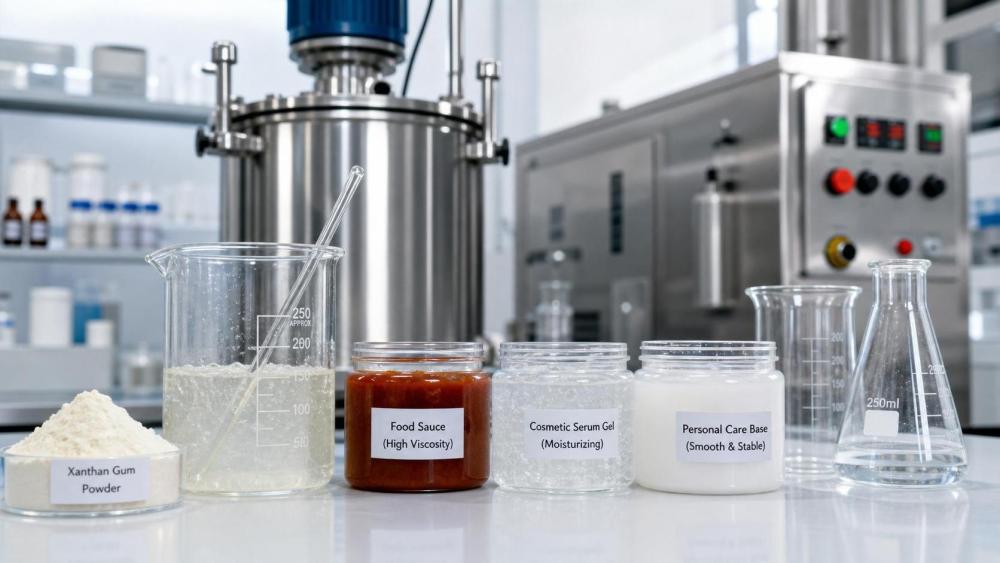
Xanthan gum looks simple on paper, yet its real value appears only inside a working formula.
In food, personal care, and home care, it helps control flow, suspend particles, and stabilize sensory texture.
That is why xanthan gum remains central to clean-label thickening and broader FMCG formulation design.
Still, the same ingredient behaves differently in salad dressing, serum, sauce, shampoo, or fragrance-rich gel.
The gap comes from pH, salt load, thermal history, shear intensity, and the order in which powders meet water.
For an intelligence platform like FFAI, xanthan gum matters because texture is never just texture.
It affects shelf life, flavor release, active delivery feel, visual stability, and even compliance choices across markets.
In actual use, the better question is not whether xanthan gum works.
The more useful question is under which formulation conditions it keeps working without hidden trade-offs.
Different applications ask different things from xanthan gum
A beverage system usually wants suspension at low dosage and a clean pour.
A sauce often wants cling, gloss, freeze-thaw tolerance, and resistance to phase separation during transport.
A facial gel may care more about light glide, electrolyte tolerance, and compatibility with costly active ingredients.
A shampoo base usually judges xanthan gum by pour behavior, foam perception, and long-term viscosity drift.
These are related needs, but not identical ones.
More often, formulation mistakes happen when similar textures are treated as equivalent performance targets.
A smooth yogurt-style mouthfeel does not predict good acid sauce stability.
Likewise, a clear cosmetic gel may fail after salts, perfumes, or botanical extracts enter the system.
This is where xanthan gum becomes a formulation decision, not a commodity line item.
In food systems, stability limits show up through acid, heat, and sensory expectations
Xanthan gum is valued in sauces, fillings, beverages, and dairy alternatives because it builds viscosity efficiently.
It also supports particle suspension and helps maintain uniform appearance during shipping.
Yet food systems quickly expose its limits when pH drops and thermal exposure becomes aggressive.
In acidic condiments, short hot-fill cycles may be manageable, but prolonged heating can reduce final body.
The loss may not appear immediately at the kettle.
It often appears later as serum separation, weak cling, or spice sediment at retail temperature.
Frozen desserts create a different challenge.
Here, xanthan gum supports body and melt control, but overuse can make the texture pasty or sticky.
That is especially important when flavor houses and texture teams aim for indulgence without heaviness.
In clean-label products, the pressure is even sharper.
Xanthan gum may replace more complex stabilizer systems, but single-gum solutions do not always reproduce the same eating profile.
A good process trial therefore compares fresh viscosity, storage stability, and flavor release together.
Personal care formulas usually fail on compatibility before they fail on viscosity
In personal care, xanthan gum is often chosen because it is familiar, mild, and useful at low addition levels.
It can suspend beads, stabilize botanical particles, and create a soft gel network.
But elegant texture in a lab beaker does not guarantee market-ready performance.
High-end serums and anti-aging gels often include peptides, acids, humectants, and mineral salts.
Those additions can shift the rheology curve and create stringiness, air entrapment, or thinning over time.
The problem becomes more visible when fragrance oils or essential oil blends are added late.
A base that looked stable before perfume addition may turn hazy or uneven after filling.
In cleansing systems, xanthan gum is rarely judged alone.
Surfactants, salt, pearlizers, and preservative packages all reshape the final flow pattern.
This is why FFAI’s cross-category view matters.
The same molecule that improves spoonable texture in food may behave differently beside surfactant micelles or transdermal actives.
The right judgment is not simply “xanthan gum is compatible.”
The better judgment is “compatible with which active load, fragrance phase, and viscosity target.”
Most processing mistakes are small at the tank, but expensive after filling
The most common xanthan gum failure is poor hydration.
When dry powder hits water too quickly, fisheyes form and never fully dissolve.
Operators may then add more xanthan gum, misreading lumps as under-dosing.
That usually creates uneven viscosity and an unnecessarily high cost position.
Ingredient order is the next frequent mistake.
Acids, salts, sugars, or surfactants added too early can interfere with full hydration.
A pre-blend with other dry materials often helps, but only when particle distribution is consistent.
Shear is another area where teams overgeneralize.
Xanthan gum is shear-thinning, which is useful during pumping and pouring.
Still, aggressive processing over long periods can damage the intended texture profile.
A short burst to disperse is different from extended high-shear recirculation.
- Hydrate xanthan gum in a controlled vortex, not a flooded dump-in step.
- Delay strong acids, salts, and fragrance components until hydration is established.
- Match shear time to dispersion need, rather than running the mixer by routine.
- Check viscosity after 24 hours, because xanthan gum often finishes developing later.
These details look operational, but they directly shape product stability and sensory credibility.
Misjudgments usually come from treating similar formulas as interchangeable
One common misread is relying on supplier specification alone.
Viscosity data in water does not represent a finished emulsion, acidified sauce, or surfactant-rich cleanser.
Another mistake is choosing xanthan gum only by unit cost.
A cheaper grade can become more expensive if it needs higher dosage, more mixing time, or more rework.
There is also a frequent assumption that natural positioning guarantees universal fit.
In reality, clean-label expectations, active integrity, and fragrance performance can pull the formula in different directions.
For export-oriented products, regulatory framing matters too.
Food and cosmetic pathways do not share the same documentation depth, impurity concerns, or market claims logic.
That broader view is especially relevant in the FFAI landscape, where rheology, safety, and premium sensory value intersect.
A practical way to judge xanthan gum before scaling up
Before locking a formula, define what xanthan gum must actually do in that product.
The answer may be suspension, cling, creamy mouthfeel, visual stability, or active-friendly gel structure.
Then test the ingredient under the exact stresses the product will face.
That means real pH, real salt load, real fragrance system, real heat exposure, and realistic filling conditions.
- Confirm the hydration sequence and allowable mixing window.
- Measure fresh and aged viscosity, not one-point viscosity only.
- Evaluate texture after actives, pigments, preservatives, or perfumes are added.
- Review whether xanthan gum alone is sufficient or needs a partner hydrocolloid.
- Compare process cost, failure risk, and sensory quality together.
Xanthan gum remains one of the most versatile rheology tools in modern formulation.
Its strengths are real, but so are its stability limits and processing traps.
The safest next step is to map the exact use scenario, define the failure point to avoid, and build trials around those conditions.
That approach produces better textures, fewer surprises, and more reliable decisions about xanthan gum in formulation.
Related News
- How to assess a bio-based thickener manufacturer's batch consistencyOct 16, 2026Food Rheology Expert
- Verifying halal status of hydrocolloid ingredients in the Middle EastOct 15, 2026Food Rheology Expert
- How Do You Test Hydrocolloid Viscosity After Changing a Thickener?Oct 17, 2026Food Rheology Expert
- Which Natural Hydrocolloid Works Best in Acidic Cosmetic Formulas?Oct 16, 2026Food Rheology Expert
Related News
- 00
0000-00
Can biomimetic peptides in cosmetics reduce the look of wrinkles? - 00
0000-00
How to assess a bio-based thickener manufacturer's batch consistency - 00
0000-00
Verifying halal status of hydrocolloid ingredients in the Middle East - 00
0000-00
How to interpret active matter on a surfactant specification sheet - 00
0000-00
How Do You Test Hydrocolloid Viscosity After Changing a Thickener?
Food Rheology Expert
Weekly Insights
Stay ahead with our curated technology reports delivered every Monday.