





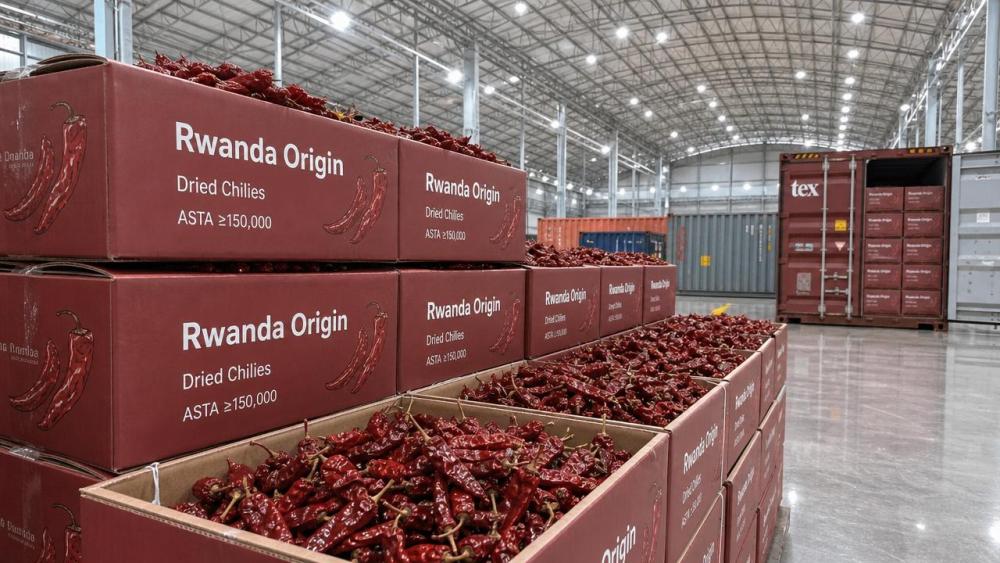
Effective May 1, 2026, China implemented zero tariff treatment on dried chilies imported from Rwanda—a trade policy shift directly impacting the natural food colorants sector. This measure is already reshaping sourcing strategies for pigment manufacturers reliant on capsanthin, the primary red carotenoid in chili peppers.
Confirmed Policy Implementation and Export Surge
On May 1, 2026, China formally applied zero import tariffs to dried chilies originating in Rwanda. Following this change, Fisher Global—a Rwandan agri-export firm—reported a year-on-year export increase of over 200% to China. Its high-color-value chili batches (≥150,000 ASTA) are now being procured by Chinese natural food colorant producers as a validated raw material source. The initiative supports efforts by Chinese pigment exporters to reduce overreliance on single-origin supplies from India and Peru—and concurrently catalyzes bilateral discussions on harmonized extraction standards for natural pigments.
Impact Across Supply Chain Roles
International trading enterprises
Exporters like Fisher Global benefit directly from reduced tariff barriers and simplified customs clearance, enabling faster cash conversion and expanded order volumes. They must now prioritize documentation alignment with China’s updated HS code classification for dried chilies and ensure traceability compliance per China’s General Administration of Customs requirements.
Raw material procurement teams
Purchasing departments at pigment manufacturers face revised supplier qualification protocols. With Rwanda entering the approved origin list, procurement workflows must integrate new risk assessments—including phytosanitary certification validity, seasonal yield variability, and logistics lead time fluctuations from East Africa.
Extraction and manufacturing facilities
Processing plants sourcing capsanthin must verify whether existing solvent-based or supercritical CO₂ extraction parameters remain optimal for Rwandan chili matrices, which differ in moisture content, capsaicin profile, and pigment stability versus Indian or Peruvian varieties. Technical validation of batch consistency (e.g., ASTA value retention across seasons) becomes operationally critical.
Supply chain service providers
Third-party inspection, cold-chain logistics, and certification support firms must expand their regional capacity—particularly in Kigali and Shenzhen—to accommodate increased volume, tighter quality gate checks (e.g., heavy metal screening per GB 2762), and emerging joint standardization initiatives between Rwandan and Chinese technical bodies.
Strategic Priorities for Industry Stakeholders
Validate origin-specific compliance documentation
Confirm that Rwandan exporters hold valid Certificate of Origin (Form A under the China-Rwanda Preferential Trade Agreement), phytosanitary certificates endorsed by Rwanda’s Ministry of Agriculture, and aflatoxin test reports meeting China’s GB 2761 limits—especially given tropical storage conditions.
Assess technical compatibility of new feedstock
Conduct comparative lab trials using Rwandan chili powder against current Indian/Peruvian benchmarks to evaluate extraction yield, color stability under thermal processing, and regulatory acceptability in target markets (e.g., EU EFSA, US FDA color additive provisions).
Engage early in cross-border standard development
Participate in ongoing technical working groups co-hosted by China’s Standardization Administration (SAC) and Rwanda Standards Board (RSB) focused on unified analytical methods for capsanthin quantification (ASTA vs. HPLC-UV), residual solvent thresholds, and microbial load specifications for natural pigment precursors.
Adjust procurement planning cycles
Extend lead-time buffers for Rwandan-sourced chilies due to longer maritime transit (approx. 35–45 days from Dar es Salaam to Shanghai) and potential port congestion; align inventory models with harvest windows (typically August–November in Rwanda’s Southern Province).
Industry Observation: Beyond Tariff Relief
Analysis shows this policy should not be viewed solely as a cost-reduction mechanism. What deserves closer attention is its function as a catalyst for structural resilience: it introduces geographic redundancy into a supply chain previously vulnerable to monsoon-related yield shocks in India and El Niño–driven export restrictions in Peru. From an industry perspective, the real strategic value lies in accelerated co-development of upstream technical norms—not just trade access. Observably, the push for joint extraction standards reflects a broader shift where regulatory convergence, rather than tariff schedules alone, now defines competitive advantage in natural colorant markets.
Broader Implications for Natural Pigment Sourcing
This development marks a tangible step toward multipolar sourcing in the natural food colorants industry—not as theoretical diversification, but as operational reality supported by enforceable trade terms and coordinated technical infrastructure. It underscores how targeted tariff adjustments, when aligned with quality infrastructure upgrades, can recalibrate global input hierarchies without requiring full-scale manufacturing relocation.
Source Attribution and Verification Notes
This article was generated exclusively from the provided title, event date (2026-05-01), and summary. Specific official source links were not provided in the input and should be verified continuously. Stakeholders are advised to monitor updates from China’s Ministry of Commerce (MOFCOM), General Administration of Customs of China (GACC), and the Rwanda Development Board (RDB), particularly regarding implementation guidelines for preferential tariff claims, phytosanitary protocol revisions, and progress on SAC–RSB standardization work plans.
Related News
- How to assess color stability from a natural food colors manufacturerOct 06, 2026Food Rheology Expert
- When does amino acid surfactant powder improve cleanser mildness?Oct 05, 2026Surfactant Chemistry Architect
- How to verify a cosmetic nanotechnology supplier's safety documentationOct 04, 2026Dr. Chloe Vance
- How rheological thickeners for shampoo affect suspension stabilityOct 03, 2026Prof. Elian Thorne
Related News
- 00
0000-00
How to assess color stability from a natural food colors manufacturer - 00
0000-00
When does amino acid surfactant powder improve cleanser mildness? - 00
0000-00
How to verify a cosmetic nanotechnology supplier's safety documentation - 00
0000-00
How rheological thickeners for shampoo affect suspension stability - 00
0000-00
How to assess recombinant collagen ingredients for cream stability
Industry Global
Weekly Insights
Stay ahead with our curated technology reports delivered every Monday.