





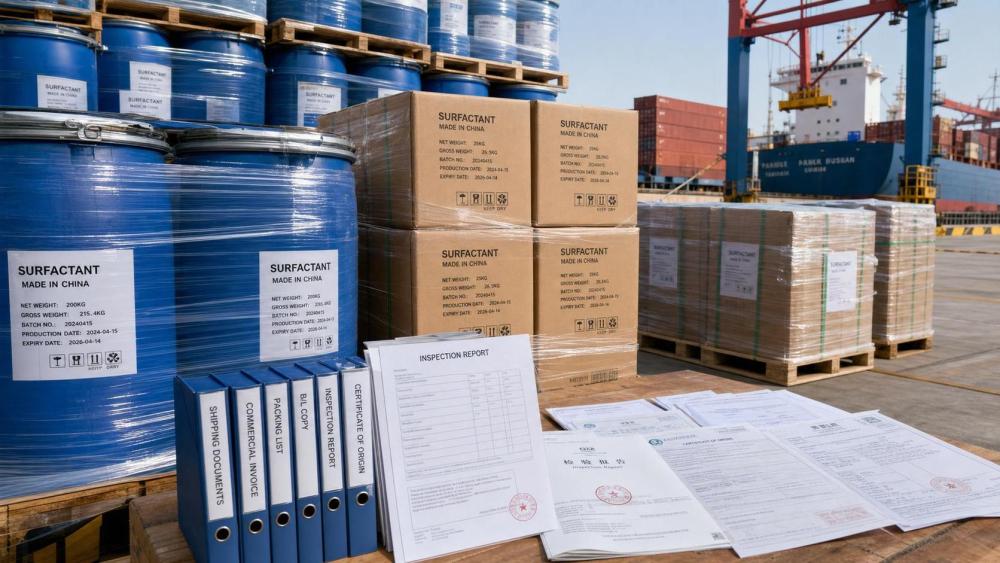
On 3 July 2026, China Customs began applying a new clearance rule to exports of amino acid surfactants headed to Japan and South Korea. Under the new arrangement, export declarations can be automatically approved through the “Green Channel AI Clearance” system when the required documents are uploaded 72 hours before shipment, including JIS or KS certification, SDS, and batch-specific heavy metal test reports. For exporters, buyers, testing parties, and supply chain operators handling these products, the change is worth watching because it links customs efficiency directly to documentation readiness and pre-shipment compliance.
What the New Clearance Arrangement Confirms
The confirmed change is limited but operationally clear. Starting 3 July 2026, China Customs’ “Green Channel AI Clearance” system automatically approves export declarations for amino acid surfactants destined for Japan and South Korea when complete documentation is submitted 72 hours before shipment.
The products referenced in the event summary include sodium lauroyl glutamate and cocamidopropyl betaine. The required documents named in the summary are JIS or KS certification, SDS, and batch-specific heavy metal test reports.
According to the event summary, the average clearance time is reduced from 3.2 days to less than 4 hours for shipments meeting those conditions.
Where the Practical Impact Will Be Felt First
Export teams will need to move compliance work earlier
From an industry perspective, exporters are likely to feel the most immediate effect because the new process rewards document completion before cargo is staged for shipment. The main operational shift is that customs speed now depends less on last-minute filing and more on whether certification, safety documentation, and batch-level test records are already aligned within the 72-hour window.
What deserves closer attention is the risk of losing the faster route if any required file is incomplete, delayed, or inconsistent across the shipment record.
Procurement and production planning may become more document-driven
For manufacturers and raw material procurement teams, the change may affect production release and shipment scheduling. Analysis shows that when batch-specific heavy metal test reports are a named condition for automated approval, batch management and document handoff become part of the delivery timetable rather than a separate quality step.
This matters particularly for orders tied to fixed export slots, because a faster customs channel is only available when the paperwork is prepared early enough to meet the stated pre-shipment timing requirement.
Testing and certification support functions gain a tighter timing role
Testing service providers and certification-related support functions may also be affected because the new arrangement explicitly connects clearance eligibility to JIS or KS certification, SDS, and batch-specific test documentation. Observably, this does not create a new confirmed certification rule beyond the documents listed in the event summary, but it does make the timing and completeness of those records more commercially relevant for export execution.
Buyers and logistics partners may revise delivery expectations
For overseas buyers and supply chain service providers, the main issue is delivery reliability. Analysis shows that a reduction in average clearance time from 3.2 days to less than 4 hours can influence shipment planning, booking coordination, and expected handover timing. At the same time, the benefit appears conditional rather than universal, because it depends on the exporter meeting the stated document and timing requirements.
What Companies Should Track in Day-to-Day Execution
Check whether export files are complete before the 72-hour mark
Companies shipping eligible surfactants should review whether internal workflows allow JIS or KS certification, SDS, and batch-specific heavy metal test reports to be prepared and uploaded within the required pre-shipment window. This is a practical checkpoint rather than a broad management issue, because missing the timing condition could affect access to automated approval.
Review batch-level traceability against customs filing needs
Analysis shows that batch-specific reporting is one of the most concrete signals in the event summary. Companies should therefore pay attention to whether batch identification, test records, and shipment declarations can be matched cleanly. Where records are prepared across different teams or external service providers, consistency may matter as much as speed.
Reassess lead-time assumptions for Japan and South Korea orders
Exporters, buyers, and planners may need to revisit delivery schedules for shipments to Japan and South Korea involving the covered product category. It is more appropriate to understand this as a potential change in execution rhythm rather than a guaranteed outcome for every shipment, because the stated time reduction applies when the specified conditions are met.
Continue watching for execution language and market adoption
The event summary confirms the launch date, covered destination markets, required documents, and reported clearance-time change. It does not provide further operational detail on edge cases, exception handling, or broader scope. For that reason, companies should continue tracking later official wording, document review practices, and how the process is applied in routine export operations.
Why This Looks Like an Execution Signal More Than a Broad Policy Rewrite
Observably, this development is best read as an implementation-level trade facilitation signal tied to compliance readiness. It does not, based on the provided information, announce a broad rewrite of product regulation or a new standalone certification framework. Instead, it shows customs efficiency being explicitly linked to advance filing discipline and document completeness for a defined product group and two destination markets.
From an industry perspective, the more meaningful question is not only whether clearance becomes faster, but whether companies can operationalize the 72-hour documentation requirement without creating bottlenecks upstream in testing, certification handling, or shipment release.
How to Read the Change at This Stage
At this stage, the event is more appropriately understood as a rule already put into operation for a specific export scenario, while some aspects of day-to-day execution still merit observation. The confirmed message is clear: customs processing can become materially faster for eligible amino acid surfactant exports to Japan and South Korea when the required documents are complete and submitted early enough. The broader industry significance lies in how strongly export speed is now tied to documentation discipline, batch traceability, and pre-shipment coordination.
Basis of This Article
This article is generated from the user-provided news title, event date, and event summary. The analysis is limited to the confirmed facts provided in that input and does not rely on any unverified policy number, official notice text, company statement, or external market data.
For this type of event, commonly relevant source categories may include official customs announcements, regulatory releases, trade authority updates, industry association notices, standards-related documents, and reporting from authoritative trade media. A specific official source link was not provided in the input, so subsequent verification is still needed.
What still requires continued observation includes any later policy detail, implementation wording, certification review practice, document acceptance standards, tender or buyer document changes, market feedback, and actual execution patterns among exporters and service providers.
Related News
- When does amino acid surfactant powder improve cleanser mildness?Oct 05, 2026Surfactant Chemistry Architect
- When to Seek Shampoo Formulation Support for Foam, Mildness, or Stability IssuesAug 07, 2026Surfactant Chemistry Architect
- FDA Tightens GRAS Data Requirements for Amino Acid SurfactantsJul 20, 2026Surfactant Chemistry Architect
- Amino Acid Surfactant Prices Rise on Coconut Oil TightnessJul 15, 2026Surfactant Chemistry Architect
Related News
- 00
0000-00
Verifying halal status of hydrocolloid ingredients in the Middle East - 00
0000-00
How to interpret active matter on a surfactant specification sheet - 00
0000-00
What Quality Checks Should You Run on Fragrance Ingredient Suppliers? - 00
0000-00
How to assess a flavor chemistry manufacturer's batch consistency - 00
0000-00
What drives fragrance ingredients price changes in bulk orders?
Surfactant Chemistry Architect
Weekly Insights
Stay ahead with our curated technology reports delivered every Monday.