





On November 1, 2026, a new set of feed import and export rules will take effect under General Administration of Customs Order No. 283, introducing a four-tier risk classification system. For companies involved in feed additives that do not contain animal or plant ingredients, this update deserves close attention because certain products are placed in the lowest risk tier and will face only routine inspection and quarantine, with significantly shorter customs clearance times. Importers, overseas registrants, procurement teams, compliance staff, and supply chain operators are among the business roles most likely to feel the change first.
What the new rule confirms
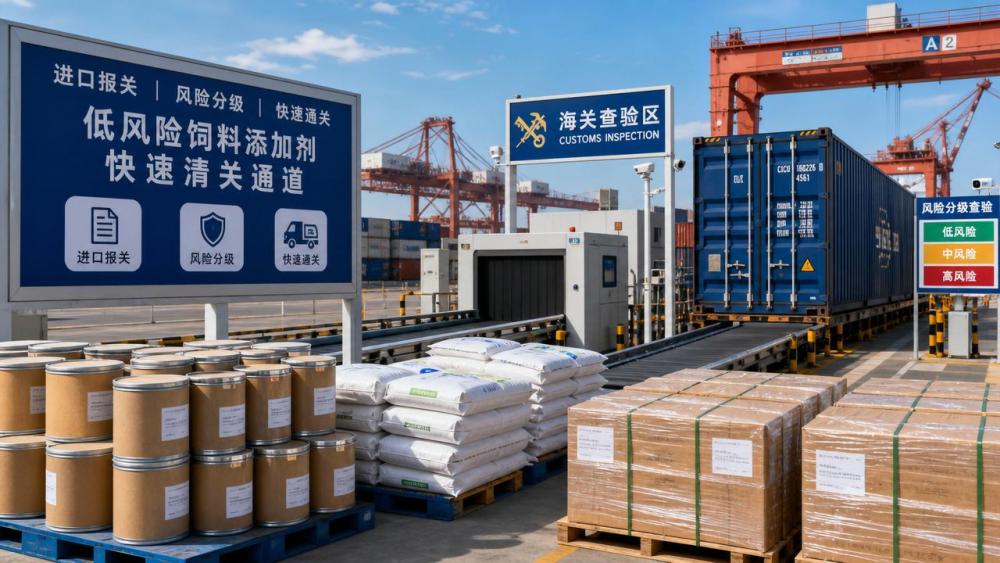
The confirmed change is that General Administration of Customs Order No. 283 will be implemented on November 1, 2026. The rule establishes a four-level risk grading framework for feed-related imports and exports. Under this framework, feed additives without animal or plant ingredients are classified as Tier IV, the lowest risk level.
The examples provided for this Tier IV category include high-purity amino acid surfactants, water-soluble flavor carriers, and food-grade chelating agents. According to the information provided, these products will require only routine inspection and quarantine, and customs clearance time will be substantially reduced.
A six-month transition period has already started. During this period, companies may complete overseas registration and filing in advance.
Where the impact is likely to appear first
Imported additive traders may see the most immediate operational change
From an industry perspective, traders handling eligible low-risk feed additives are likely to be directly affected because customs handling is a core part of their delivery cycle. The main impact is expected in border clearance planning, shipment scheduling, and document preparation. What deserves closer attention is whether a product can clearly be identified as falling within the non-animal, non-plant ingredient category covered by Tier IV treatment.
Procurement teams may need to reassess timing and sourcing arrangements
For raw material buyers and feed-related procurement teams, the practical effect may appear in ordering rhythm, supplier selection, and expected delivery windows. Analysis shows that shorter clearance time matters most when procurement depends on imported specialty additives. The key issue is not only whether the product may move faster through customs, but also whether registration and filing work has been completed in time during the transition period.
Manufacturing and fulfillment functions should watch supply continuity
Processing and manufacturing businesses may be affected through production scheduling and inventory planning rather than through customs procedures themselves. Observably, if a business relies on imported low-risk additives, any improvement in clearance efficiency could influence how safety stock, replenishment cycles, and customer delivery commitments are managed. At the same time, companies still need to separate policy wording from actual execution at the product and shipment level.
Service providers may face new documentation and coordination demands
Customs brokers, compliance advisers, and supply chain service providers are also likely to be affected because they sit between overseas suppliers and domestic importers. Their work may shift toward confirming product classification, checking filing status, and aligning documentation with the new risk-based approach. The most relevant change for this group is procedural clarity rather than a broad change in demand.
What companies should focus on during the transition
Check whether products fit the Tier IV definition
The first practical issue is product scope. Companies should focus on whether a feed additive is clearly within the group described as containing no animal or plant ingredients. This matters because the benefit of routine inspection and faster clearance depends on how the product is classified under the new framework.
Use the six-month window for registration and filing
The transition period is one of the most actionable parts of the update. Businesses that rely on imports should review overseas registration and filing status now rather than waiting until the implementation date. Analysis shows that the policy signal and the actual customs experience may differ if administrative preparation is incomplete.
Align documents, supplier communication, and delivery promises
Procurement, compliance, and logistics teams should coordinate more closely with overseas suppliers on registration progress and supporting documents. This is especially relevant for businesses that have committed delivery timelines to downstream customers. What deserves closer attention is whether internal teams are treating the rule as an immediate operating change or only as a policy headline.
Keep watching for official wording and implementation detail
Even with the confirmed implementation date and the Tier IV examples already provided, companies should continue tracking how the rule is expressed in official notices and operational practice. Observably, the difference between a favorable classification principle and smooth execution often lies in document standards, filing completeness, and shipment-level review.
Why this looks like both an immediate change and a longer-term signal
Analysis shows that this update should not be read only as a shorter-clearance story. It also signals a more structured, risk-based approach to feed import and export supervision. In the near term, the clearest effect is on the products explicitly placed in Tier IV and on the companies that can complete registration and filing during the transition period.
At the same time, it is more appropriate to understand this as a policy development that still requires observation in practice. The confirmed facts show a clear regulatory direction, but the business impact will depend on how accurately products are categorized and how consistently implementation works across real shipments and compliance workflows.
How this update is best understood for now
At this stage, the industry significance lies in the combination of a formal implementation date, a four-tier risk framework, and a clearly defined low-risk group that may move through customs faster. For affected businesses, this is not simply a headline about faster clearance; it is also a reminder to prepare registration, filing, classification, and documentation work in advance.
From a neutral industry reading, this is best understood as a concrete short-term operational change for some feed additives and a longer-term regulatory signal for the broader feed trade system. The immediate opportunity is preparation during the transition period, while the broader implications still need continued observation.
Basis of this article and points for continued verification
This article is based on the user-provided news title, event date, and summary. The information used here covers the November 1, 2026 implementation date, the four-tier risk classification system under General Administration of Customs Order No. 283, the Tier IV treatment for feed additives without animal or plant ingredients, the examples provided for that category, the routine inspection and quarantine requirement, the expected reduction in clearance time, and the already launched six-month transition period for overseas registration and filing.
For this type of industry update, relevant source categories usually include official notices, company announcements, industry association updates, authoritative media coverage, and standard-setting documents. A specific official source link was not provided in the input, so continued verification remains necessary. The main follow-up points to watch are any further official wording, implementation detail, and how product classification and filing requirements are applied in practice.
Related News
- When does amino acid surfactant powder improve cleanser mildness?Oct 05, 2026Surfactant Chemistry Architect
- When to Seek Shampoo Formulation Support for Foam, Mildness, or Stability IssuesAug 07, 2026Surfactant Chemistry Architect
- FDA Tightens GRAS Data Requirements for Amino Acid SurfactantsJul 20, 2026Surfactant Chemistry Architect
- Amino Acid Surfactant Prices Rise on Coconut Oil TightnessJul 15, 2026Surfactant Chemistry Architect
Related News
- 00
0000-00
Verifying halal status of hydrocolloid ingredients in the Middle East - 00
0000-00
How to interpret active matter on a surfactant specification sheet - 00
0000-00
What Quality Checks Should You Run on Fragrance Ingredient Suppliers? - 00
0000-00
How to assess a flavor chemistry manufacturer's batch consistency - 00
0000-00
What drives fragrance ingredients price changes in bulk orders?
Surfactant Chemistry Architect
Weekly Insights
Stay ahead with our curated technology reports delivered every Monday.