





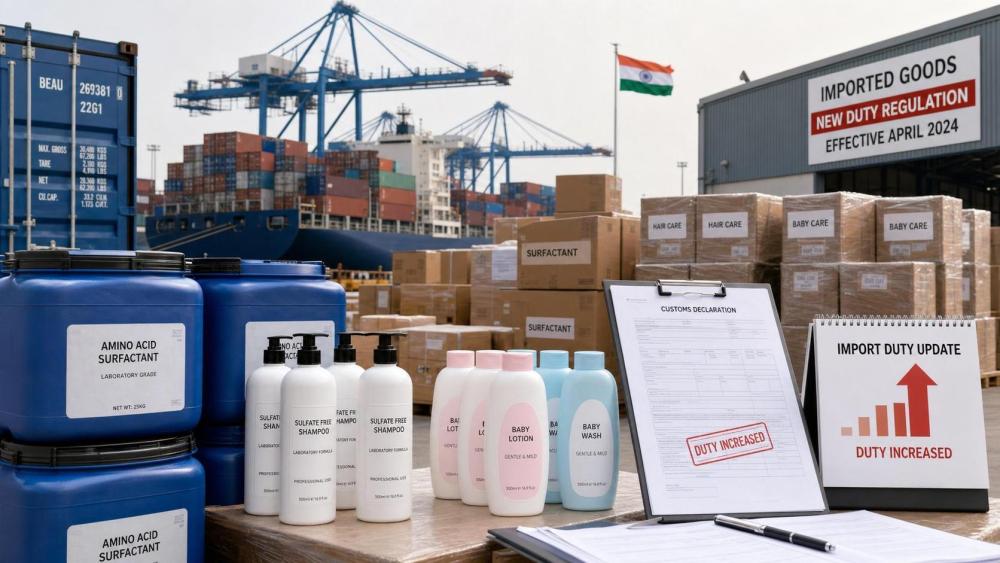
On 10 July 2026, India put into effect a revised indirect tax treatment for imported amino acid-based surfactants under HS 3402.20, lifting the IGST rate from 5% to 12%. For businesses tied to baby care and sulfate-free shampoo formulations, this is not just a tax update; it is an immediate trade and sourcing change that can affect import cost calculations, procurement decisions, supplier evaluation, and delivery planning across the surfactant supply chain.
A tariff change now in force
According to the information provided, India’s Central Board of Indirect Taxes and Customs (CBIC) notified revised GST rates effective 10 July 2026. The notified change raises IGST on HS 3402.20, covering amino acid-based surfactants, from 5% to 12%.
The stated basis for the change is domestic capacity expansion and anti-dumping concerns. The information provided also indicates that the increase raises landed cost for EU- and US-based FMCG brands importing these mild surfactants for use in baby care and sulfate-free shampoo products.
Where the pressure is likely to appear first
Imported raw material programs face direct cost pressure
From an industry perspective, the most immediate effect is on companies importing amino acid-based surfactants into India. The increase in IGST changes the landed-cost structure at the import stage, which may force a review of purchase pricing, order timing, and product margin assumptions for imported inputs used in mild personal care formulations.
What deserves closer attention is whether importers have product classification, customs documentation, and internal cost models aligned with the new rate from the effective date. Even where no change is made to product design, the tax treatment alone can alter the economics of ongoing procurement contracts and inventory replenishment.
FMCG formulators may need to revisit sourcing choices
For FMCG brands using these surfactants in baby care and sulfate-free shampoos, the issue extends beyond tax. Analysis shows that sourcing strategy may now become part of formulation planning, especially where imported mild surfactants were previously chosen on a stable cost basis. The provided information specifically points to an urgent review of India-sourced alternatives or tariff engineering strategies.
In practical terms, affected teams may need to compare procurement routes, supplier qualifications, and technical substitution feasibility while keeping product consistency and documentation traceability in view. This is particularly relevant where a formulation depends on mildness claims or ingredient-specific sourcing standards.
Supply chain and trade service providers may see documentation sensitivity increase
Observably, customs brokers, trade compliance teams, and sourcing intermediaries may also be affected because a rate increase tied to a defined HS heading puts more attention on import documentation accuracy. The operational impact is likely to appear in declaration review, shipment costing, and handoff between procurement, logistics, and customs functions.
Businesses involved in cross-border fulfillment should therefore pay closer attention to tariff treatment, supporting product descriptions, and internal review of documentation used for imported surfactant materials. The available information does not provide further execution detail, so this remains an area for careful monitoring rather than assumption.
What companies should review now
Check classification and import paperwork against the effective date
Analysis shows that companies should first confirm that affected imports under HS 3402.20 are being reviewed against the revised IGST rate effective 10 July 2026. Where shipments, contracts, or customs entries span the implementation date, consistency between product description, classification, and import records deserves immediate attention.
Reassess supplier options without assuming immediate substitution
The information provided points to a review of India-sourced alternatives. That should be understood as a sourcing and compliance task rather than an automatic replacement decision. Businesses may need to examine supplier qualification status, technical documentation, and fit with existing product requirements before changing raw material origin.
Evaluate tariff engineering carefully
The summary provided also references tariff engineering strategies. What deserves closer attention is that any such review should be handled as a compliance-sensitive exercise. Companies should avoid treating cost mitigation as purely commercial; classification logic, product scope, and supporting records all matter when trade treatment changes.
Watch for downstream changes in tenders, specifications, and delivery planning
Even though no detailed execution guidance is included in the provided information, affected businesses should watch for changes in procurement specifications, tender language, and delivery commitments. Where imported surfactants are embedded in recurring supply programs, planning assumptions may need updating to reflect revised input cost and sourcing flexibility.
Why this looks like an execution signal, not just a headline
Analysis shows that this development is better understood as a rule already taking effect rather than a tentative policy discussion. The rate revision is described as effective from 10 July 2026, which gives the market a concrete implementation point. At the same time, it would be premature to treat all commercial outcomes as settled, because the provided information does not include detailed enforcement guidance, market response, or follow-on clarification.
From an industry perspective, the more useful reading is that this is an execution signal with broader implications for import cost control and sourcing structure. Continued attention is warranted not because all consequences are already known, but because procurement and compliance decisions may begin shifting before a stable market response becomes visible.
How this change is best understood at this stage
At this stage, the IGST increase on imported amino acid-based surfactants is most appropriately understood as a live trade and tax adjustment with immediate relevance for importers and FMCG supply chains using these ingredients. The confirmed change is narrow in scope but practical in effect: it alters landed cost and raises the importance of sourcing review, import compliance, and documentation discipline.
A neutral reading is therefore more appropriate than a broad market conclusion. The rule change is real and effective, but its full commercial impact will depend on how companies adjust procurement, qualification, and delivery arrangements in response.
Basis of this article and what still needs verification
This article is generated based on the user-provided news title, event date, and event summary. For developments of this type, relevant source categories usually include official notices, regulatory releases, customs or trade authority publications, industry association updates, standards-related documents, and reporting by established business or trade media.
No specific official source link was provided in the input, so the underlying notice and any later clarification should be continuously verified. What still merits ongoing observation includes detailed implementation language, compliance interpretation, tender or specification changes, industry feedback, and how affected companies execute sourcing or tariff-response strategies after the 10 July 2026 effective date.
Related News
- When does amino acid surfactant powder improve cleanser mildness?Oct 05, 2026Surfactant Chemistry Architect
- When to Seek Shampoo Formulation Support for Foam, Mildness, or Stability IssuesAug 07, 2026Surfactant Chemistry Architect
- FDA Tightens GRAS Data Requirements for Amino Acid SurfactantsJul 20, 2026Surfactant Chemistry Architect
- Amino Acid Surfactant Prices Rise on Coconut Oil TightnessJul 15, 2026Surfactant Chemistry Architect
Related News
- 00
0000-00
Can biomimetic peptides in cosmetics reduce the look of wrinkles? - 00
0000-00
How to assess a bio-based thickener manufacturer's batch consistency - 00
0000-00
Verifying halal status of hydrocolloid ingredients in the Middle East - 00
0000-00
How to interpret active matter on a surfactant specification sheet - 00
0000-00
How Do You Test Hydrocolloid Viscosity After Changing a Thickener?
Surfactant Chemistry Architect
Weekly Insights
Stay ahead with our curated technology reports delivered every Monday.