





Why Supplier Selection Matters More Than a Sample Pass
Choosing a surfactant technology supplier is rarely a simple sourcing decision.
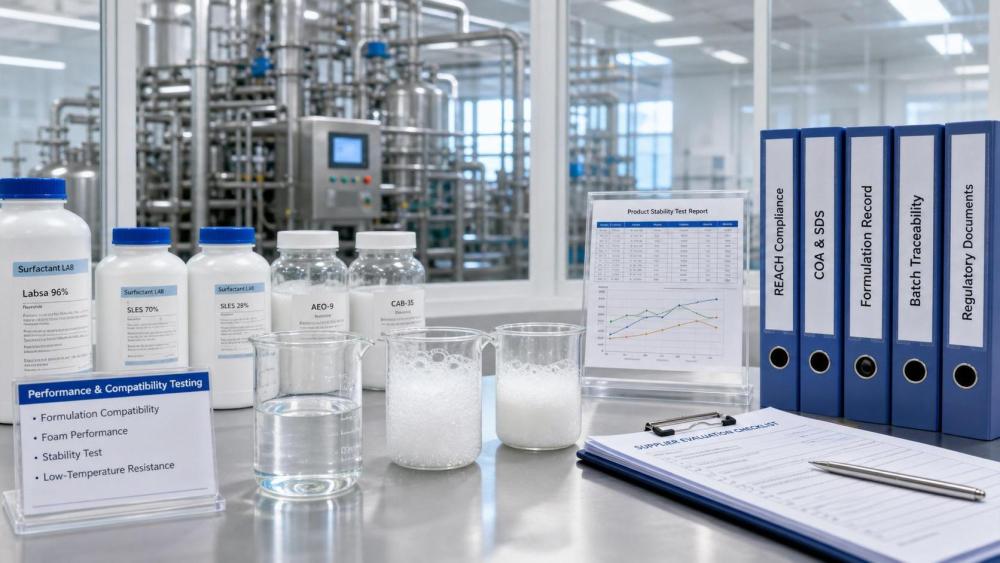
A lab sample may look promising, yet full production can expose foam instability, poor rinsing, odor interaction, viscosity drift, or compliance gaps.
That is why the better question is not only whether a surfactant works, but whether the supplier can support performance under real commercial conditions.
This issue has become more important across FMCG categories.
Laundry, home care, personal care, food-contact cleaning systems, and premium sensory products now face tighter regulatory pressure and faster formulation cycles.
In that environment, a surfactant technology supplier sits close to the center of product quality, safety, and brand positioning.
For platforms such as FFAI, which track ingredient performance across taste, beauty, preservation, texture, and cleaning chemistry, surfactants are not isolated raw materials.
They influence how formulas clean, feel, rinse, stabilize, and comply.
A capable supplier therefore needs to understand both molecular behavior and market realities.
What a Surfactant Technology Supplier Is Really Providing
A surfactant technology supplier provides more than an anionic, nonionic, amphoteric, or cationic ingredient.
The supplier is also providing formulation guidance, impurity control, process knowledge, documentation, and often the roadmap for future upgrades.
In practical terms, surfactants are the active interface managers of many formulations.
They lower surface tension, form micelles, lift soil, disperse oils, assist wetting, and shape foam behavior.
In shampoos, they influence cleansing strength and scalp feel.
In detergents, they affect grease removal, rinse profile, and compatibility with enzymes or builders.
In complex FMCG systems, they may also interact with fragrances, thickeners, preservatives, and high-value actives.
That interaction is where supplier quality starts to matter.
A technically strong surfactant technology supplier should be able to explain not just what the ingredient is, but why it behaves as it does in a finished formula.
The Current Industry Signals Behind the Decision
Several industry shifts are changing how suppliers should be assessed.
One is the move toward biodegradability and milder profiles.
Another is the demand for clean-label logic, even outside food, where ingredient transparency now shapes consumer trust.
There is also a stronger expectation for multi-functional formulations.
A cleanser may now need deep cleaning, premium foam, fragrance stability, color clarity, and support for sensitive-skin claims.
At the same time, regulatory scrutiny is expanding across raw material traceability, residuals, environmental profile, and export documentation.
FFAI’s broader ingredient perspective is useful here.
The same formulation discipline used in preservatives, thickeners, fragrance systems, and cosmetic actives also applies to washing surfactants.
The market increasingly rewards ingredients that combine technical efficacy with sensory control and compliance confidence.
Core Checks Before Shortlisting Any Supplier
The first checkpoint is formulation compatibility.
A surfactant can test well alone and fail when combined with fragrance oils, salts, polymers, enzymes, pigments, or botanical extracts.
Ask for data from complete or near-complete systems, not only from single-ingredient sheets.
The second checkpoint is cleaning performance under relevant conditions.
That includes water hardness, pH range, temperature, dilution rate, rinse behavior, and target soil type.
A strong surfactant technology supplier should show how performance changes when the environment changes.
The third checkpoint is mildness and sensory effect.
In personal care especially, cleansing is only part of the evaluation.
Foam texture, after-feel, residue, fragrance carry, and scalp or skin tolerance often decide whether a formula can move forward.
The fourth checkpoint is documentation.
Technical data sheets, safety data sheets, allergen statements, biodegradability information, origin data, and regional compliance files should be current and consistent.
A practical review table
Where Technical Depth Becomes Visible
Not every supplier with a broad catalog has real formulation depth.
Technical depth becomes visible in the questions a supplier asks and the limitations it admits.
A reliable surfactant technology supplier should ask about target viscosity, packaging format, fragrance load, preservative system, storage cycle, and intended market claims.
That usually indicates practical understanding rather than brochure-level knowledge.
It is also worth checking whether the supplier can discuss mechanism.
For example, can they explain why an amino acid surfactant improves mildness yet may require a different thickening strategy?
Can they explain why a formula loses clarity after fragrance addition?
Can they interpret how micelle structure affects grease capture or rinse feel?
Those details matter in categories where cleaning, sensory appeal, and premium positioning need to coexist.
That alignment is especially relevant to the FFAI view of ingredient systems, where chemistry and user experience meet.
Compliance, Traceability, and Export Readiness
Many supplier evaluations fail because compliance is treated as paperwork after technical approval.
In practice, it should be part of the initial screen.
A surfactant technology supplier serving global FMCG programs should be ready for region-specific requests.
That may include FDA-related food-contact considerations, cosmetic documentation linked to CPNP pathways, impurity disclosure, and sustainability evidence.
This is one reason intelligence-led evaluation matters.
The compliance lens described in FFAI’s Strategic Intelligence Center is useful because it connects raw material choice with downstream market access.
If a supplier cannot provide clear answers on traceability, manufacturing consistency, or restricted substance risk, the technical promise is incomplete.
Documentation speed also matters.
Slow responses often signal weak internal systems, and that usually reappears during audits or launch preparation.
Supply Stability and Commercial Resilience
Even a technically excellent surfactant technology supplier can become a risk if supply is fragile.
This is particularly important when surfactants are tied to high-volume detergent lines or prestige personal care launches.
The evaluation should cover manufacturing footprint, backup production, raw material dependence, shipping flexibility, and batch-to-batch consistency.
Price should also be read carefully.
A low quoted price can hide weak concentration, higher use levels, unstable lead times, or extra reformulation cost.
A more expensive ingredient may still deliver better value if it improves dose efficiency, claim support, or premium sensory performance.
That is consistent with FFAI’s market view that advanced ingredients can create downstream pricing power when they solve real formulation problems.
How to Turn Evaluation Into a Better Decision
A useful review process compares suppliers on evidence, not on presentation quality.
- Define the target system clearly, including cleaning goal, sensory target, pH, fragrance load, and regulatory market.
- Request application data under realistic conditions, not only standard benchmark charts.
- Check how the surfactant technology supplier handles incompatibility, not just successful cases.
- Review documentation quality before pilot scale begins.
- Compare total formulation impact, including use level, claims support, stability, and supply continuity.
- Track response speed and technical clarity during trials, because that usually predicts long-term support quality.
The strongest supplier relationship usually starts with a precise brief and a disciplined review matrix.
From there, it becomes easier to distinguish a commodity vendor from a surfactant technology supplier that can support scale, compliance, and product differentiation.
The next step is simple.
Map the required performance, documentation, and supply thresholds before any commercial negotiation starts, then test each supplier against the same framework.
That approach produces better technical decisions and far fewer surprises after launch.
Related News
- When does amino acid surfactant powder improve cleanser mildness?Oct 05, 2026Surfactant Chemistry Architect
- When to Seek Shampoo Formulation Support for Foam, Mildness, or Stability IssuesAug 07, 2026Surfactant Chemistry Architect
- FDA Tightens GRAS Data Requirements for Amino Acid SurfactantsJul 20, 2026Surfactant Chemistry Architect
- Amino Acid Surfactant Prices Rise on Coconut Oil TightnessJul 15, 2026Surfactant Chemistry Architect
Related News
- 00
0000-00
Can biomimetic peptides in cosmetics reduce the look of wrinkles? - 00
0000-00
How to assess a bio-based thickener manufacturer's batch consistency - 00
0000-00
Verifying halal status of hydrocolloid ingredients in the Middle East - 00
0000-00
How to interpret active matter on a surfactant specification sheet - 00
0000-00
How Do You Test Hydrocolloid Viscosity After Changing a Thickener?
Surfactant Chemistry Architect
Weekly Insights
Stay ahead with our curated technology reports delivered every Monday.