





A cleanser can feel mild in a one-week consumer panel and still create problems in a longer wear test, after repeated hand washing, or on compromised facial skin. That is why technical evaluators tend to ask a more useful question than “Is this surfactant gentle?”: Under which formulation conditions does amino acid surfactant powder measurably improve mildness without weakening cleansing performance, foam, viscosity, or microbiological robustness?
Amino acid surfactant powder improves cleanser mildness when it is selected as part of a compatible surfactant system—not simply added as a premium label ingredient. Its benefit is most apparent when the formula is designed around suitable pH, active matter, micelle structure, oil-removal target, and rheology strategy. In an incompatible system, the same powder may add cost, complicate processing, or produce a product that is mild on paper but disappointing in use.
For rinse-off facial cleansers, body washes, shampoos, intimate washes, and hand cleansers positioned around skin comfort, the evaluation should move beyond a single headline claim. Mildness is the combined outcome of protein interaction, lipid extraction, surfactant monomer concentration, deposition behavior, rinse profile, and the way the finished product feels after drying.
Why amino-acid-derived surfactants can shift the mildness balance
Amino acid surfactants typically use head groups derived from amino acids such as glycine, glutamic acid, sarcosine, alanine, or aspartic acid. Common families include sodium cocoyl glycinate, sodium lauroyl glutamate, sodium cocoyl glutamate, sodium lauroyl sarcosinate, and related salts. Their hydrophobic chains still lift sebum, sunscreen residues, particulate soil, and makeup oils; the difference lies in the chemistry at the water-facing end of the molecule and in the aggregate structures formed in solution.
In practical terms, many amino acid surfactant systems can reduce the harsh “squeaky-clean” after-feel associated with highly detergent-focused cleansing bases. They may have a more favorable interaction profile with skin proteins than strongly charged primary anionic systems under comparable use conditions. They can also support a dense, creamy foam rather than only a large-bubble, rapidly collapsing lather.
But “milder” does not mean “non-stripping” in every formula. A high total active matter level, aggressive co-surfactants, low emollient content, frequent-use exposure, very warm rinse water, or an unsuitable pH can override the contribution of an amino acid surfactant powder. The ingredient is a lever, not a complete mildness claim.
The moment it makes the greatest difference
The strongest case for introducing amino acid surfactant powder usually appears when a development team is trying to solve a defined formulation trade-off. It is especially relevant in the following situations.
- A facial cleanser leaves tightness after rinsing. If a conventional anionic base removes oils efficiently but users report dryness around the cheeks or mouth, replacing part of the primary surfactant load—or restructuring the system around an amino acid surfactant—can soften the cleansing profile.
- A sulfate-free concept still feels too sharp. Removing sulfates alone does not automatically produce a mild cleanser. Some sulfate-free anionic blends remain highly cleansing or leave an astringent after-feel. Amino-acid-based surfactants can be useful when the brief calls for gentler sensory performance rather than a label-only reformulation.
- The target consumer has a low tolerance for cleansing stress. Sensitive-skin routines, mature-skin care, post-procedure-adjacent cosmetics where permitted, dry-skin cleansers, and frequent-use hand products often benefit from a more carefully moderated surfactant system.
- A formula needs both foam and a softer finish. Many developers face a familiar tension: lower detergency can reduce lather, while a foaming base can feel too cleansing. Properly paired amino acid surfactants may help bridge this gap, particularly with amphoteric co-surfactants and a viscosity approach that does not rely solely on salt.
- Brand positioning requires a biodegradable or naturally derived surfactant story. For clean-label-adjacent and ingredient-conscious markets, amino acid surfactants may support a formulation narrative aligned with renewable feedstocks and a more considered sensory profile. Claims, however, should always be checked against the actual INCI, sourcing route, regional rules, and substantiation file.
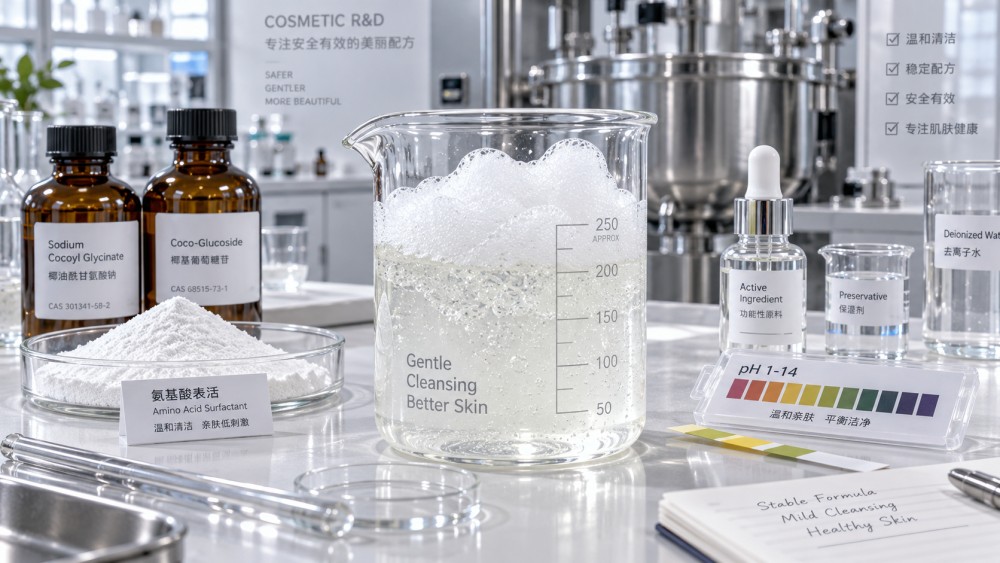
pH is not a finishing adjustment; it is part of the surfactant design
One of the most common evaluation mistakes is to assess amino acid surfactant powder as though it behaves identically across the pH range. It does not. The ionization state of the amino-acid-derived head group, solution clarity, viscosity, foam behavior, and skin feel can all shift as pH changes.
For many facial cleansing concepts, a mildly acidic to near-neutral pH is considered a sensible development region because it aligns more closely with the natural acidic surface environment of skin than strongly alkaline cleansing systems. Yet there is no universal target that guarantees mildness. A pH selected for skin feel must also preserve physical stability, active compatibility, preservative performance, fragrance solubility, and acceptable appearance.
Technical teams should establish the pH window early, then test within it rather than adjusting only at the end of development. Some amino acid surfactants show reduced solubility or altered viscosity behavior when driven too close to their acid form. Others may require a particular neutralization state for reliable incorporation. A formula that looks clear immediately after batching may haze, settle, or thin during temperature cycling if this relationship is overlooked.
Active matter and free surfactant matter more than the ingredient list
A mild INCI list can conceal a high-detergency formula. Conversely, a system containing a conventional anionic surfactant can perform acceptably when total active matter is restrained and micelle behavior is intelligently managed. For this reason, the question is not simply whether amino acid surfactant powder is present, but what proportion of the active surfactant system it represents and what it is being asked to do.
At low inclusion levels, an amino acid surfactant may mainly serve as a sensory modifier, foam contributor, or positioning ingredient. At a more meaningful share of the surfactant phase, it can influence cleansing character more clearly. The optimum point depends on product format. A rinse-off gel cleanser intended to remove daily sunscreen needs a different soil-removal profile from a cream cleanser for dry skin, while a scalp cleanser must balance sebum removal, foam expectations, and rinse cleanliness.
Evaluators should compare systems at matched total active matter whenever possible. Comparing a low-active amino acid blend with a high-active conventional base says little about intrinsic mildness. Use conditions also matter: dilution during washing changes micelle structure, and the skin is exposed not only to micelles but also to surfactant molecules that remain free in solution. A well-designed mixed system can reduce the concentration of these more interactive species, which is one reason co-surfactant selection deserves as much attention as the primary powder.
Co-surfactants determine whether the promise survives in the finished cleanser
Amino acid surfactant powder rarely performs in isolation. It is commonly combined with amphoteric surfactants, nonionic surfactants, other anionics, polymers, oils, humectants, or refatting agents. These choices determine the difference between a technically attractive bench formula and a scalable commercial cleanser.
Amphoteric partners
Amphoteric surfactants are often used to improve foam texture, reduce the harsh impression of anionic systems, and support viscosity. Their compatibility must still be confirmed at the intended pH and salt level. A blend can develop attractive foam but become too thin after fragrance addition or during cold storage. Do not interpret good initial lather as proof of long-term formula resilience.
Nonionic components
Nonionic surfactants can assist with makeup removal, fragrance solubilization, or mildness perception. However, excessive solubilizing power may increase oil removal beyond the intended profile. In a dry-skin facial cleanser, that can work against the benefit expected from amino acid surfactant powder. The correct amount is guided by the soil challenge, not by the assumption that more solubilization is always better.
Polymers, thickeners, and emollient systems
Viscosity strongly influences how consumers judge gentleness. A thin formula may be perceived as more aggressive even if its irritation potential is not higher, while a cushiony gel or cream can signal care before the product is rinsed away. Rheology modifiers, including compatible hydrocolloids and synthetic polymers, should be screened for electrolyte tolerance and interaction with the surfactant network. In some systems, adding salt produces little thickening; in others, it creates a narrow viscosity peak followed by collapse.
Small amounts of suitable emollients or refatting agents may further improve post-rinse feel, but they can suppress foam, challenge clarity, or interfere with preservation. Mildness should therefore be evaluated as a whole-system property rather than assigned to one raw material.
A practical screening route for technical evaluation
Rather than moving directly from a supplier sample to a final concept, build a compact comparison matrix. Prepare a control cleanser using the current or benchmark surfactant system, then create variants in which amino acid surfactant powder replaces part of the primary surfactant phase at equivalent total active matter. Hold fragrance, pH target, humectant package, and viscosity target as consistent as possible during the first screen.
Assess the variants in layers:
- Processability: Record wetting, dispersion time, heating requirements, neutralization sequence, foaming during manufacture, and batch-to-batch reproducibility. Powders can create handling advantages in concentrated or water-reduced formats, but poor addition order may create agglomerates or localized gel structures.
- Physical behavior: Review appearance, odor, pH drift, viscosity, centrifugation response where relevant, freeze-thaw behavior, and elevated-temperature storage. Check again after fragrance, color, botanical extracts, and other late-stage additions.
- Performance: Evaluate foam volume, foam density, rinse speed, cleansing of representative soils, makeup or sunscreen removal where relevant, and combability for hair applications.
- Mildness indicators: Use an appropriate internal or external testing approach, such as controlled-use assessment, instrumental screening, corneocyte or protein-interaction methods, or other validated models available to the organization. No single test captures every real-world sensation.
- Preservation compatibility: Confirm that the final pH, water activity, chelation strategy, packaging, and surfactant environment support the preservative system. A gentle cleanser is not a successful cleanser if its microbiological protection becomes unreliable.
The result should be interpreted as a profile, not a pass/fail score. One candidate may be superior in after-feel but weaker in sunscreen removal. Another may retain foam better but require a more complex viscosity system. This is where technical evaluation creates value: it identifies the best compromise for the intended user and claim territory.
Where amino acid surfactant powder may not be the answer
There are situations where its use is less compelling. A heavy-duty clarifying shampoo, industrial hand cleaner, or highly oily soil-removal product may prioritize detergency and rapid rinse over a comfort-led surfactant profile. An amino acid surfactant can still have a role, but it may not justify a major reformulation if performance requirements are stringent and the user expects a very clean finish.
It can also be a poor shortcut for fixing unrelated issues. If irritation arises from fragrance allergens, high ethanol content, exfoliating acids, unsuitable preservative choices, or excessive use frequency, changing the surfactant alone will not resolve the user experience. Likewise, if the formula’s problem is poor viscosity caused by an incompatible polymer, adding more amino acid surfactant powder may increase complexity rather than provide a solution.
Questions to ask before approving a raw material
For procurement and R&D teams, the raw-material review should include more than the marketing description. Confirm the surfactant’s active content, counterion, physical form, recommended processing conditions, odor profile, color specification, microbial limits, residual salt level, and lot consistency. Ask for data relevant to the intended application rather than accepting generic mildness language.
Regulatory and documentation review remains equally important. The correct INCI naming, regional compliance status, impurity information, allergen considerations, biodegradability documentation where claimed, and supply-chain continuity should all be considered. For global FMCG programs, these details affect whether a promising prototype can move into a market-ready formula without late-stage redesign.
The practical conclusion
Amino acid surfactant powder improves cleanser mildness most convincingly when a formula needs to reduce tightness, harsh after-feel, or excessive cleansing stress while still maintaining credible foam, rinse behavior, stability, and preservation. Its impact is most visible in systems built around a realistic use case: a daily facial wash, a comfort-focused body cleanser, a sensitive-skin hand wash, or a balanced shampoo rather than a generic “gentle” concept.
The best technical decision is not to treat amino acid surfactants as an automatic mildness upgrade. Treat them as a formulation tool with a distinct pH response, mixed-micelle behavior, processing profile, and sensory contribution. When those variables are deliberately aligned, the powder can help turn a cleanser from merely sulfate-free or trend-compliant into something users genuinely want to keep using every day.
Related News
- When does amino acid surfactant powder improve cleanser mildness?Oct 05, 2026Surfactant Chemistry Architect
- When to Seek Shampoo Formulation Support for Foam, Mildness, or Stability IssuesAug 07, 2026Surfactant Chemistry Architect
- FDA Tightens GRAS Data Requirements for Amino Acid SurfactantsJul 20, 2026Surfactant Chemistry Architect
- Amino Acid Surfactant Prices Rise on Coconut Oil TightnessJul 15, 2026Surfactant Chemistry Architect
Related News
- 00
0000-00
Wissen Research: Global Cosmetics Market to Reach $497.2 Billion by 2031 - 00
0000-00
Can biomimetic peptides improve skin firmness? - 00
0000-00
China Records 543 New Cosmetic Ingredients, Including 167 in 2026 - 00
0000-00
How to check a fragrance raw material specification for IFRA compliance - 00
0000-00
Australia and New Zealand Weigh Wider Steviol Glycoside Use in Griddle Products
Surfactant Chemistry Architect
Weekly Insights
Stay ahead with our curated technology reports delivered every Monday.